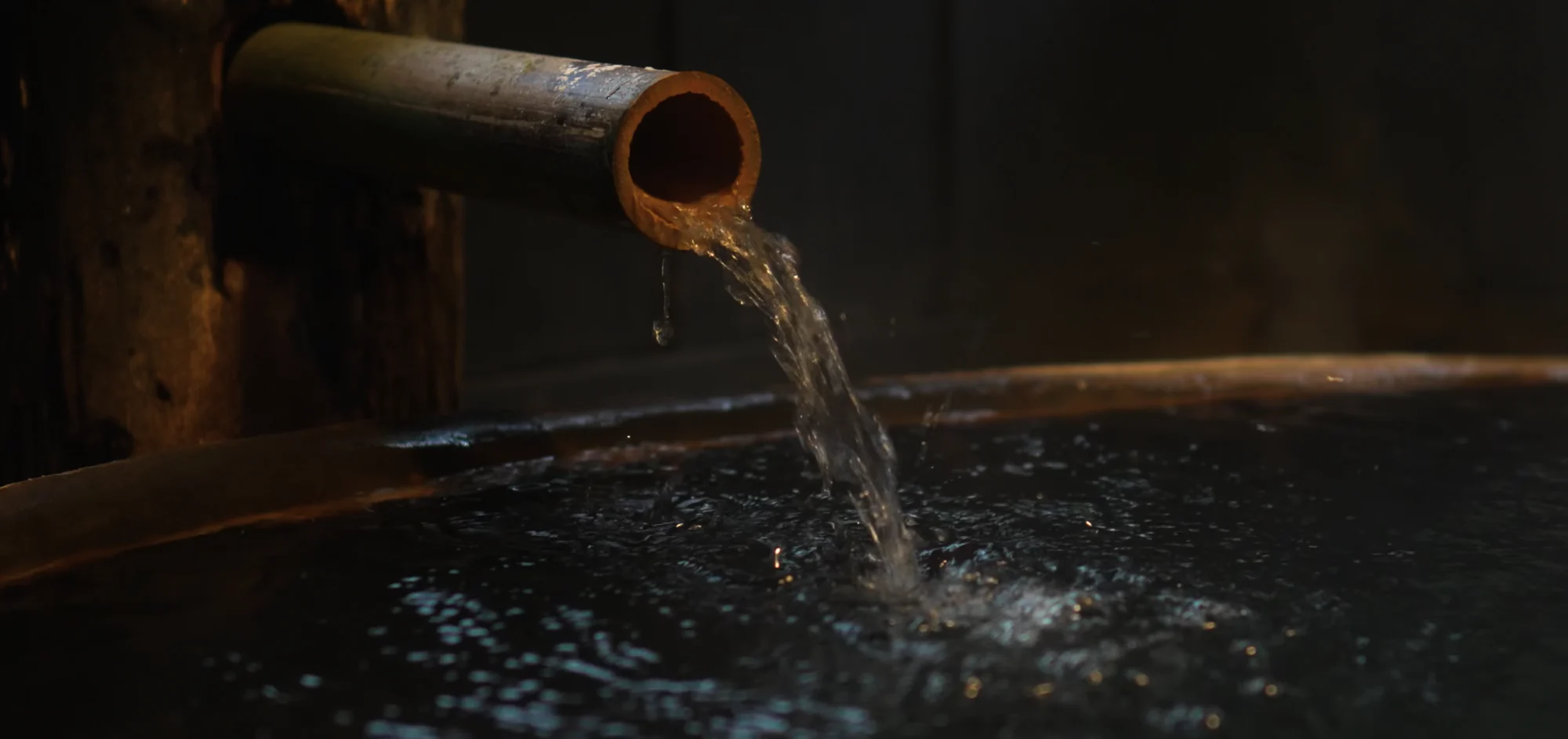
Every inn owns its own source. So the village has no single water, and that is the interesting part.
Why there's no single answer
Most onsen towns can answer "what's the water like" in one line; Kurokawa structurally cannot, and saying so is this page's whole value. Each inn drilled or channels its own 源泉, each source carries its own mineral signature, and the spa association's own data sheet lists four registered families across the village — sulfur springs, bicarbonate springs, chloride springs, and sulfate springs. The consequence for bathers is the tegata's secret second function: three stamps buy three chemistries, not just three views. Misato's milky sulfur bath and a clear bicarbonate tub two lanes over are different products from the same hillside.
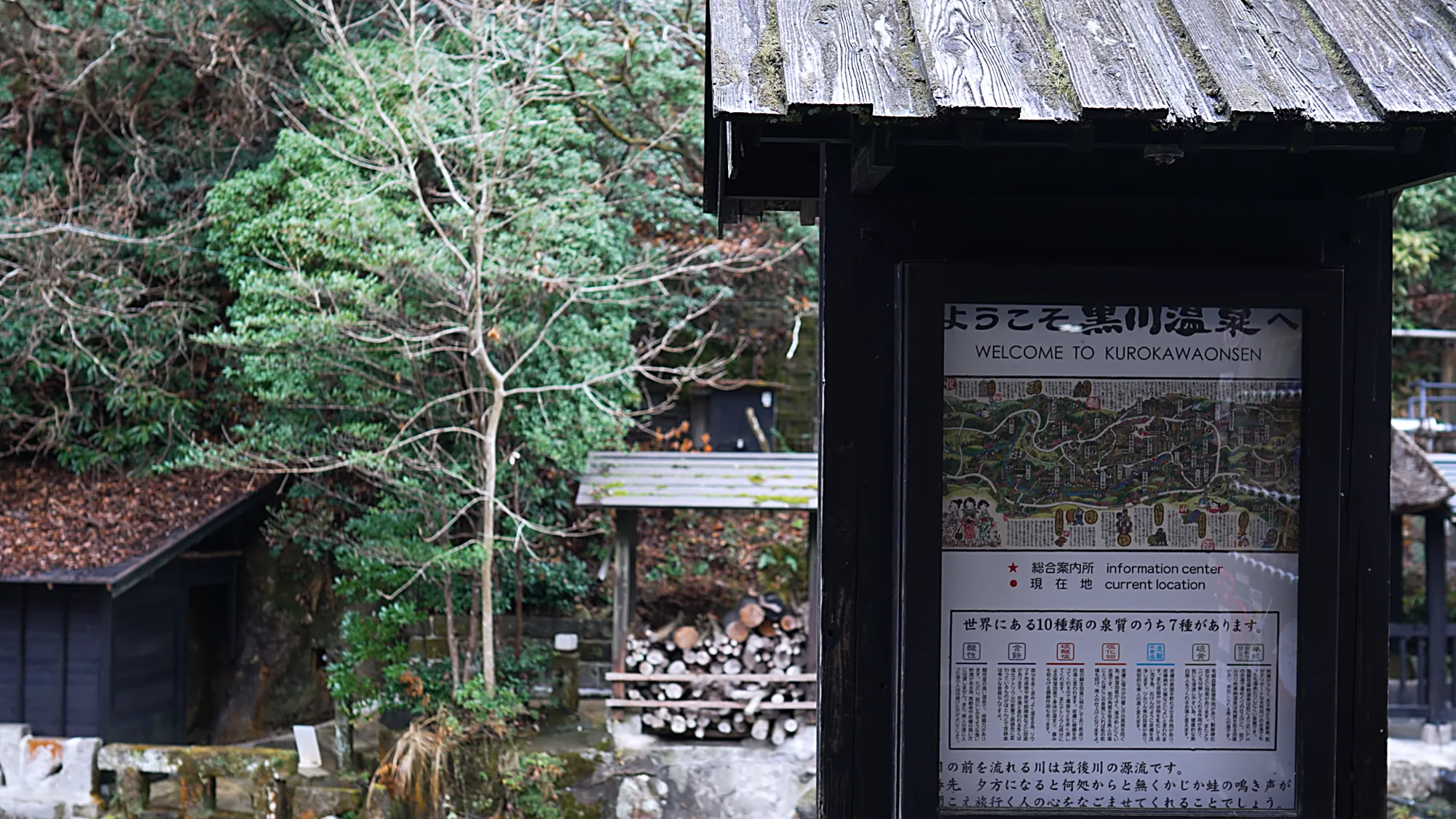
The village's own board states the count. Seven of the world's ten spring types.
Content
Where the water comes from
Geography sets the chemistry, and Kurokawa's is specific. The village sits at about 700 m (2,300 ft) on the highland skirt between the outer rim of the Aso caldera, one of the largest on earth, and the Kujū volcanic range, which is to say it is sandwiched between two great heat engines.
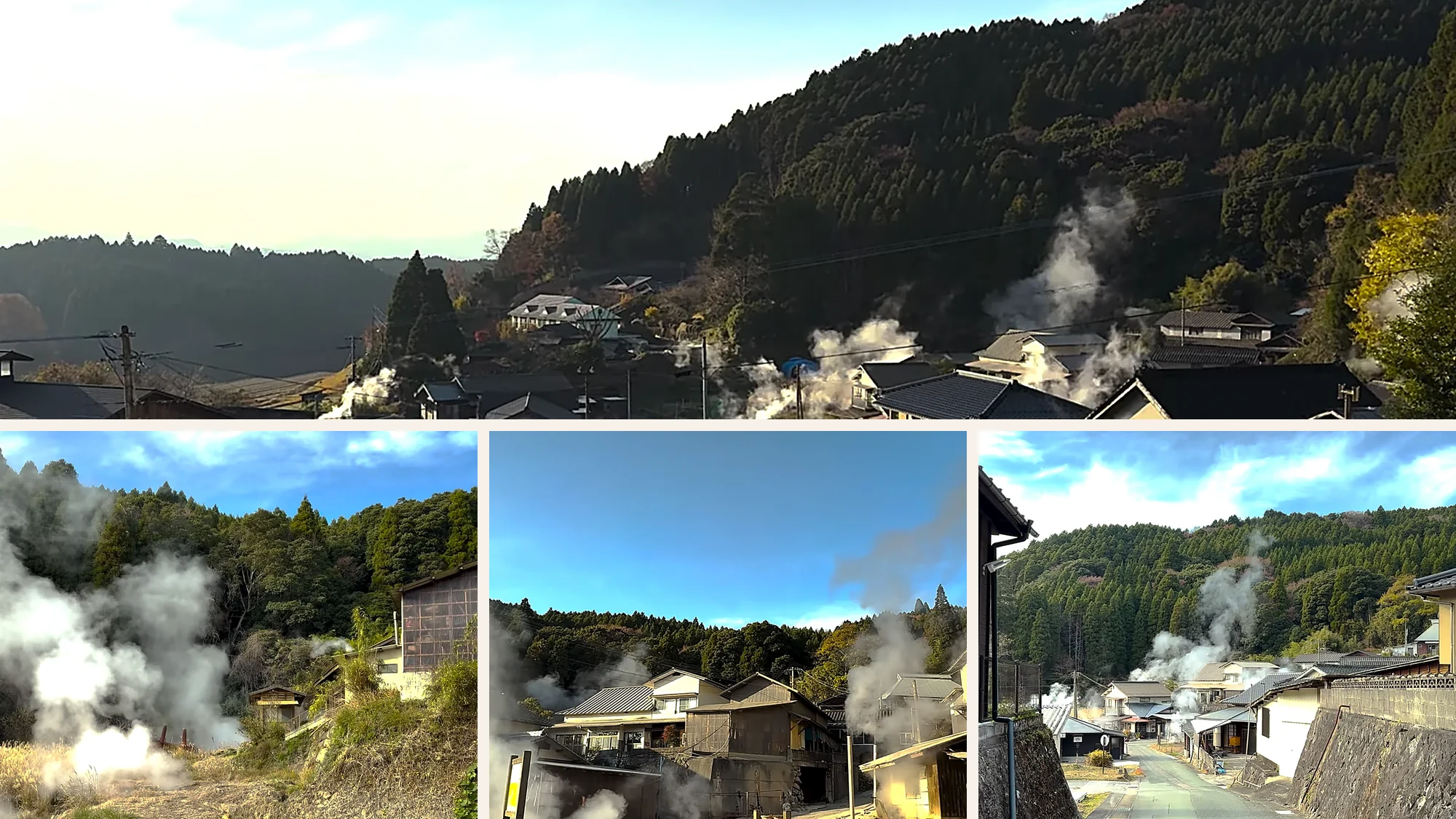
A hamlet over the ridge, where the water arrives before anyone has plumbed it.
The stream that runs through the lanes, the Tanohara River, is one of the uppermost sources of the Chikugo, Kyushu's largest river, so the water in the baths and the water under the bridges are both, in the largest sense, the beginning of something: rain and snowmelt off volcanic highlands, heated and mineralised underground, surfacing at the top of a river system that crosses the whole island.
That volcanic plumbing is why the sources run hot, why neighbouring hamlets a few kilometres apart pull entirely different mineral signatures out of the same hillside, and why no two inns' certificates quite match. A bath here is groundwater interrupted on its way to becoming Kyushu's biggest river, borrowed hot for an hour.
The geography that makes the plurality
Kurokawa's many waters are a product of where it sits. The village is on the highland skirt between the outer rim of the Aso caldera and the 九重連山 (Kujū range), at about 700 m (2,300 ft), on the uppermost reaches of the 筑後川 (Chikugo River) — the stream through the lanes, the 田の原川, is a Chikugo tributary.
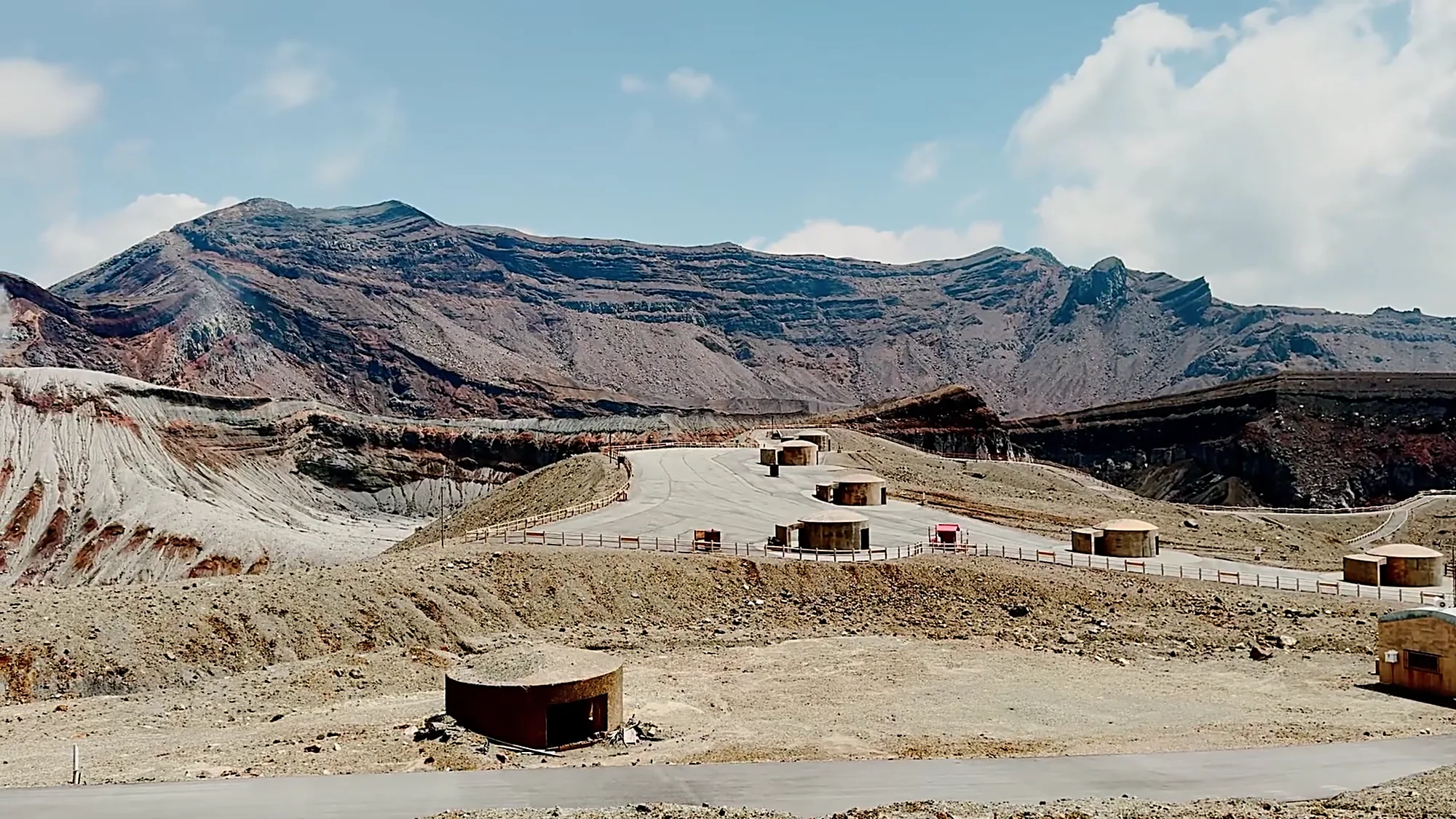
Two heat engines, one highland skirt between them. That is the whole explanation.
A volcanic highland threaded by multiple fault-fed sources is exactly the setting that produces different water in adjacent valleys, and it is why a designated area of five hamlets can hold four or five spring families at once. The altitude also runs the village three to five degrees Celsius (about five to nine Fahrenheit) cooler than the Kumamoto lowlands, which is why the hot sources are so often tempered with 加水 and why the cold-air contrast of a sulphur soak reads so sharply here.
Depth, heat and altitude: the physics wrapped around the chemistry
Three physical variables shape how the same water feels, and Kurokawa plays all three. Depth first: most Japanese tubs seat you waist-deep, but Fumoto's standing bath runs 1.5 m (4.9 ft), immersing a standing adult to the chest, and the difference is not novelty, it is pressure.
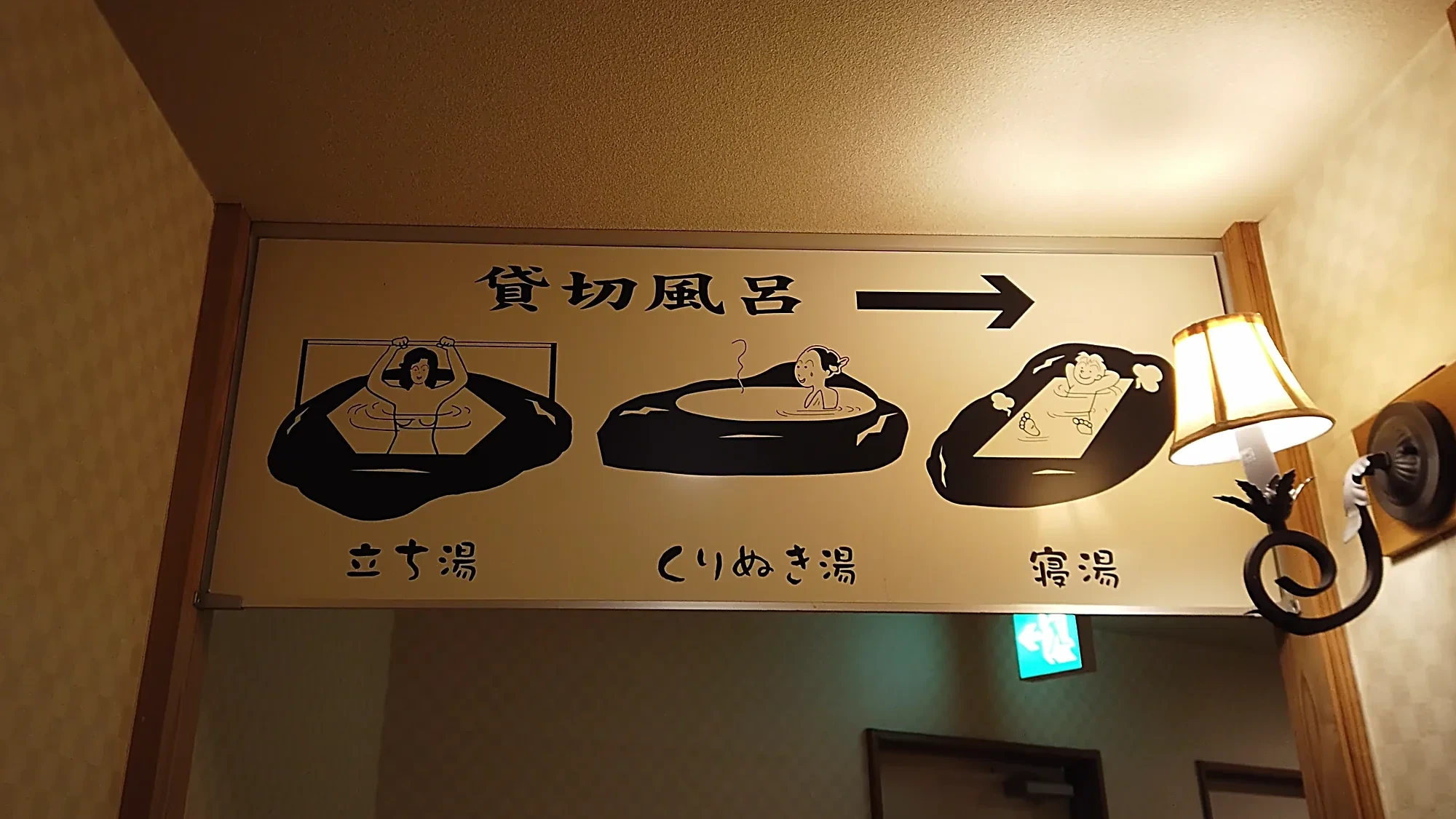
A standing bath immerses you to the chest. That is pressure, not novelty.
Deeper immersion loads the body with more hydrostatic squeeze, which is why a standing bath feels like more bath, the water working on circulation from all sides at once; it is also why the depth is posted and the rail is there, and why the standing tub rewards a calm few minutes rather than a long stay.
Temperature second: the interplay between water heat and air is the actual instrument a rotenburo plays, and at this altitude the air side of the equation swings some 3 to 5°C (5 to 9°F) below the lowlands in every season.
In January that spread is the whole show, near-freezing air on the face and shoulders against source-hot water at the neck, the contrast that makes winter the connoisseur's season here; in August it is the mercy that makes evening bathing pleasant while the lowland cities swelter. Altitude third, and subtlest: 700 m (2,300 ft) cools the nights year-round, which means the classic bathing hours, first thing and after dinner, always carry a temperature differential worth walking out for.
None of this appears on the analysis certificate, and all of it decides how the certificate's chemistry lands on your skin. The water is the text; depth, air and altitude are the reading conditions, and this valley sets them unusually well.
How many spring types does Kurokawa really have?
A count you will see repeated online credits Kurokawa with most of Japan's official therapeutic spring types. We do not print that figure, because the most authoritative records do not support it: the Japan Spa Association's area sheet lists four spring families across the village, and the government-designation profile maps five across all five hamlets of the wider 南小国温泉郷. So the honest answer is four to five, not the higher number that circulates, and we leave the inflated count off the page.
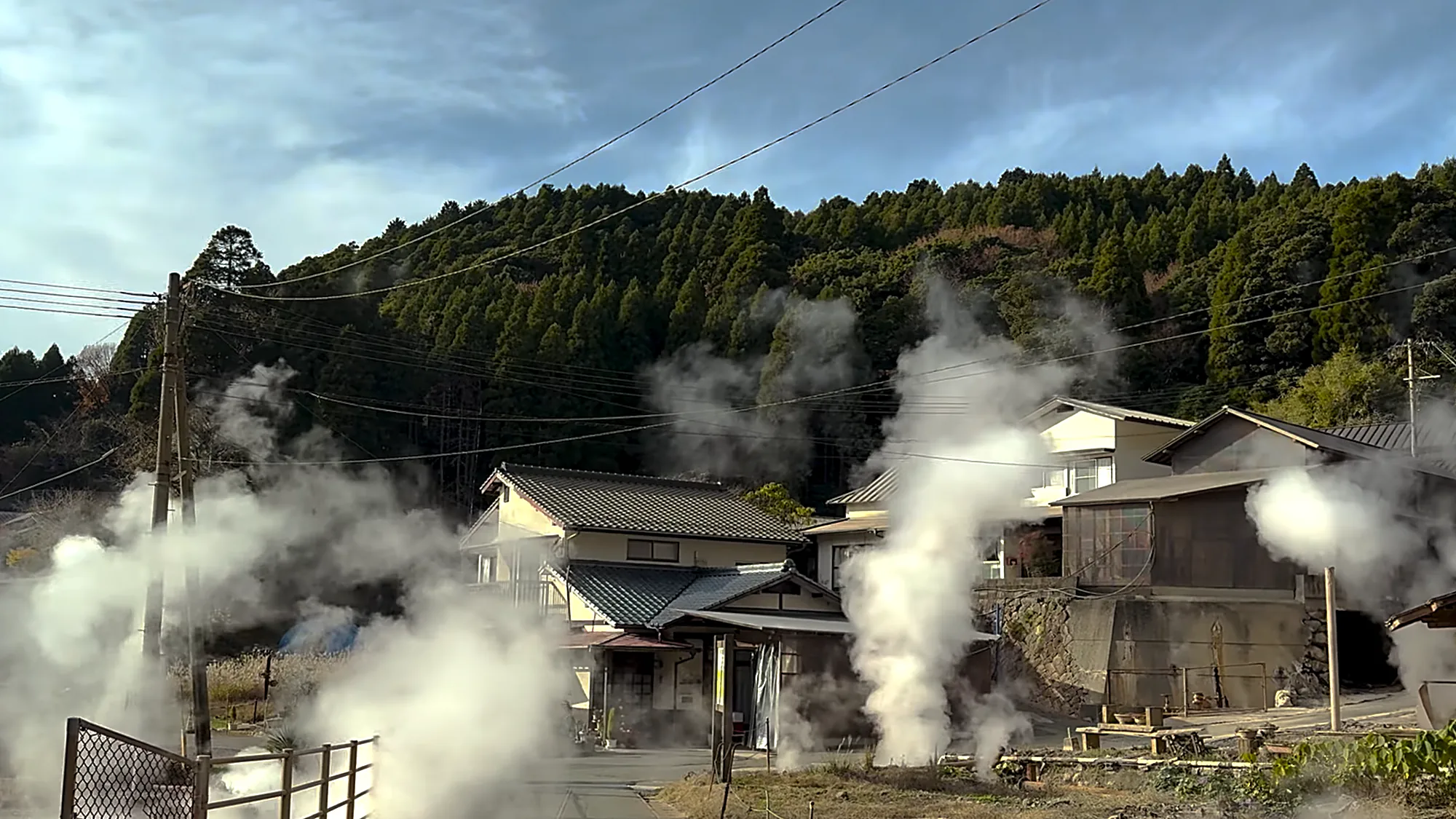
Waita, next valley over. The heat is not subtle here.
The register, in full
The official indications for Kurokawa's spring types deserve printing completely rather than summarised, because they are the published record, and because their precision is the point. For the sulphur springs, the registered 泉質別適応症 are atopic dermatitis, psoriasis vulgaris, chronic eczema and epidermal suppuration. For the chloride springs: cuts, peripheral circulatory disorder, sensitivity to cold, depressive states and dry skin. For the simple springs of Kurokawa proper: autonomic instability, insomnia and depressive states.
The general register, applying across types, covers chronic muscle and joint pain and stiffness, motor-paralysis stiffness, cold sensitivity, peripheral circulatory disorders, mild hypertension, glucose intolerance, mild asthma and emphysema, haemorrhoid pain, autonomic instability, stress symptoms, convalescence, fatigue and health promotion.
The contraindications, the 禁忌症, are equally official and more important: acute illness especially with fever, active tuberculosis, advanced malignancy, severe anaemia, serious heart or lung disease, severe kidney disease, gastrointestinal bleeding, visible bleeding, and the acute worsening of any chronic condition, with sensitive skin and elderly dry-skin conditions flagged for the sulphur register specifically.
Two framing sentences must travel with every word of that. These are the traditional balneological designations published by the Japan Spa Association for the spring types, a formal register with centuries of practice and a national body behind it. And they are not medical advice, not treatment claims, and not a substitute for a doctor; a traveller with any listed condition, on either list, should read the register as an invitation to ask their physician, not their innkeeper.
The official register, by spring type
The Japan Spa Association publishes the traditional register for each family, and it is worth setting down in full since this is the page for it. For 硫黄泉 (sulphur), the official 適応症 (indications) run to atopic dermatitis, psoriasis vulgaris, chronic eczema and epidermal suppuration — the skin register. For 塩化物泉 (chloride), cuts, peripheral circulatory disorder, sensitivity to cold, and dry skin. For 単純温泉 (simple springs), autonomic instability, insomnia and depressive states.
The general onsen register adds chronic muscle and joint pain, circulatory complaints, fatigue and convalescence. The 禁忌症 (contraindications) are the standard exclusion list: acute illness with fever, active tuberculosis, advanced malignancy, severe anaemia, serious heart, lung or kidney disease, gastrointestinal bleeding, and the acute worsening of a chronic condition; sulphur additionally cautions sensitive skin. All of it is published tradition attributed to 日本温泉協会 — the register posted at the door, not medical advice, and never a treatment claim. Anyone with a health condition should consult a physician.
The four families, told apart by your own senses
The registers name Kurokawa's spring families in chemical language, but a bather meets them through skin and nose, so here is the field guide in those terms. Sulphur water announces itself before you reach it: the faint struck-match smell in the changing room, and in the Shirakawa-side baths that carry it, sometimes the visible evidence, Misato's water shifting colour with the day and Ichinoi's yunohana, the pale mineral flakes, drifting in the tub like the water's own snow.
Bicarbonate water, the family under Tanohara, Manganji and Oda, tells you nothing by smell and everything by touch; it leaves the skin faintly slick, the sensation Japanese bathers have always read as the softening, cleansing signature of the type. Chloride water declares itself afterwards: it holds heat against the body long after you towel off, which is why a chloride soak before the walk home is the winter bather's trick, warmth carried out the door like a coal in the pocket.
And simple springs, the unshowy fourth family, are recognised by their very reticence, clear, mild, gentle enough for the longest soaks and the widest range of bathers. None of this requires a certificate or a word of Japanese. A day that runs through three hamlets will hand you the comparison directly, and once your skin has learned the difference, the analysis sheets posted by the changing-room doors stop being paperwork and become confirmation of something you already felt. That is the deepest amenity this valley offers: water various enough to teach the subject by immersion.
Chemistry you can see
Two of the village's baths perform their mineral content visibly, which makes them the teaching baths of the circuit. Misato's claim, in the association's own directory line, is that it is the only inn in Kurokawa whose sulphur water changes colour, and its spa-association listing describes the milky-white pour; in a central hamlet whose registered types run mostly clear, that white is sulphur announcing itself.
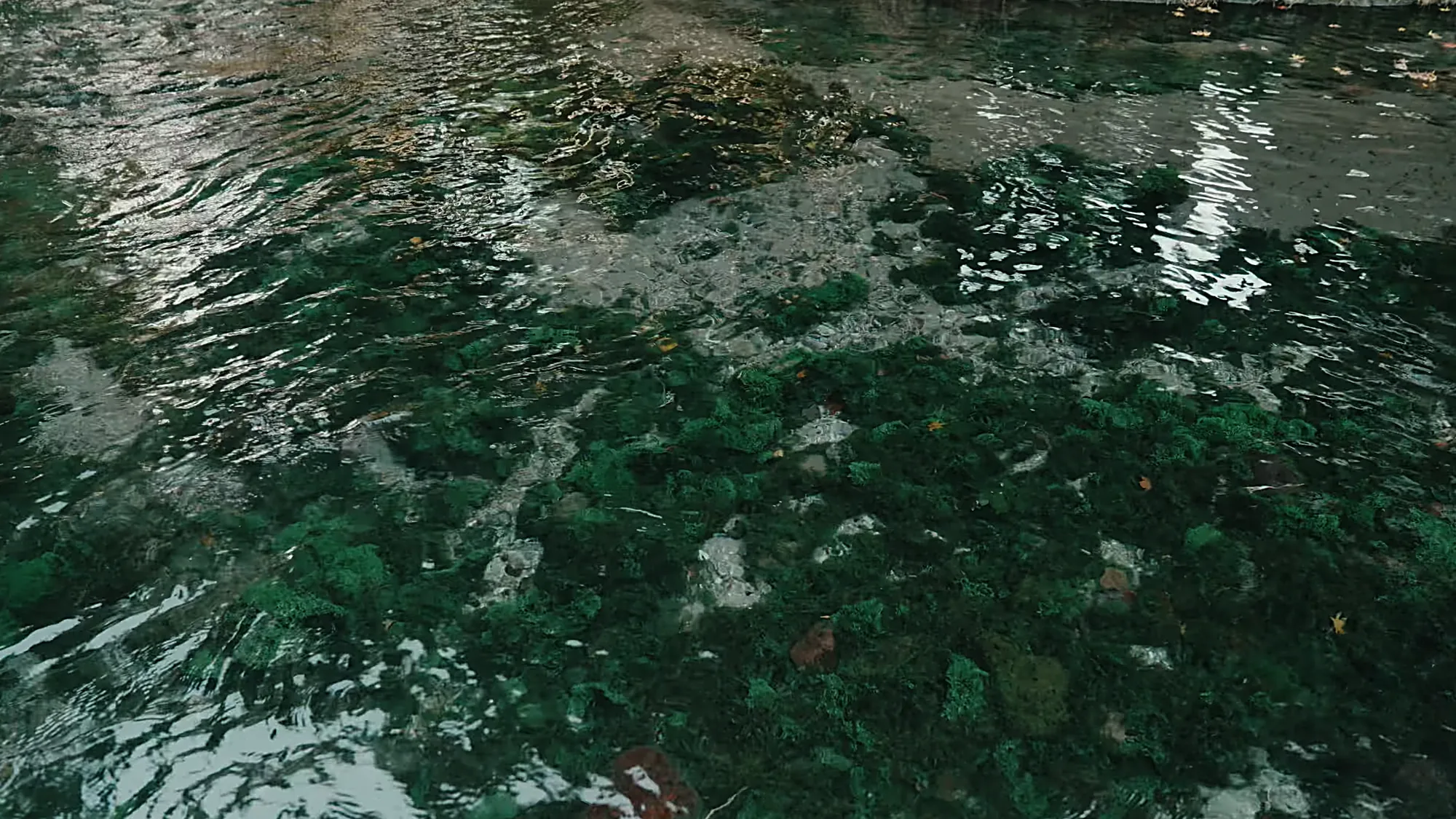
Two baths a hundred metres apart, one clear and one clouded. The chemistry is visible.
Ichinoi's directory line promises sulphur water with yunohana floating in it, the pale flakes of precipitated mineral that form as hot, saturated water cools on contact with air. Both are worth a stamp precisely as demonstrations: the flakes in Ichinoi's tub and the shifting cast of Misato's water are the same subterranean chemistry the certificates describe, performing where you can watch. A useful habit follows for the rest of the circuit.
Water that looks like nothing is not chemically nothing, and the clear baths of the simple springs carry their own register; colour is chemistry's costume, not its rank, and the village's plainest-looking tub may be exactly the gentle water the register recommends for sleep.
What the indication registers are, and how to read them
Japanese onsen law gives every certified spring a formal record, and Kurokawa's registers carry the two lines travellers most often photograph and least often understand: 適応症, the indications, the conditions for which bathing in that spring type is traditionally held beneficial, and 禁忌症, the contraindications, the circumstances in which soaking is cautioned against. Three things make these lines useful rather than mystical.
First, they are type-specific: the indications attached to a sulphur spring differ from those attached to a bicarbonate one, which is the official system's way of saying what this page keeps saying, that the families are genuinely different substances. Second, they are posted: the analysis certificate at each bath carries its own lines, so the authoritative answer for the tub you are standing beside is on its wall, not in any guidebook, ours included.
Third, they are tradition codified, not prescription: the register descends from centuries of tōji, the therapeutic-stay culture, and modern Japanese practice treats it as heritage guidance to be read alongside, never instead of, a doctor's advice. The practical reading, then: a healthy traveller can enjoy every family in the valley and treat the indications as a cultural text; a traveller managing a heart condition, pregnancy, recent surgery or any condition that makes heat itself a question should read the 禁忌症 line seriously, keep soaks short and cool-headed, and ask their own physician rather than the front desk. The registers are the oldest consumer-protection labels in Japanese travel. Kurokawa's are dense because its water is; reading them is part of the visit.
What the waters traditionally claim
The published register for the Kurokawa entry runs sulfur-led: traditional 泉質別適応症 for atopic dermatitis, psoriasis, chronic eczema; the general register covers chronic muscle and joint pain, cold sensitivity, circulatory complaints, fatigue and convalescence; 禁忌症 flag sensitive skin and the standard exclusion list. The designation profile adds the per-type texture: sulfur toward skin indications, chloride toward cuts and cold, simple springs toward autonomic instability and sleep. All of it as published — tradition at the door, not medical advice.
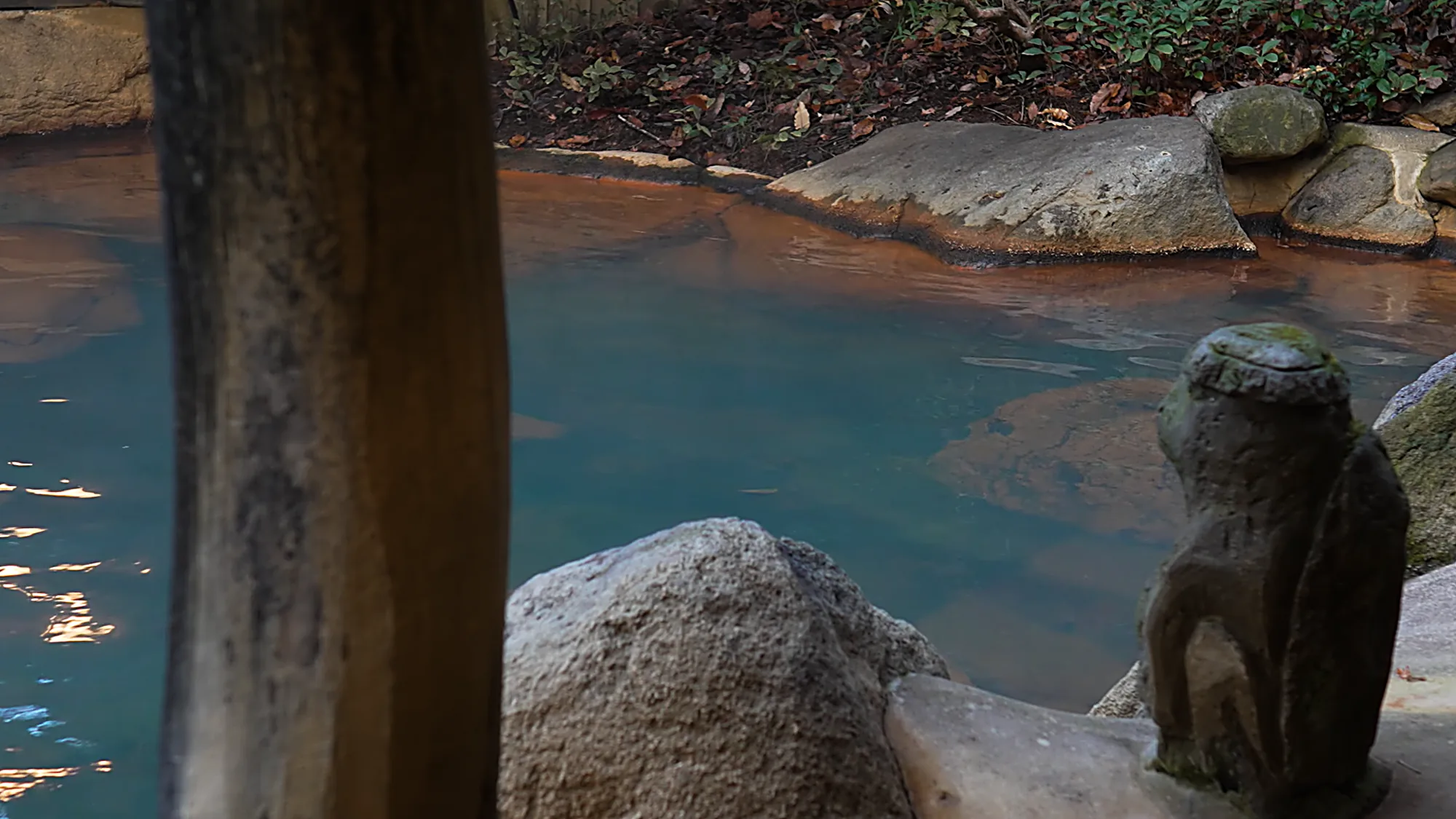
Milky blue means sulphur. You will smell it before you see it.
How to read the certificate at the door
Every inn's bathhouse posts its 温泉分析書, the official spring analysis, and learning to skim one turns any Kurokawa lane into a chemistry walk. The document names the source; states the spring type, the 泉質, in the standard nomenclature this page uses; gives the source temperature; lists the dissolved constituents; and states pH and total dissolved solids, with the registered indications and contraindications below.
The reason this page prints no per-inn pH or TDS numbers is a matter of method, not modesty: the certificates are posted at the baths, not published online, and no per-inn figures surfaced in a source we can stand behind, so numbers you meet on the internet are transcriptions of transcriptions, unverifiable at best. The honest procedure is the pleasant one.
Stand in the changing room, read the certificate the law requires the inn to display, and you hold the primary source itself, more current and more local than anything this or any website can offer. Ask the front desk どんな泉質ですか, what is the spring type, and an inn proud of its source, which in Kurokawa is all of them, will tell you the rest.
Reading the analysis certificate in five lines
The framed 温泉分析書 by the changing-room door yields its essentials to five lines, and knowing them turns every bath in Japan into an open book. First, the spring name line, 泉質, which states the family, the word ending in 泉 naming the type this page has been sorting: a glance tells you whether you are in sulphur, bicarbonate, chloride or simple water.
Second, the source temperature, 泉温, the heat the water left the ground with; compare it against the roughly 40°C (104°F) of a comfortable tub and you know how much cooling stood between the spring and your shoulders. Third, the pH line, acidity to alkalinity, which predicts feel: higher figures toward the slick-skinned end, mid-range figures toward neutrality, this valley's waters running in the gentle bands rather than the extremes some famous acid springs advertise.
Fourth, the dissolved-mineral figure, the grams of the earth actually in solution, which separates a light simple spring from a heavy mineral one at a glance. Fifth, the pair of register lines, indications and contraindications, read as the previous section describes.
Everything else on the sheet, the ion table, the sampling date, the laboratory's stamps, is the supporting evidence, and the sampling date is worth a half-second's respect: it means someone carried this specific water to a laboratory and published what it contained, an audit repeated across every certified bath in the country. Five lines, thirty seconds, and the tub in front of you stops being generic hot water and becomes what it actually is, a named, measured, disclosed mineral event.
Source-water, and the honest 加水 disclosure
A page about Kurokawa's water would be dishonest without the qualification the association itself volunteers. Nearly every Kurokawa inn is genuinely free-flowing from its own source — 源泉かけ流し. But because the source runs hot, many inns add water (加水) to bring it to bathing temperature, and the association states plainly that doing so does not change the mineral content or the designated effects.
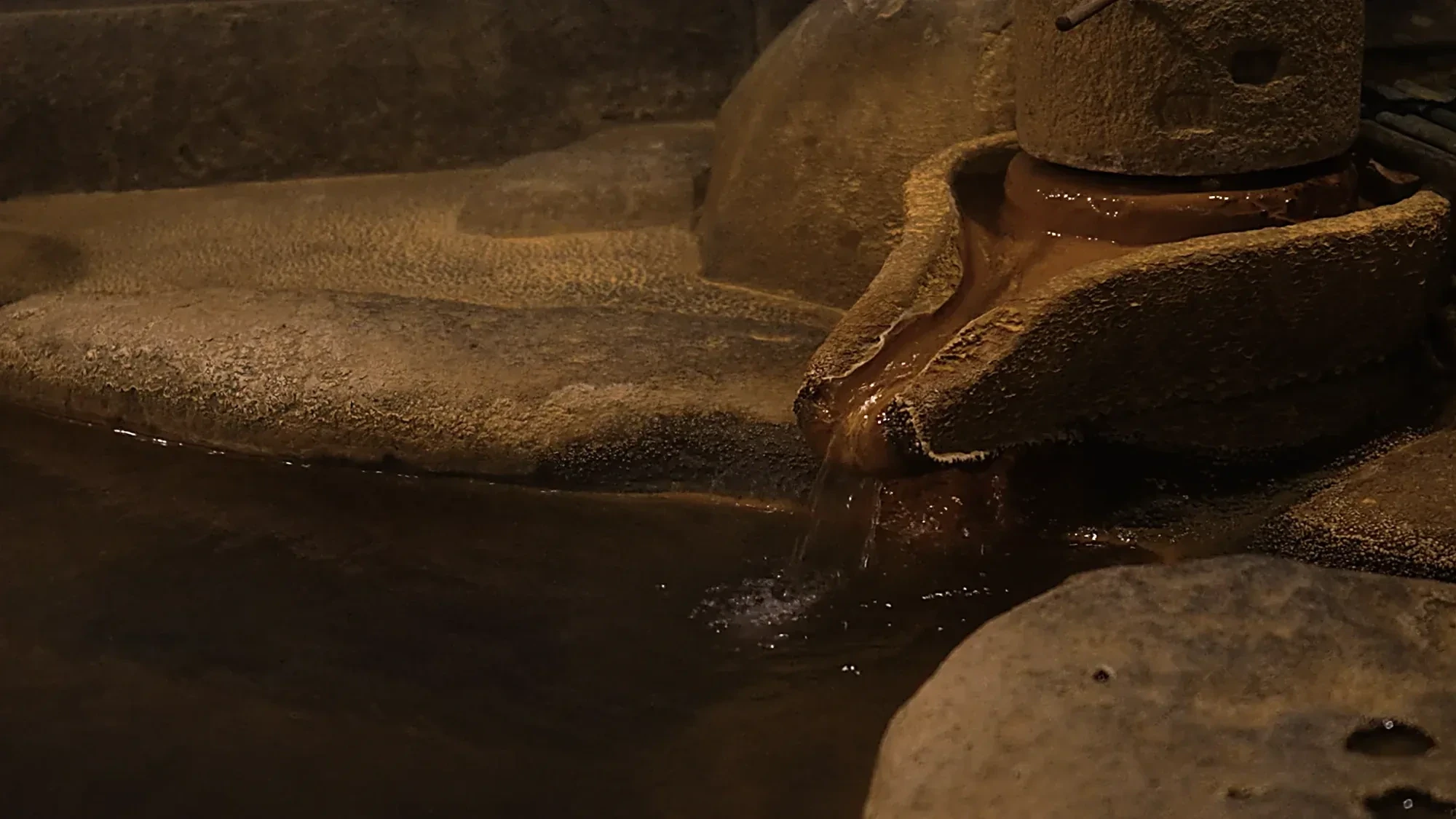
Kakenagashi: it runs in, it runs out, nothing recirculates.
This is exactly the class of fact worth publishing and almost never published in English, where coverage says "natural hot spring" and stops: the water is genuinely from the source, and it is genuinely tempered with water where the source is too hot to enter. Stating both is not a hedge; it is the truth of a hot highland field, and it lets a bather read the register above without imagining a purity the inns do not claim.
The honesty at the source: kakenagashi, with a footnote
The claim most onsen towns lead with, gensen kakenagashi, water flowing straight from the source without recirculation, is one Kurokawa can genuinely make, and the reason to trust it is that the village volunteers its own footnote. The association's FAQ states plainly that nearly every Kurokawa inn is free-flowing from source, and then adds, unprompted, that because the source temperature runs high, many inns add water to bring the baths down to bathing temperature, with the mineral content and the designated effects unchanged.
Sit with how unusual that sentence is. The easy version, natural hot springs, full stop, would satisfy every visitor who never asked; instead the operator publishes the asterisk. For bathers the practical meaning is simple: the water is the real thing, hot enough at origin that dilution for safety is part of serving it, and the variation you feel between baths, some scalding, some gentle, reflects each inn's own balance of source heat and added water.
For readers of this site the meaning is larger: a village that discloses its own water treatment unasked is a village whose other claims deserve the benefit of the doubt, and that disclosure, more than any mineral count, is why we rate Kurokawa's water culture as seriously as its water.
The honesty clause: kakenagashi with water added, explained
The association's bathing disclosure contains a phrase that puzzles careful readers: the baths run kakenagashi, free-flowing from the source, with water added. To a purist this sounds like a confession. It is the opposite, and the chemistry says why. Kurokawa's sources rise hotter than skin can use, so every inn faces the same engineering choice: cool the water by holding it, by machinery, or by dilution.
Adding cool water is the method that keeps the spring moving, fresh from the ground to the tub to the overflow drain in hours rather than days, no recirculation, no filtration loop, no chemical treatment, at the acceptable cost of a modest dilution of the mineral load.
The alternative that impresses on paper, undiluted water, would in practice mean either scalding tubs or held, reheated, recirculated water, which is the compromise most of Japan's larger bath hotels quietly make and few disclose. Kurokawa's association publishes its method plainly, which is the detail worth trusting: a bathing town honest about dilution is being honest about everything upstream of it.
The benchmark at the tradition's far end sits one hamlet over, where Tanohara's springs arrive at bathing temperature naturally and are served without reheating, the geology doing the engineering. Between those poles, every tub in the valley is a slightly different answer to the same hot problem, and the posted analysis sheet tells you which answer you are sitting in. Read the disclosure line the way you would read a menu's sourcing note. The point is not that the kitchen has no techniques. The point is that it tells you.
The designation's map
Zoom out and the plurality is official: Kurokawa anchors the 南小国温泉郷 — the five-hamlet National Recuperation Hot Spring Area (黒川・田の原・満願寺・小田・白川) designated by the Environment Ministry — whose profile registers Kurokawa proper as simple and chloride springs, the middle hamlets as bicarbonate country, and Shirakawa as sulfur. Serious soakers can read the 郷 as a graded menu: gentle simple springs to full sulfur theater inside one bus route inter-hamlet transit verify at launch.
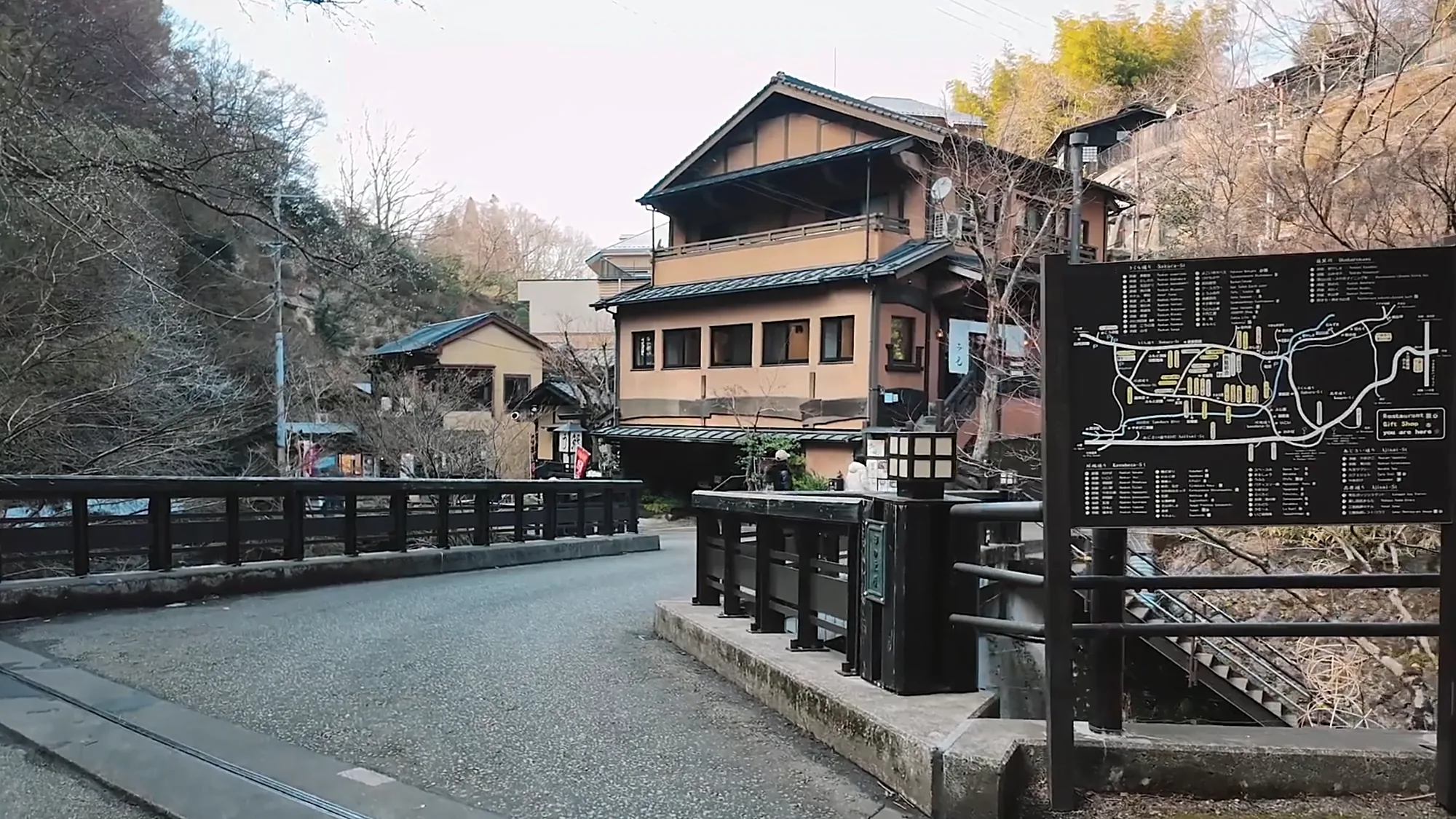
The designated area is wider than the lane most visitors photograph.
Using the map
The practical version: ask each front desk どんな泉質ですか (what's the spring type?) — inns proud of their source answer in detail; pick your three tegata stamps across families, not within one; rinse after sulfur if your skin runs sensitive; and treat any per-inn pH number you meet online with suspicion — no certificates surfaced in our verification, so neither do numbers here.
The five hamlets, one water at a time
The clearest way to hold Kurokawa's plurality is to walk the designated 南小国温泉郷 hamlet by hamlet, because the Japan Spa Association's government-designation profile assigns each its own spring family. 黒川 (Kurokawa) proper is 単純温泉 (simple) and 塩化物泉 (chloride) — the gentle, broadly tolerated end, chloride's salts holding heat and traditionally eased toward cuts and cold. 田の原 (Tanoharu) is 炭酸水素塩泉 (bicarbonate), the "beauty-water" family that leaves skin smooth.
満願寺 (Manganji) is bicarbonate too, as is 小田 (Oda) — three hamlets of bicarbonate country in a row. And 白川 (Shirakawa) is 硫黄泉 (sulphur), the theatrical end, milky and mineral and unmistakable. Read as a route rather than a list, the 郷 is a graded menu from simple springs to full sulphur inside one designated area — which is exactly why "what is Kurokawa's water" has no single answer, and why the honest reply names a hamlet before it names a type.
The hamlet portraits: four waters around the famous one
The designation's per-hamlet map rewards a slower read than the summary above gives it. Tanohara, immediately up the valley, is bicarbonate country with the area's deepest working credentials: known as a cure-ground, a toji resort, for some three hundred years, with a source that emerges hot enough to need no reheating at all, a rarity the old cure culture was literally built on.
Manganji, also bicarbonate, stages the area's most elemental bathing, its stone-ringed bath set into the bank of the Shizu River so that spring and stream mingle around the bather, in water clean enough to host okichi-mozuku, a protected freshwater alga that survives only in a handful of clear spring-fed rivers in Japan; the thirteenth-century temple above the bath supplies the setting's gravity. Oda completes the bicarbonate belt more quietly.
And Shirakawa, the fifth hamlet, is the sulphur pole of the map, the register's skin-indication country. Around them sits the honour the whole system shares: designation by the Environment Ministry as a National Recuperation Hot Spring Area, and selection among the Hundred Famous and Secret Hot Springs of Japan.
For the chemistry-minded visitor the implication is an itinerary: Kurokawa's own simple-and-chloride baths on day one, and on day two a graded tour, gentle bicarbonate at Tanohara, river-bathing at Manganji, sulphur at Shirakawa, that no single onsen town in Japan can stage inside its own borders.
The neighbouring hamlets, in depth
The bicarbonate and sulphur hamlets are worth their own visit, and two are genuinely rewarding. 田の原温泉 (Tanoharu) has been a 湯治場 — a cure resort — for some three hundred years, its bicarbonate source erupting hot enough to need no reheating; it was, for the record, a filming location for the Tora-san films.
満願寺温泉 (Manganji) offers a river bath in the truest sense: an open-air bath enclosed by stones on the bank of the 志津川, where you bathe in the stream itself, beside the thirteenth-century temple 立護山満願寺, founded by 北条時定; the stream holds オキチモズク, a protected natural monument. 小田 (Oda) rounds out the bicarbonate trio, and 白川 (Shirakawa) is the sulphur end.
None is on the Kurokawa tegata, but together they are the reason the "no single water" answer widens from four families to five across the designated 郷.
Bathing the map: a water itinerary across the five hamlets
The five-hamlet spring map turns into an itinerary the moment you read it as one. A first trip stays in Kurokawa hamlet itself, where the simple and chloride families run under the famous lanes, and that is correct: the tegata circuit is here, and the two mildest-to-warmest families suit a first immersion. A second trip should cross the water map deliberately.
Tanohara, the neighbouring bicarbonate hamlet, is the connoisseur's detour for reasons the record makes plain: a tōji lineage of some three hundred years, and source water managed without reheating, the spring arriving at the tub on its own thermal terms, which is as close as modern Japan gets to bathing in the eighteenth century.
Manganji pairs the same bicarbonate family with the valley's most primitive setting, the stone-ringed pool in the running river below a temple founded in the thirteenth century, water and landscape not yet separated into plumbing. And the Shirakawa side holds the sulphur family, the valley's most theatrical water, where colour and flake make the chemistry visible. Oda completes the bicarbonate belt for those working through the register.
The distances are trivial by car and manageable by the local buses, minutes rather than hours, which is the map's quiet gift: this is one of the few places in Japan where four spring families sit inside one township, so a two-night stay can bathe across a chemical range that would otherwise take a week of travel to assemble. Most visitors bathe one hamlet and believe they have bathed Kurokawa. The map says otherwise, politely.
Misato, and the water that changes colour
If any single inn is the village's water showpiece, the association's own description makes it 和風旅館美里 (Misato): the only inn in Kurokawa whose sulphur water changes colour. That is a stronger and more specific fact than the "milky sulphur" often written, and it is the association's line, not ours.
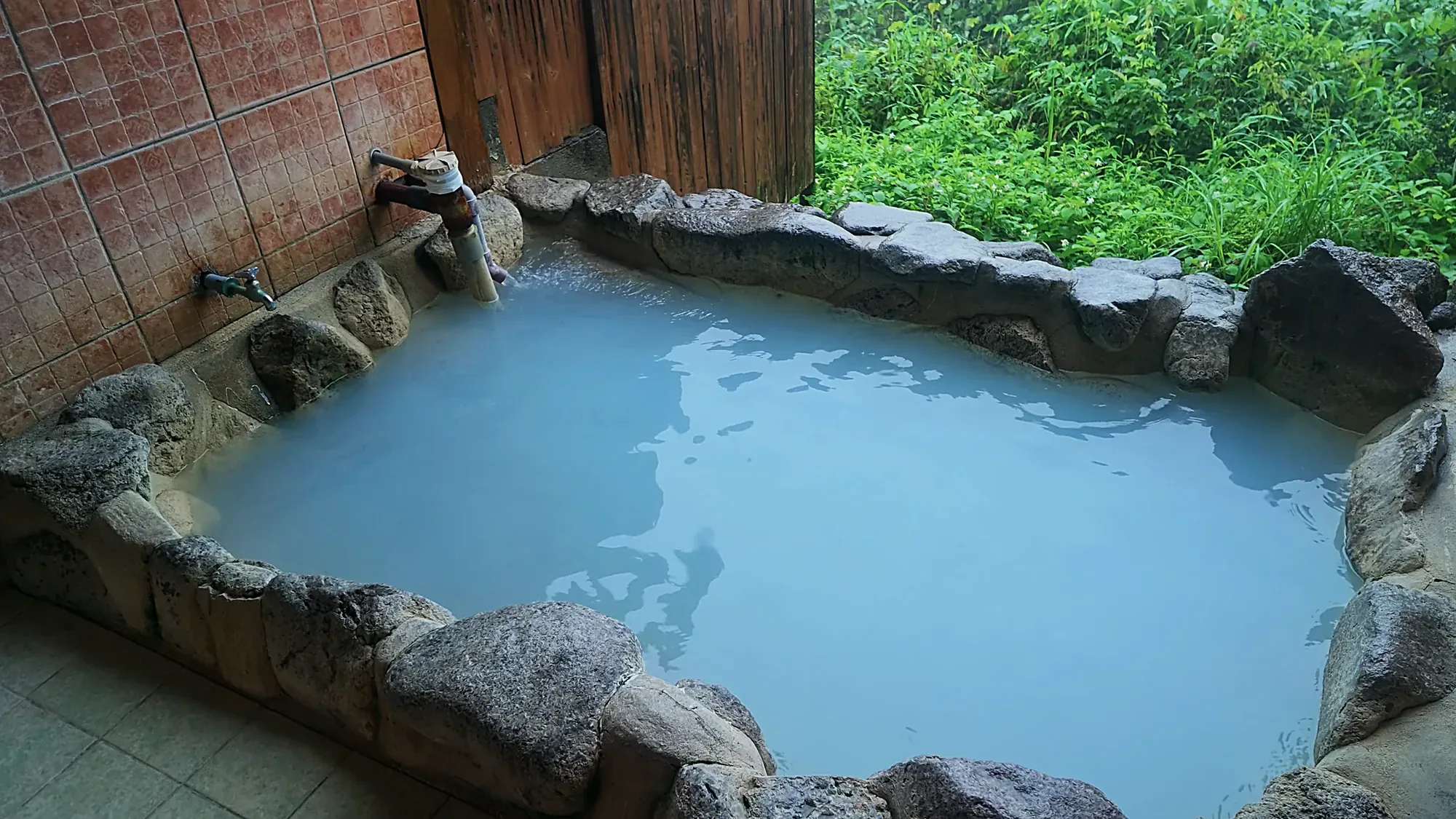
Some of these waters change colour with the weather and the hour.
Colour, though, is chemistry's costume, not its rank — a milky bath is not a stronger one, only a more visible one — so Misato is a showpiece of sulphur's theatre rather than a verdict on which water is "best." The best water is the register you personally want, which is the whole argument of this page: ask the front desk どんな泉質ですか (what is the spring type?), and pick for the effect, not the colour.
Per-inn water notes the association records
Beyond the hamlet map, the association's member listings record specific water and bath facts worth planning a chemistry flight around. 壱の井 (Ichinoi) runs sulphur water with yunohana floating in it — the visible mineral flower of a genuine sulphur source. いこい旅館 (Ikoi) is the only Kurokawa inn on the 日本の名湯秘湯百選 list, with thirteen baths. 新明館 (Shinmeikan) holds the hand-dug cave bath, its water reaching deep into the hillside.
ふもと旅館 (Fumoto) keeps a 1.5 m standing bath (立湯) among its eight baths. やまびこ旅館 (Yamabiko) has the village's largest open-air Senninburo, and 黒川荘 (Kurokawa-sō) the 屏風岩 folding-screen-rock view bath. These are the association's own notes, not visitor impressions, and they are the reliable basis for choosing three stamps across three registers rather than three views of one.
The legend baths, and their own sources
At the humble end of the plural map sit two public bathhouses tied to the village's founding legend. Per the government-designation profile, 地蔵湯 (Jizō-yu) and 穴湯 (Ana-yu) are 共同浴場 — communal baths — anchored to the story of the headless substitute Jizō, and they pour their own sources. They are the plainest expression of what this page argues: even the village's oldest, cheapest, legend-bound baths draw water distinct from the inn a lane away.
Jizō-yu, the locals' bath at the village centre, is a few hundred yen in the box, no view, all sincerity — and it stands where the founding legend says the hot water first ran. For a bather who wants the water without the ryokan, the communal baths are the honest floor of the same graded menu.
The tegata as a chemistry flight
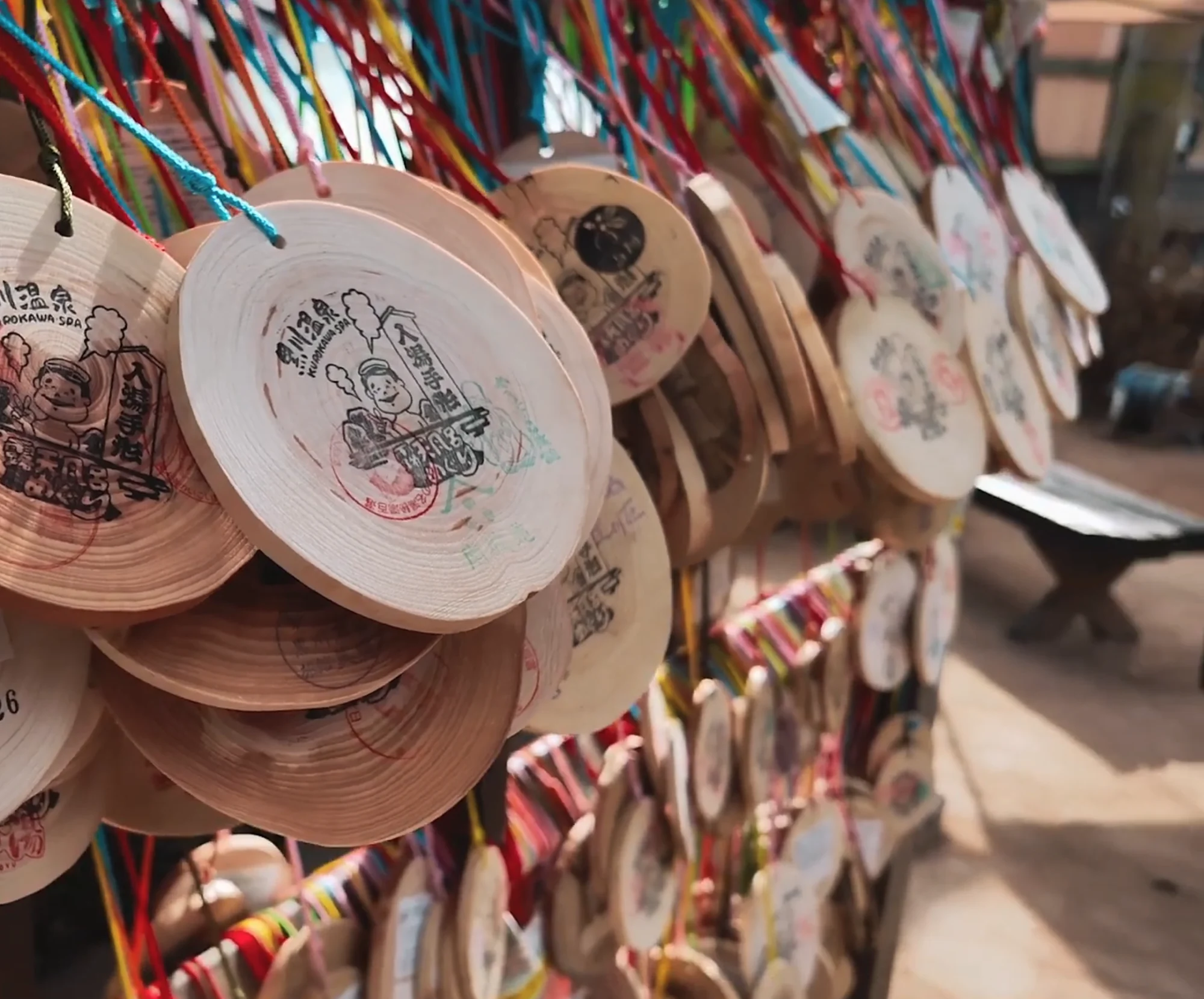
The bath-hopping pass is, on this page's reading, a tasting flight of waters, and its mechanics support the plan. The 入湯手形 (nyūtō tegata) costs ¥1,500 for an adult and ¥700 for a child (about US$10 / US$4.70), carries three stickers, and admits the holder to any three of the twenty-five scheme baths between 8:30 and 21:00. It is valid six months from purchase — an unfinished pass may be used on a return visit — and is one pass per person, not shareable. Spend the three stickers across families — one sulphur, one bicarbonate, one chloride — and the pass becomes a chemistry flight rather than a photo tour; that contrast is free and is half the tegata's point.
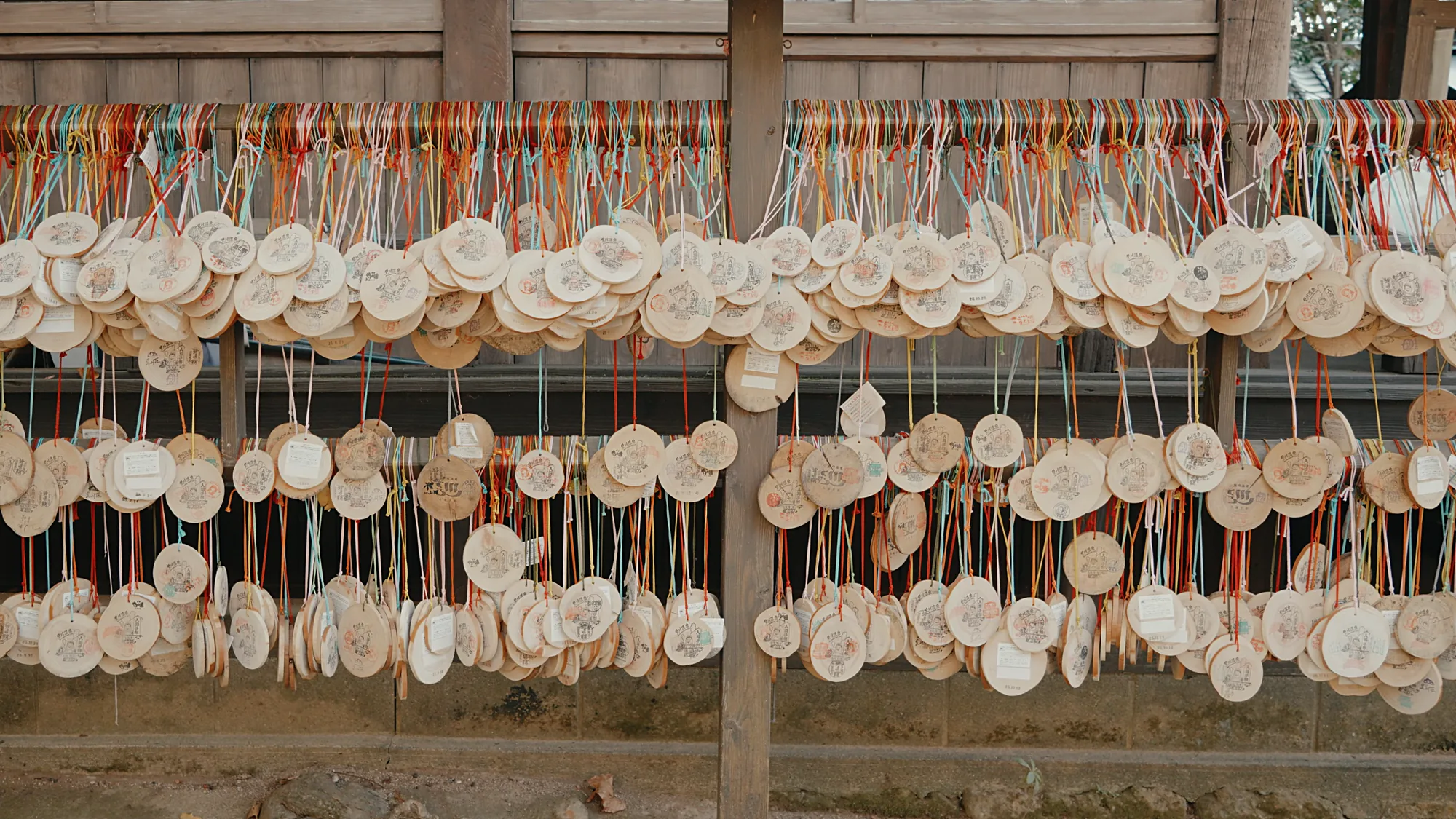
Three stamps, chosen for chemistry rather than convenience.
Two quieter facts: one percent of all tegata sales funds landscape and conservation work, and each inn carries its own stamp design. Buy it at any member inn or the 風の舎 (Kaze-no-ya) house.
A bathing order built on the chemistry
If the day is yours to sequence, let the water's strength set the order, mildest first, most assertive last. Begin with a simple or bicarbonate bath: the gentle families warm the body, open the pores and cost the skin nothing, which makes them the right first soak on skin that has been travelling.
Take the chloride bath in the middle of the day if the weather is cold, banking its long heat for the walk between inns, or late if the evening stroll is the plan. Save sulphur for the final soak, and treat it as the day's dessert for the same reason it needs placing: it is the most characterful family and the one whose scent stays with you, pleasantly in memory, literally on the skin.
Between baths, the standard onsen rules do the pacing for you: rinse before entering, rest and drink water between soaks, keep each immersion moderate rather than heroic. One chemistry-specific note completes the sequence. Whether to rinse off after the final bath is a genuine choice: leaving the mineral film on the skin extends the water's effect and is the traditional preference, while bathers with sensitive skin, or anyone finishing on the sulphur family, may prefer a brief fresh-water rinse, and the gentler families make that decision costless.
Three soaks ordered this way take a leisurely five or six hours with lunch and lanes between them, exactly the tegata's natural day, and the sequence quietly turns the pass from a sampler of famous tubs into a structured tasting of the valley's actual product.
Sulphur, silver, and the practicalities of a chemistry flight
A few practical habits follow from the water being real and varied. At the sulphur stops, silver tarnishes almost instantly — the reaction is traditional and harmless, but leave the rings and the necklace in the room. If your skin runs sensitive, rinse after a sulphur soak rather than towelling the minerals in; the register above lists sulphur toward skin conditions, but sensitive skin is also in its cautions, and a rinse settles the difference.
Because the day-use baths a bath-hopper visits supply almost nothing, carry a small towel, your own soap, and coins for the entry boxes — the unofficial kit of the flight. And spread the three stamps across the day rather than stacking them: Kurokawa's waters are genuinely strong, so three spaced soaks in different registers relax where three back-to-back tire. The point of the flight is contrast enjoyed, not volume achieved.
Tips
Contrast is free: one sulfur, one bicarbonate, one chloride — the tegata as chemistry flight.
Milky ≠ stronger; color is chemistry's costume, not its rank.
Silver off at the sulfur stops; the tarnish is instant and traditional.
The 郷's hamlets extend the sampler transit verify — the quiet second-day play.
Private and mixed baths, for a water on your own terms
To sit with a single water uninterrupted, the private baths are the answer. Most inns rent kashikiri (貸切) private baths by the hour, and 黒川荘 (Kurokawa-sō) gives its guests three private baths free with a reservation — a way to have a chosen register to yourself.
Konyoku (混浴) mixed baths survive at several inns, entered from separate changing rooms and, at some, with women-only hours: 奥の湯 (Okunoyu), on its own site, reserves certain mixed baths for women from about 8 to 10 pm. On tattoos, the association sets no village-wide ban and publishes no inn list, routing each question to the individual inn, so we name none; a booked kashikiri bath is the reliable route to any of the village's waters without a policy conversation. Privacy, here, is a way to choose your chemistry as much as your company.
The village that shares its sources
The reason a bather can move so easily between waters is a design decision the village made deliberately. The modern village began from failure — the 1964 Yamanami Highway brought a boom that faded — and in the lean years the third-generation owner of 新明館 dug a cave bath by hand, aged twenty-four, with a chisel, over about three and a half years (the inn's history records the feat without naming him, and neither do we).
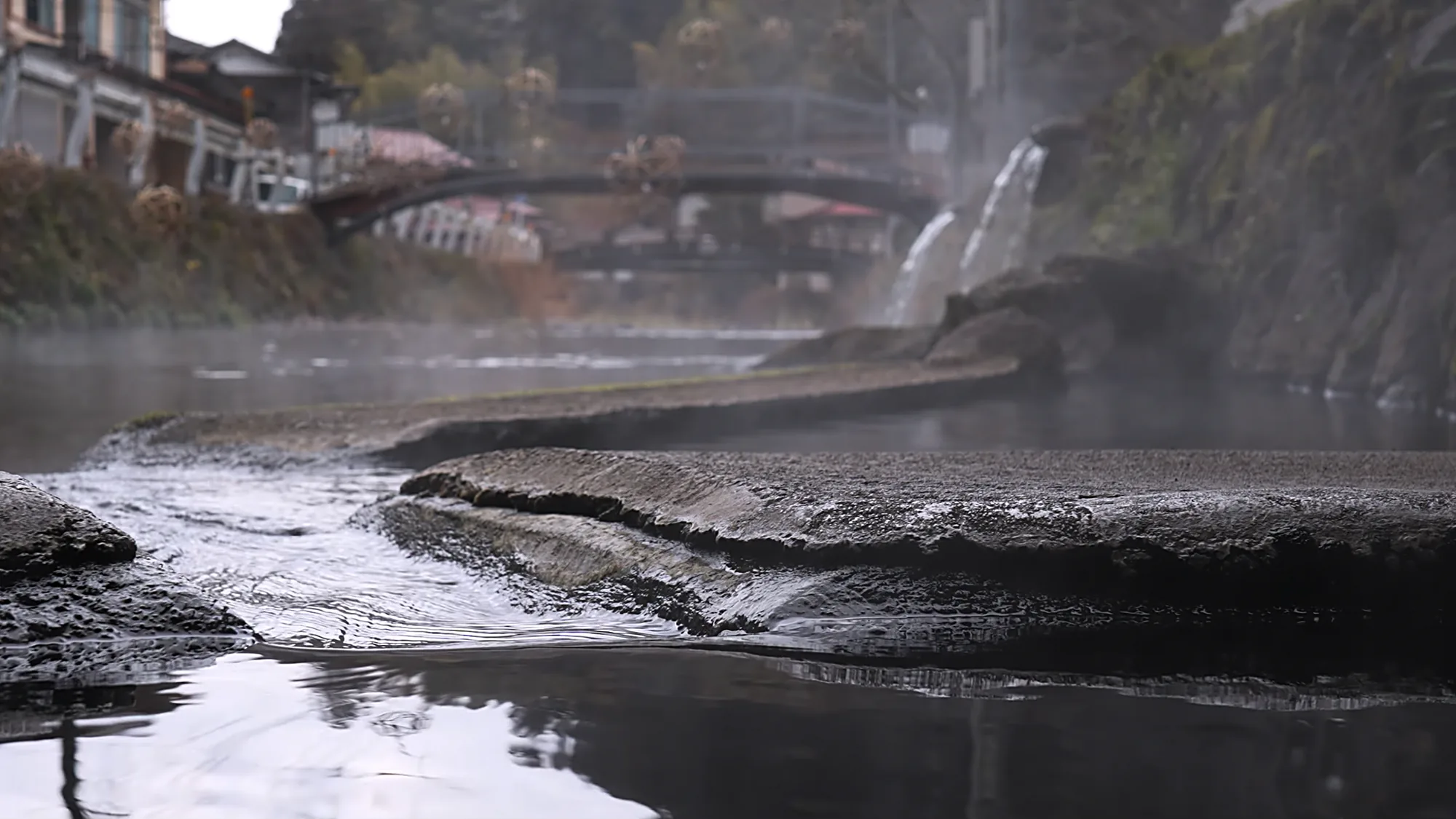
The sources are shared. So is the decision about how to use them.
From the 1980s the innkeepers took roughly two hundred signs down off the lanes together, enforced natural materials, and bound the village to the slogan 黒川温泉一旅館 — "the whole village, one inn," with the tegata turning thirty rival sources into a single shared flight. The plurality of the water was always there in the geology; what the revival added was the system that lets one visitor, one afternoon, one ¥1,500 pass, drink from three of its registers.
The village that regulates its soap
One more water fact belongs on this page because it reveals the system behind all the others. The town's own slogan for its countryside is kiyora no sato, the land of clear purity, and the designation profile records that the town regulates the soap and shampoo used at its onsen, out of concern for the river and the springs. Follow the logic of that ordinance.
The baths drain toward the stream; the stream is the upper Chikugo; the same aquifer that fills the tubs waters the valley. A village that lets each inn own its source but regulates what everyone may wash with has decided that the water is a commons even where the sources are private property, which is the aquatic version of the same agreement that shares the baths and bans the neon.
Visitors participate whether they notice or not, and the participation asked of you is small: use what the bath provides rather than importing your own products into the water, rinse rather than soap at the rustic rotenburo with minimal washing stations, and let the river receive as little of your visit as possible. The clearest water on the map is the reward.
The proof downstream: what clean water leaves behind
A spring town's chemistry is audited by its river, and this valley's river carries an unusual witness: オキチモズク, the rare freshwater alga recorded in Manganji's waters, a species particular enough about clarity that its presence functions as a living certificate for the stream it grows in. That certificate is not an accident; it is policy you can trace.
The wider きよらの郷 township regulates household soap use to protect its watercourses, a rule almost no visitor will ever notice and every bath downstream quietly benefits from. The bathhouses sit inside the same discipline: the design code that keeps signs subdued also keeps the riverbanks planted, and one per cent of every tegata sold is directed to conservation of the village's environment, which means the pass in your hand is, in a small way, a water-protection instrument.
Add the altitude, about 700 m (2,300 ft) of highland catchment above the taps, and the picture completes: the water in the tubs is the top of a system the community manages from source to stream. For the bather this is more than civic trivia.
It explains why the valley's baths can run kakenagashi, continuously flowing and overflowing, without the river below turning grey; why the water tastes of minerals rather than maintenance; and why the village fought so hard, through the replanting years, to keep the landscape that recruits its rain. When you rinse at the edge of a rotenburo here, the water leaving your shoulders rejoins a system that a rare alga has already inspected and approved. Few onsen towns can make that claim, and fewer still could prove it.
The visitor code at the baths
The waters are shared, and the village publishes the code that keeps them pleasant to share. From the association's own pages: keep your towel out of the bath water; photography in the open-air baths is prohibited in principle (it matters most in the mixed baths, where phones stay in the changing room); the onsen town is non-smoking outside designated areas; no drones without prior permission; do not pick plants or foliage; parking is limited with no roadside parking; and entry may be refused when a bath is crowded. The village even regulates the soap and shampoo used at its baths out of concern for the stream it sits above — a detail that fits a page about water, and a genuine measure of how seriously the place takes its sources. Behaving to the code is part of respecting the water, not just the neighbours.
Getting there to sample the waters
Reaching the sources means a bus or a car, because there is no train station. The association's matrix puts Fukuoka at 2 hours 45 minutes by direct highway bus and Kumamoto at about 3 hours, with the nearest railheads at JR Aso and JR Hita, each about an hour out by car. On the Kumamoto side the last local-bus leg ends at 南小国町役場前 (Minamioguni town hall), ten minutes short of the village by car, so arrange the inn's pickup.
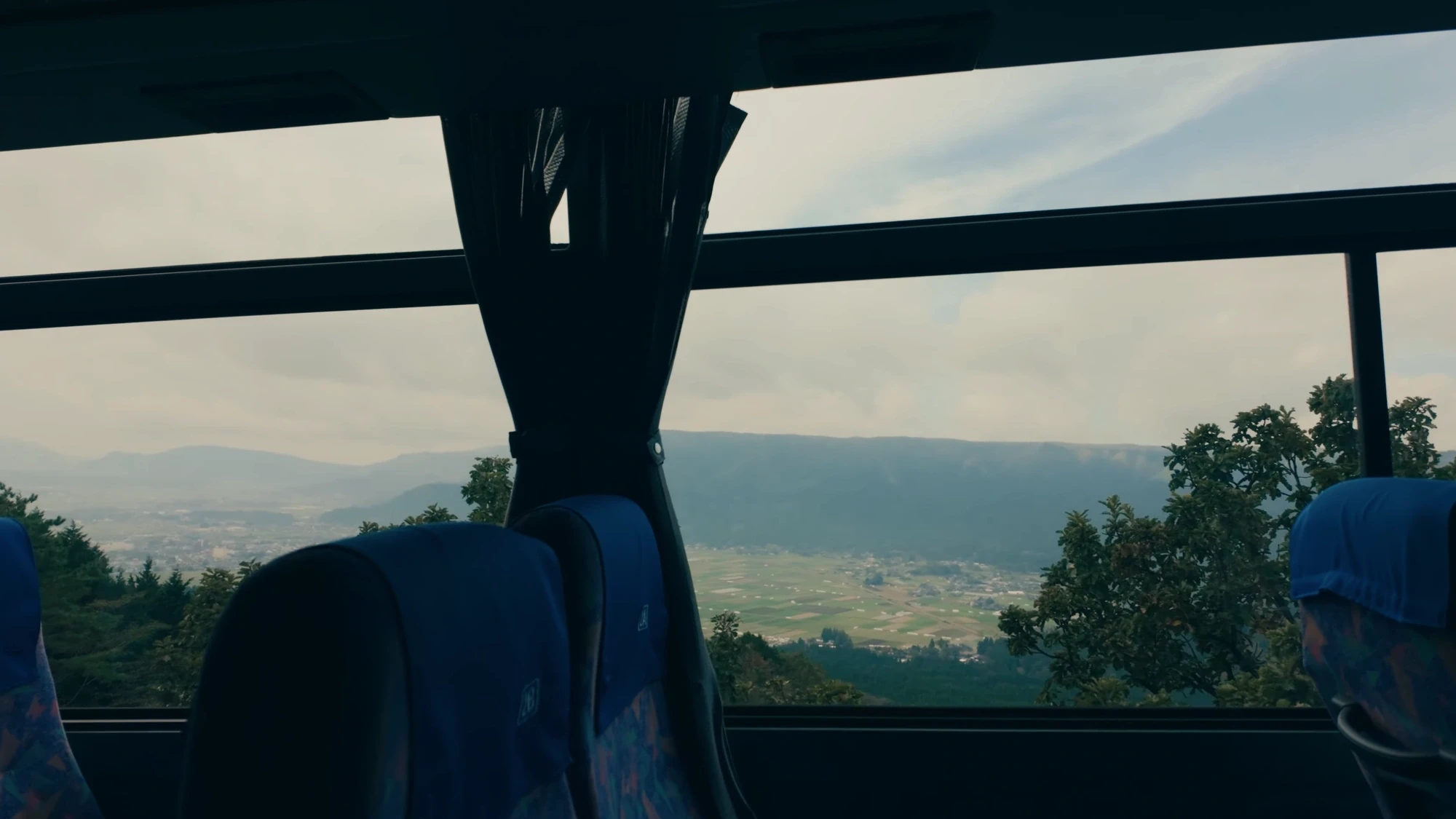
Every approach crosses the caldera that makes the water.
Sampling the neighbouring hamlets' bicarbonate and sulphur waters realistically wants a car, since inter-hamlet transit is sparse. And with the 2026 Kumamoto earthquake having thinned some regional services, check the association's live weather-and-traffic page before fixing a run; fares are not on the access page, which links out to each operator.
Getting there from further afield
For travellers sampling Kurokawa's waters as part of a wider Kyushu route, the association's matrix reaches beyond Fukuoka and Kumamoto. From Nagasaki, JR かもめ to Saga, then the 九州急行バス toward Kōsoku-Kiyama and the highway bus onward; from Kagoshima, the Shinkansen to Kumamoto in about fifty minutes, then the three-hour Crossing Bus; from Miyazaki, a highway bus of nearly four hours via Kumamoto; and from the Ōita side, the once-daily Kyushu Crossing Bus through Beppu and Yufuin.
Each spends the better part of a day in transit, which is why sampling more than the Kurokawa-proper waters — reaching the bicarbonate and sulphur hamlets — really wants a car and an overnight, not a day trip built around a bus timetable.
Where to stay for the water
Because the water is inn-by-inn, where you sleep partly decides which register you soak in longest, and the association's price list runs, per person with two meals, tax excluded, from ¥12,727 at the four-room お宿玄河 (Genka) to ¥122,700 at 月洸樹 (Gekkoju) — nearly ten times the floor across thirty inns, with the middle around ¥18,000–27,000.
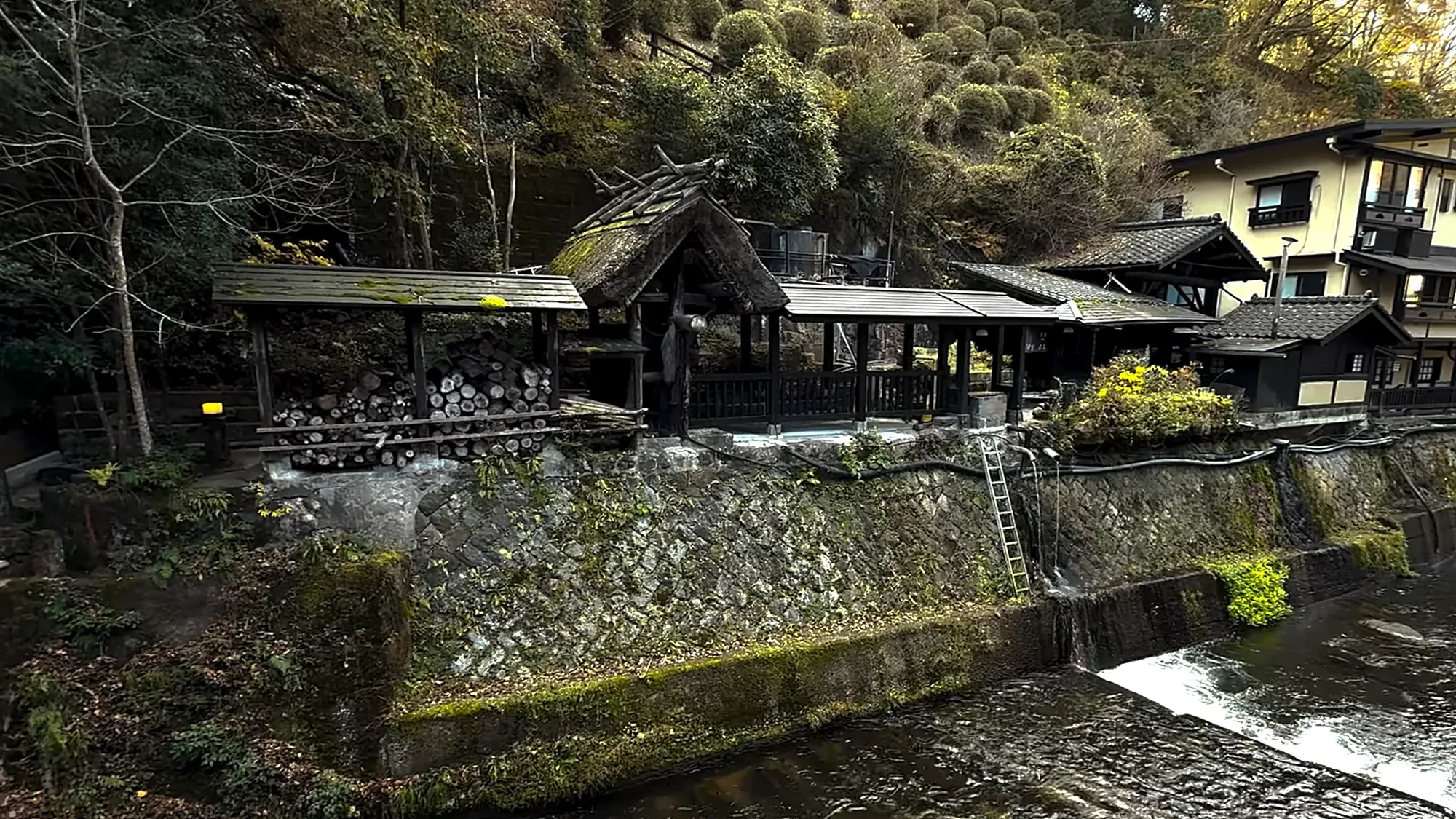
Sleep where the water you want is.
A water-minded booking might favour a sulphur showpiece like 美里, the standing bath at ふもと, or the thirteen baths at いこい, then spend the tegata across contrasting families. There are no hostels in the roster; even the floor is a real ryokan with its own source, and the ¥1,500 tegata gives that room's guest the same access to the village's other waters as any villa. Book two to four months ahead for winter and the November foliage weekends.
The food and shops between the waters
A chemistry flight leaves gaps to fill, and the association's directory names what lies between the baths. It lists thirteen places to eat and fourteen souvenir shops. For a soak-to-soak snack: dorayaki at どらどら, soy-milk soft-serve at とうふ吉祥 (Tōfu Kissho) — itself made with headwater from the Chikugo — and shiratama at 白玉っ子 (Shiratamakko).
Dinner is almost always at the inn, cooked for its own guests at one seating, with 褐 (-aka-) and 豚皇 (TONKOU) reservation-only and TONKOU's evening course for overnight guests only; いろり家 (Irori-ya) is one of the few places open late. Several take the tegata's green sticker, so the third stamp — the one not spent on water — buys a honey soft-serve at 杉養蜂園 or a sweet on the walk between registers. The waters are the point, but the lanes between them are the village's high street.
What we don't print about the water
Honesty about the water includes what stays off the page. A count crediting Kurokawa with seven of Japan's ten official spring types circulates online; we do not print it, because the most authoritative records contradict it — the Japan Spa Association's area sheet lists four families and the 郷 profile five across all five hamlets.
The honest figure is four to five, not the higher number. Per-inn pH and TDS values also stay out: no certificates surfaced in verification we can stand behind, so no numbers are printed rather than borrowed. And one price figure worth flagging: an older national directory still lists the tegata at ¥1,200, but the operator's own current page sets it at ¥1,500, so the live operator figure is the one to trust.
On all three, the rule is the same — the source we can stand behind wins, and where none exists, the claim does not appear.
Questions bathers ask about the water, answered plainly
Will the sulphur baths damage jewellery? Silver, yes, honestly: sulphur compounds tarnish it quickly, so rings and chains belong in the changing-room basket before any bath on the sulphur side, and this is the one item the small towel cannot protect. Is the water safe for sensitive skin?
The bicarbonate and simple families are the gentle end of the register and the sensible starting point; keep first soaks short, rinse afterwards if the skin asks for it, and let the reaction to a mild bath decide whether the stronger families join the itinerary. Can you drink the water?
Not from the tubs, ever, and otherwise only where an inn expressly posts a drinking source; where nothing is posted, the water is for skin, not stomachs, and this page will not guess past the signage. Why did the same bath feel different on the second day?
Because a living spring is weather: rain in the catchment, the day's source flow and the morning's dilution all move a tub within its range, and the colour-shifting water at Misato is only the most visible case of a variability every bath here shares. Does the mineral smell wash out? By the next day, yes, from skin faster than from towels, and most bathers reach the end of the trip regretting its departure rather than its persistence.
And the summary question, is this water genuinely different from a city super-sento's: the honest answer is the entire page above, four certified families, posted analyses, a disclosed serving method and a river-tested watershed, which is not marketing language but the specific, checkable machinery of a real spring town.
The fortieth year of the shared-water system
The system that lets one visitor drink from several of the village's registers in an afternoon is having a notable year: the 入湯手形 began in 1986, making 2026 its fortieth anniversary, and the association is running a fortieth-anniversary programme from July 1, 2026 to March 31, 2027. Before the pass, thirty inns guarded thirty sources; the tegata turned them into one shared flight, and returned one percent of every sale to the landscape and conservation work that protects the sources.
For a water-minded visitor, the anniversary is a fitting occasion to taste the plurality the pass made accessible — and the fortieth-year disc, stamped across three different waters, is the record of having done so. It is a rare thing for a village to make its geological accident — many sources in one small valley — into a shared, walkable, single-pass experience, and the fortieth anniversary is really a celebration of that decision as much as of the wooden token itself.
Tips
Contrast is free: one sulfur, one bicarbonate, one chloride — the tegata as chemistry flight.
Milky ≠ stronger; color is chemistry's costume, not its rank.
Silver off at the sulfur stops; the tarnish is instant and traditional.
The 郷's hamlets extend the sampler — the quiet second-day play.
Frequently asked questions
What type of hot spring water does Kurokawa Onsen have?
How many spring types does Kurokawa Onsen actually have?
Which inn has the best water?
What are the waters traditionally good for?
Is the water the same at the public baths?

Verified by The Japan Onsen Society
Show all sources
Multi-type list + Misato sulfur + register → 温泉地詳細[黒川(南小国温泉郷)] (日本温泉協会) → https://www.spa.or.jp/search_p/detail_p/?F_ID=430260&pg=0 → spa-association data sheet → verified Jul 7, 2026
郷 designation + per-hamlet types + legend baths → 南小国温泉郷 (国民保養温泉地) → https://www.spa.or.jp/kokumin/1131/ → government-designation profile → verified Jul 7, 2026
The claim that Kurokawa offers seven of Japan's ten spring types: left out. Two 日本温泉協会 records contradict it — the area sheet lists four spring families, and the 郷 designation profile lists five across the hamlets.
Per-inn pH and TDS figures: none found in a source we can stand behind, so none are printed.
Konyoku (mixed) baths with women-only hours (about 8–10 pm) → 奥の湯 (Okunoyu, the inn's own site) — https://www.okunoyu.com/ — verified Sep 6, 2026
The four registered spring families for the Kurokawa area, the full 適応症/禁忌症 by spring type, Misato's colour-changing sulphur water, per-inn water notes (Ichinoi yunohana, Ikoi 名湯秘湯百選 + 13 baths, Fumoto 立湯, Kurokawa-sō 屏風岩), and the legend baths 地蔵湯/穴湯 → 温泉地詳細[黒川(南小国温泉郷)] (日本温泉協会) — https://www.spa.or.jp/search_p/detail_p/?F_ID=430260 — verified Jul 7 and verified Sep 6, 2026
The five-hamlet per-type map (黒川 simple+chloride · 田の原/満願寺/小田 bicarbonate · 白川 sulphur), the 国民保養温泉地 designation, 田の原 as a 300-year 湯治場, 満願寺's river bath and オキチモズク, and the ¥1,200 directory figure → 南小国温泉郷 国民保養温泉地 profile (日本温泉協会) — https://www.spa.or.jp/kokumin/1131/ — verified Jul 7 and verified Sep 6, 2026
The 源泉かけ流し / 加水 source-water disclosure, the access matrix and journey times, nearest stations Aso and Hita, the town-hall last-leg gap, altitude and the temperature differential → アクセス・よくある質問 (黒川温泉観光旅館協同組合, official) — https://www.kurokawaonsen.or.jp/access/ + https://www.kurokawaonsen.or.jp/faq/ — verified Sep 6, 2026
Tegata mechanics (¥1,500/¥700 current price, three stickers, six-month validity, 8:30–21:00, 25 baths, one per person, green sticker, 1% conservation levy, per-inn stamps) → 入湯手形 (組合, official) — https://www.kurokawaonsen.or.jp/tegata/ — verified Sep 6, 2026
Per-inn price band (¥12,727–¥122,700), 30 inns → 宿泊 (組合 oyado list, official) — https://www.kurokawaonsen.or.jp/oyado/ — re-verified Sep 7, 2026
Live service status under the 2026 Kumamoto earthquake reductions → 天気・交通情報 (組合, official) — https://www.kurokawaonsen.or.jp/weather_traffic/ — check every publish
The 1964 Yamanami Highway boom that faded, the hand-dug cave bath, ~200 signs removed, the 黒川温泉一旅館 slogan → 新明館の歴史 (Shinmeikan) + 黒川温泉について (組合) — https://shinmeikan.jp/history/ + https://www.kurokawaonsen.or.jp/about/ — verified Sep 6, 2026
Related guides
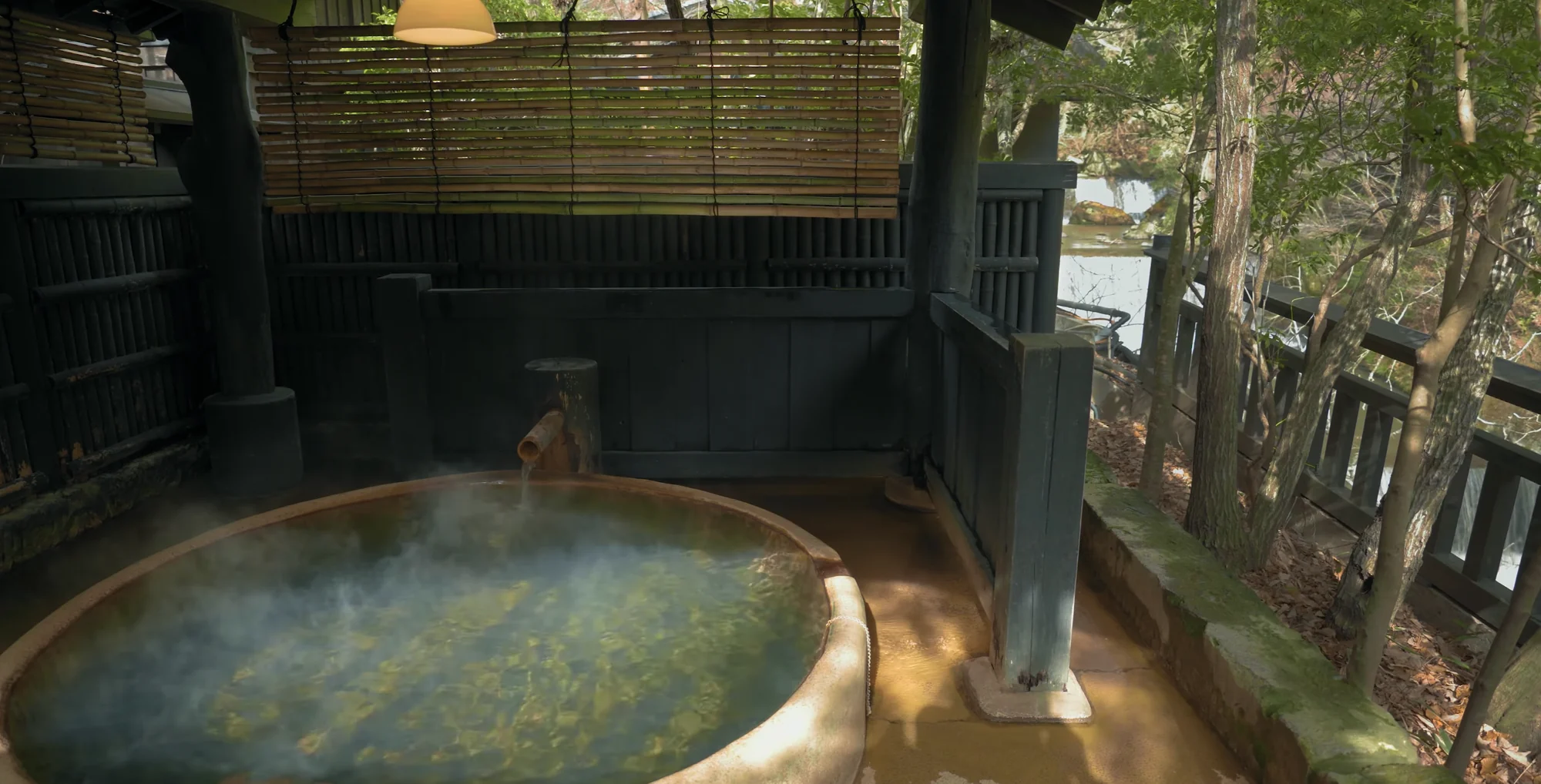
The Baths
The Best Open-Air Baths (Rotenburo)
The tegata buys three of twenty-five open-air baths. Choose for contrast — a river, a cave, a pond — not three of the same.
The Baths
The Nyūtō Tegata Explained
A wooden disc buys any three of twenty-five baths, valid six months. Two stickers can go to baths and the third to lunch.

The Baths
Kurokawa Onsen: The Complete Guide
A wooden pass buys three baths from twenty-five. The innkeepers agreed, decades ago, to look like this.