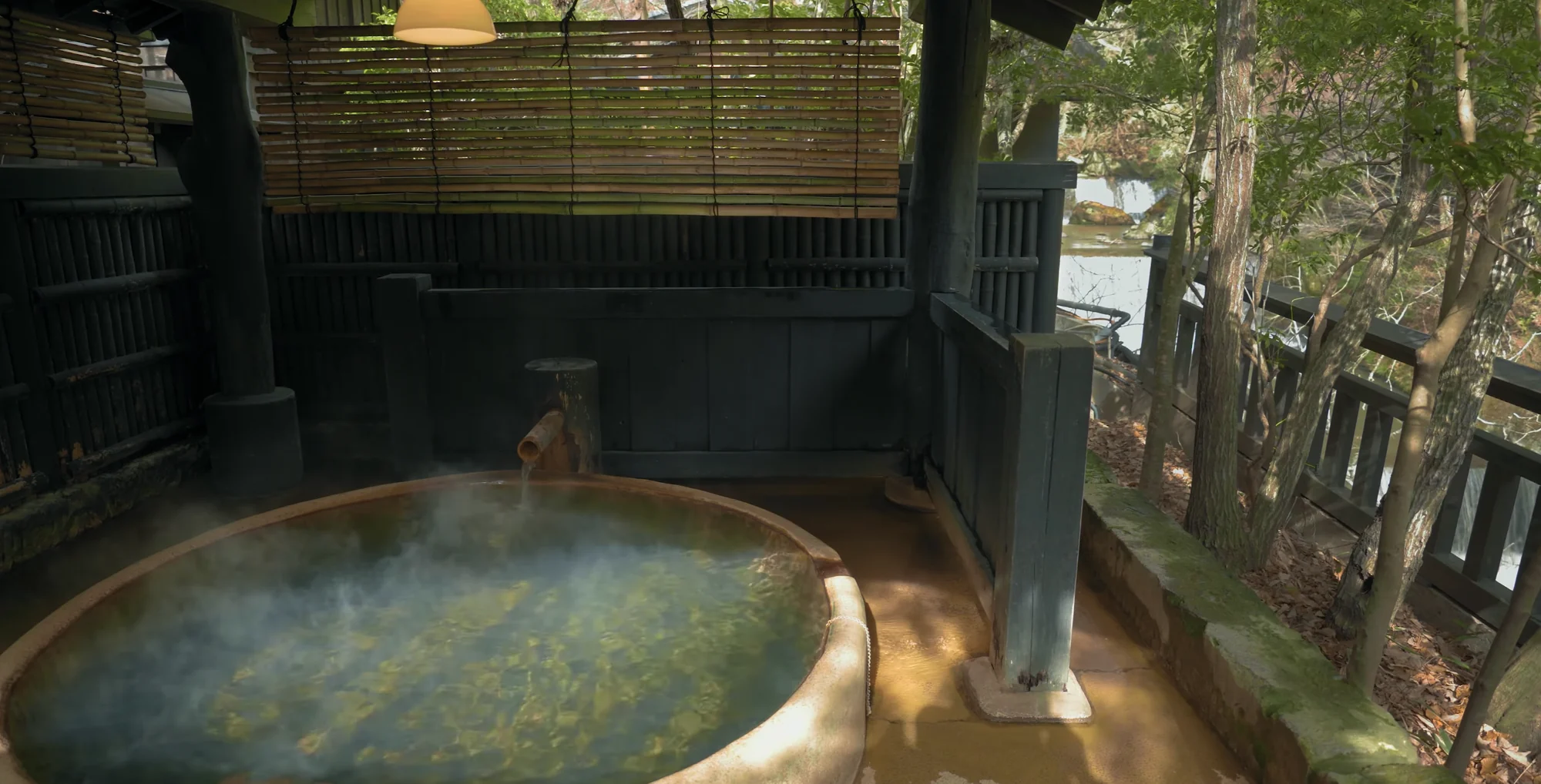
Ranking baths is a blood sport in a village whose entire identity is bathing, and any local will happily contradict the list below. Good. This page is not a census of all the rotenburo, it is an opinionated answer to the question every visitor actually has, standing at the information center with a fresh tegata and an afternoon: where should my three stamps go, and why? We choose for contrast, because three variations on one idea is a wasted pass.
Two things are worth knowing before you spend a stamp. The scheme covers twenty-five open-air baths across the member inns, not all of them equally famous, so the tegata is a sampling device and the honest game is coverage of kinds — a river bath, a cave, a big pond, a beauty water — rather than a strict ranking.
And the water itself deserves a sentence of candour that English coverage skips: the ryokan association states that nearly every Kurokawa inn is genuinely free-flowing from its own source (源泉かけ流し), but because that source runs hot, many inns add water (加水) to bring it to a bathable temperature, which the association says does not change the mineral content or the designated effects. Take that as a measure of how seriously the village documents its own baths, not as a demerit.
How the tegata actually works
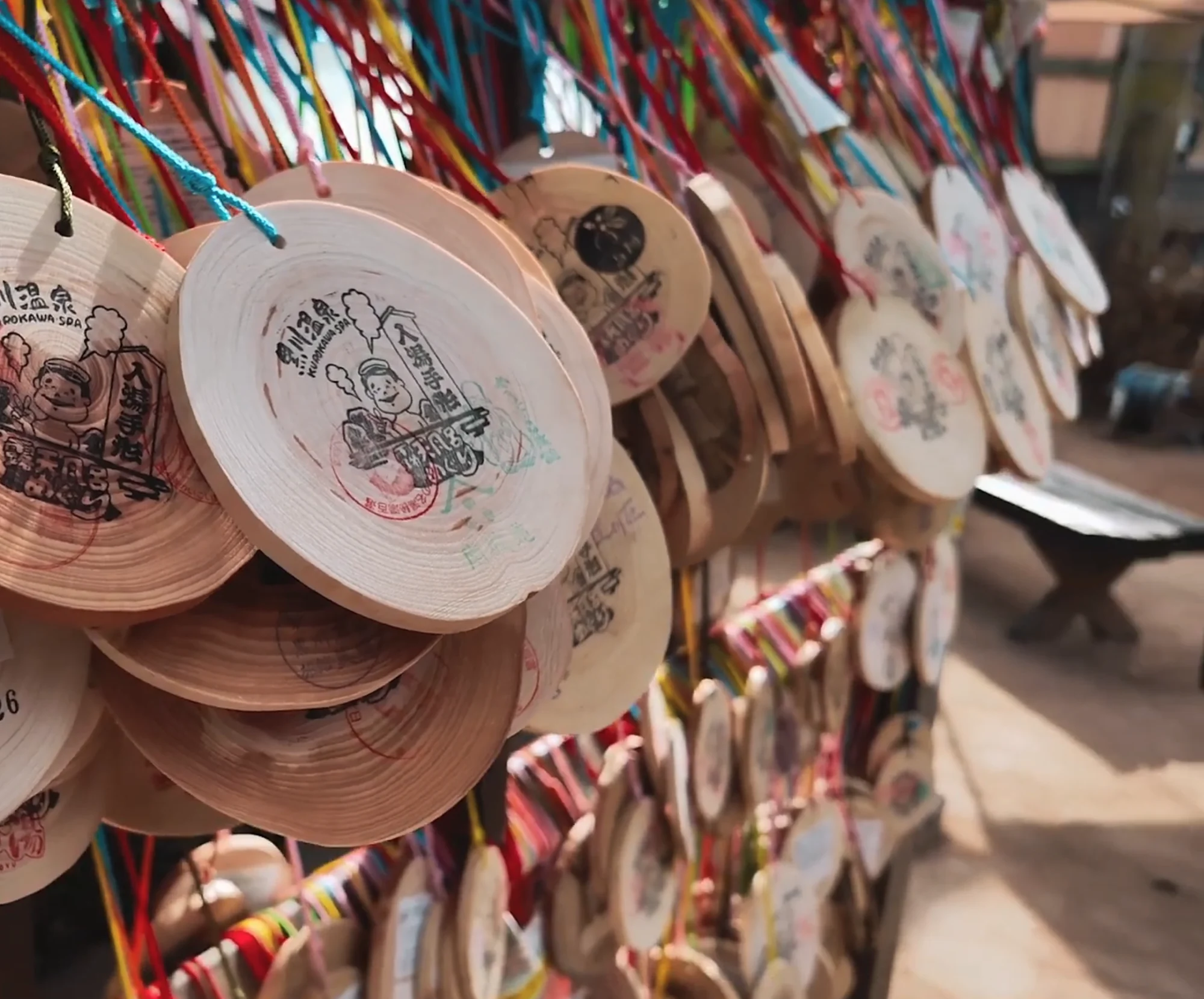
The pass is a wooden disc — the Nyūtō Tegata — with three stickers on the back, and understanding what those stickers do is most of the planning. It costs ¥1,500 for an adult and ¥700 for a child (about US$10 and US$4.70 at ¥150 to the dollar), and here is the part almost no English page gets right: you do not have to spend it on three baths.
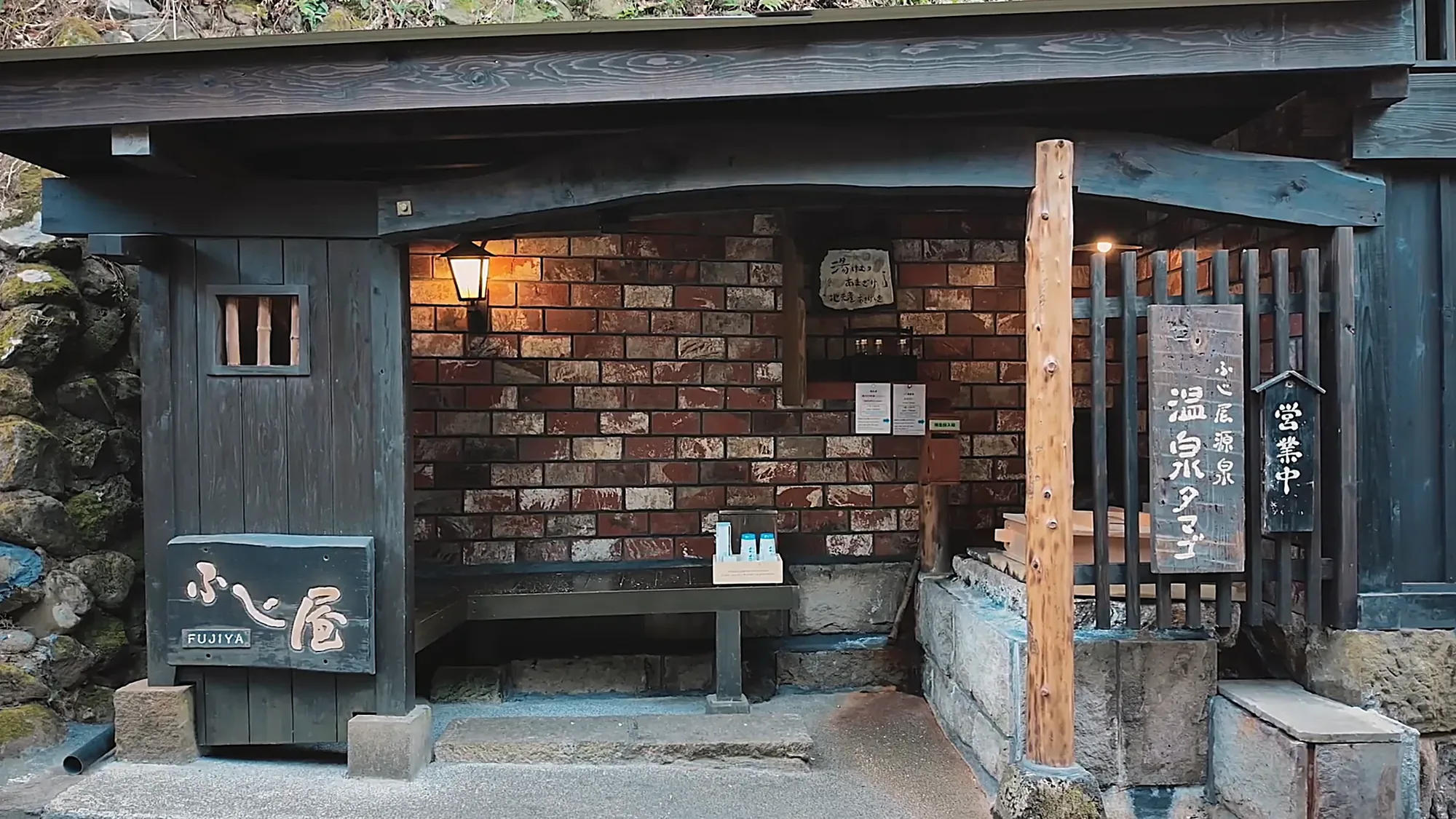
The plaque wall is the ledger. An open placard means the bath will take your stamp today.
Three red stickers buy three baths; two red stickers plus one green buy two baths and one food or souvenir item at a participating shop. The green sticker is the food-and-shopping half of the same system, and both uses are equally valid — neither is the rule.
Two more facts change how you plan. The pass is valid for six months from the day you buy it, not one day, and the association says explicitly that an unfinished tegata may be used on a return visit inside that window — so the old "you must do all three in one afternoon" anxiety is simply wrong. And it is one pass per person; it cannot be shared across a couple or a family, so a party of four needs four discs.
Buy it at any Kurokawa ryokan or at the association's own 風の舎 (Kaze-no-ya) hut in the centre of the village. Bathing runs 8:30 to 21:00, with per-inn variation, and the association posts each day's open and closed baths — cleaning closures reshuffle any plan more days than not — so that board is the first stop, before you commit a single stamp.
Two details make the disc a keepsake rather than a ticket: each ryokan carves its own stamp design, so a completed tegata is a small personalised object, and the association returns one percent of every tegata sale to landscape and nature-conservation work in the valley. The scheme began in 1986, which makes 2026 its fortieth year; a fortieth-anniversary programme runs from July 2026 through March 2027.
Three walks, three baths, three stickers
The circuit's best afternoons pair a bath, a walk and a sticker into one movement, and the documented facts assemble three such itineraries. The river walk: Yamamizuki's forest pools first, the streamside path back toward the village doing your cooling for you, and the sticker spent at the inn's own Inoya counter, its blend coffee being one of the roster's documented items, so the bath, the walk and the reward share one address.
The centre walk: the Senninburo's space at Yamabiko, then the flat stroll of Kawabata-dori with the stream alongside, closing at Tofu Kissho, where the sticker buys dango and tea beside an irori hearth. The climb: Shinmeikan's cave at the river, then up Igozaka past the kilns and the sake shop, the sticker converting at Doradora into hand-grilled dorayaki at the top, gravity having earned it.
Each pairing obeys the same design: the bath first, while the body is fresh; the walk as the interval the water requires anyway; the sticker as the full stop. Build your own on the same grammar and the tegata stops being three errands and becomes one composed afternoon, which is, as near as we can tell, exactly how the village's designers bathe it themselves.
A taxonomy of Kurokawa's bath formats
Rankings compare baths; a taxonomy explains them, and the village's documented baths sort into eight formats, each answering a different appetite. The cave, dokutsu-buro, is hot water inside rock, Shinmeikan's hand-dug tunnel the defining instance, and its appeal is enclosure: sound deadened, light rationed, weather irrelevant.
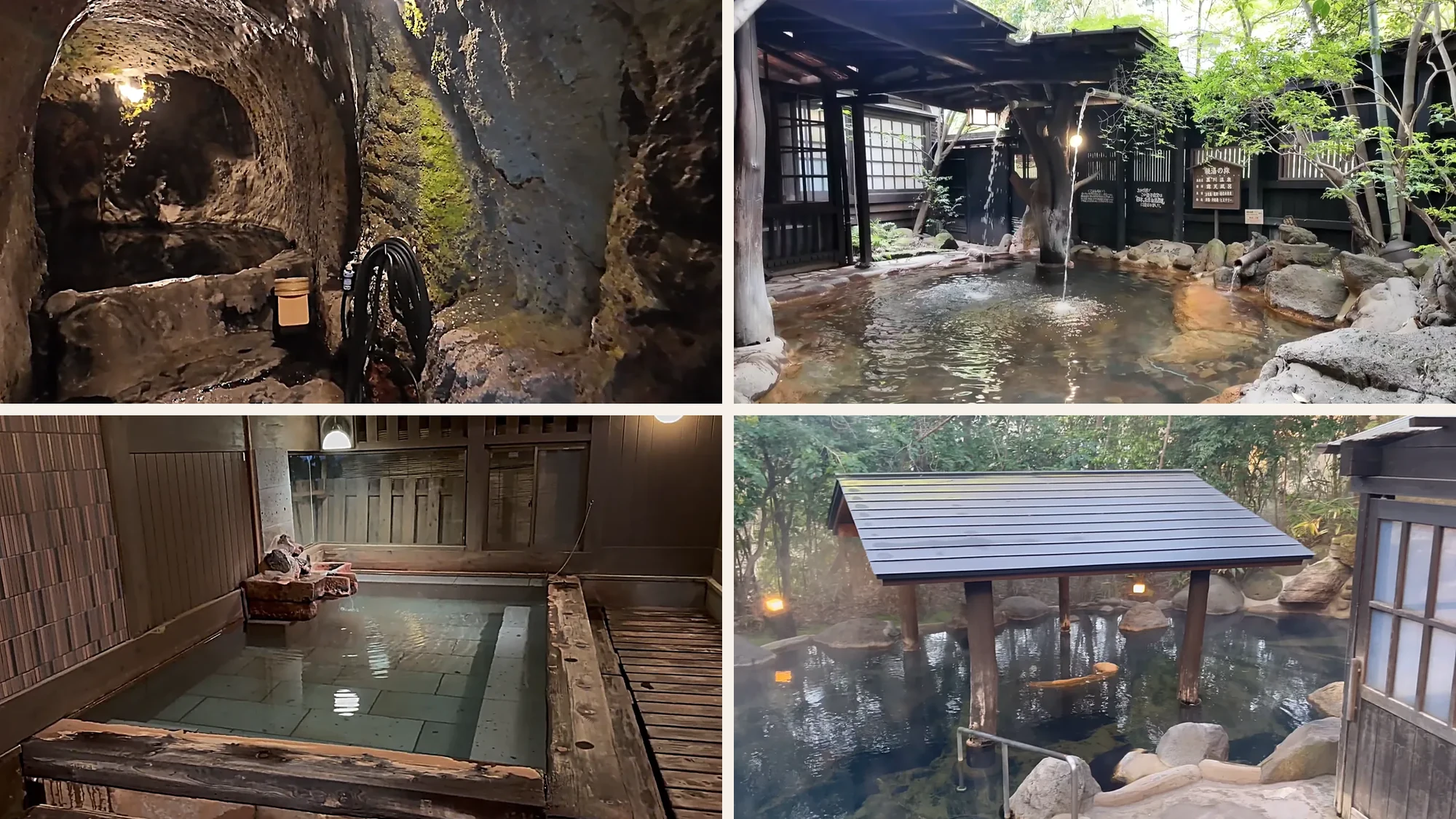
Four formats, one valley. This is the whole argument for spending three stamps carefully.
The standing bath, tachiyu, immerses vertically, Fumoto's 1.5 m (4.9 ft) example the village's documented one; the format soaks hips and spine evenly and feels, for the first minute, like wading into a warm well. The pond-scale bath, of which Yamabiko's Senninburo is the recorded champion, trades intimacy for openness, steam moving across real distance.
The riverside format puts the pool against running water, Yamamizuki's Yukoku-no-yu and Mori-no-yu the documented pair, and its currency is sound, the river running under every thought. The view bath composes scenery instead, Kurokawa-so's Byobu-iwa rock face the sourced example, a landscape hung behind the water. The connected format, indoor opening to outdoor, appears in the record at Yamamizuki, where the men's Masurao leads directly to the rotenburo, the winter-friendly architecture.
The communal floor is the sento pair, Jizo-yu and Ana-yu, coins and no frills, bathing as the town does it. And the private format, the kashikiri, converts any of the above into a locked hour. Most visitors sample three formats and assume they have seen the range; the record says the range runs twice that deep, which is the standing argument for the return visit the tegata's validity already funds.
Yamamizuki: the bath the village should be judged by
A few minutes upstream of the village center, Yamamizuki is what people imagine when they imagine Kurokawa, then slightly better. Its rotenburo sit directly on a bend of the river in open woodland, screened by trees rather than walls, so the experience is water, rock, forest and sky with the inn itself politely invisible.
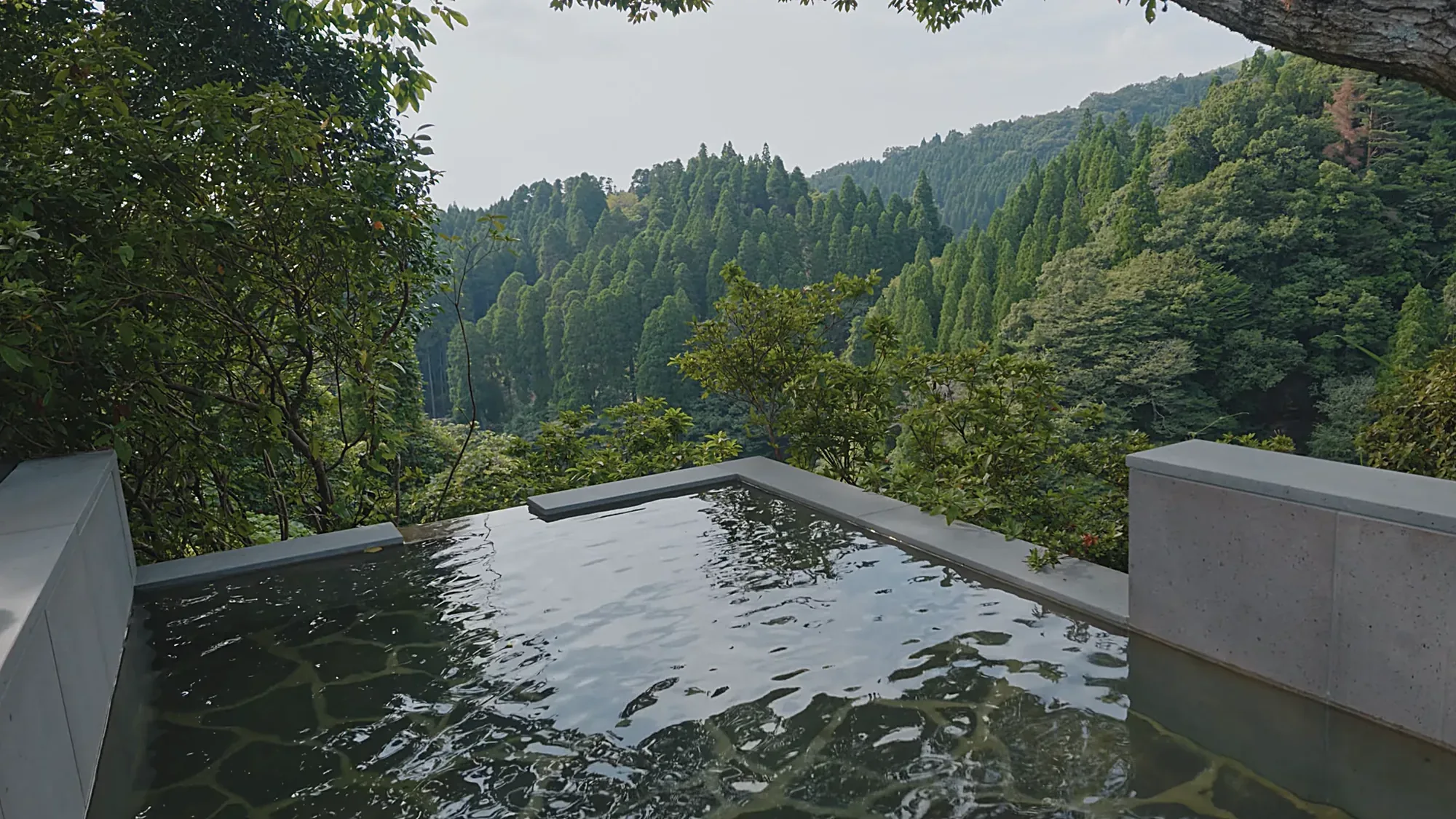
The approach is part of the bath.
In late autumn the maples turn above the pools — colour here peaks late October to mid-November, later than the lowlands because the village sits at roughly 700 m (2,300 ft), per the ryokan association — and in winter the pools steam hard against the cold. The walk out along the river path is part of the bath, and the inn's shuttle covers it when weather argues.
If you take a single bath in Kurokawa, take it here. The only honest criticisms are popularity, which the size of the grounds mostly absorbs, and distance, which is fifteen pleasant minutes you should simply budget for. Overnight rooms at Yamamizuki are among the village's most coveted; see our where to stay guide.
One sourced footnote that matters for planning: Yamamizuki (山みず木) is run by the same group as Shinmeikan and the Miyama Sansō — the Fuji Resort Group — so a day-tripper weighing the group's baths is really choosing between the wild river setting here and the historic cave in the centre. If you can reach only one and the weather is kind, this is the one.
And for the practical record, sourced from the inn's own site and the association's inn page: Yamamizuki bathes on 単純温泉 (simple, weakly acidic) water across five named pools, the Yūkoku-no-yu and Mori-no-yu among them; it offers day-use bathing at ¥600 (about US$4) from 10:00 to 15:00, a narrower window than the tegata's own hours; and it keeps twenty-one rooms in nine types with a free pickup from the bus stop — the shuttle to ask about rather than assume.
The approach is part of the bath
Kurokawa's baths begin before the water, and the documented approaches deserve their own accounting, because they decide who can comfortably reach what. The gentlest documented approach in the famous set is the village centre's: Yamabiko, Fumoto, Shinmeikan and Ikoi all sit on or near the flat of the lanes, their baths a corridor and a changing room from the street, which is why the centre cluster is the default recommendation for older bathers and anyone pacing their knees.
The most beautiful documented approach is Yamamizuki's women's side, the walk down a riverside forest path to Mori-no-yu that the inn's own page describes, an approach that is half the bath's fame and, equally, a path with weather on it.
The river-adjacent pools generally, at Yamamizuki and along the gorge, involve steps down toward water level, stone underfoot, spray in the cold months; nothing about them is difficult for the able and nothing about them is barrier-free either, and the association's own accessibility answers route through its enquiry form for exactly this reason. The climbing approach belongs to Igozaka and the high-ground houses, gradient as the price of vantage.
Reading approaches honestly yields the day's best piece of matchmaking: put the party's least mobile member's needs first when choosing the triad, because a bath anyone can enter beats a famous one somebody had to skip, and the centre cluster exists to make that trade painless.
The soundscapes, bath by bath
Close your eyes in each documented format and the village sorts itself by ear, which is a real planning axis for bathers who know what they want their head to do. The riverside pools are the loud ones, in the best sense: Yamamizuki's pair sit against running water, and the stream's white noise erases conversation, footsteps and thought at roughly equal rates, which is why the format suits bathers who come to stop thinking.
The Senninburo's pond scale is the quiet inverse, a big still surface where the loudest event is steam moving and the occasional distant bather, a soundscape for the meditative and the eavesdropping-averse alike. The cave is its own acoustic: drip, breath and water-slap under rock, close and amplified, nearer to a chapel than a spa, and genuinely startling the first time the tunnel swallows the outside world.
The tachiyu adds the body's own sounds, the deeper wading register of chest-high water. The sento pair echoes the way tiled rooms do, neighbourly and bright. And the whole village adds its evening layer, geta on stone and the river under the bridges, between every soak.
Choose by ear and the triads rewrite themselves: a loud-quiet-close sequence, river then pond then cave, is as deliberate a composition as any built on scenery, and on a misty day when the views have gone, it is the better one.
Shinmeikan: the cave that started everything
Shinmeikan is the village's origin story made bathable. In the lean postwar years its third-generation owner dug a bathing cave into the rock behind the inn by hand, over about three and a half years, betting that atmosphere would bring travellers a railway never would. The village copied his conviction, then the cooperative-bath idea, and modern Kurokawa is the result.
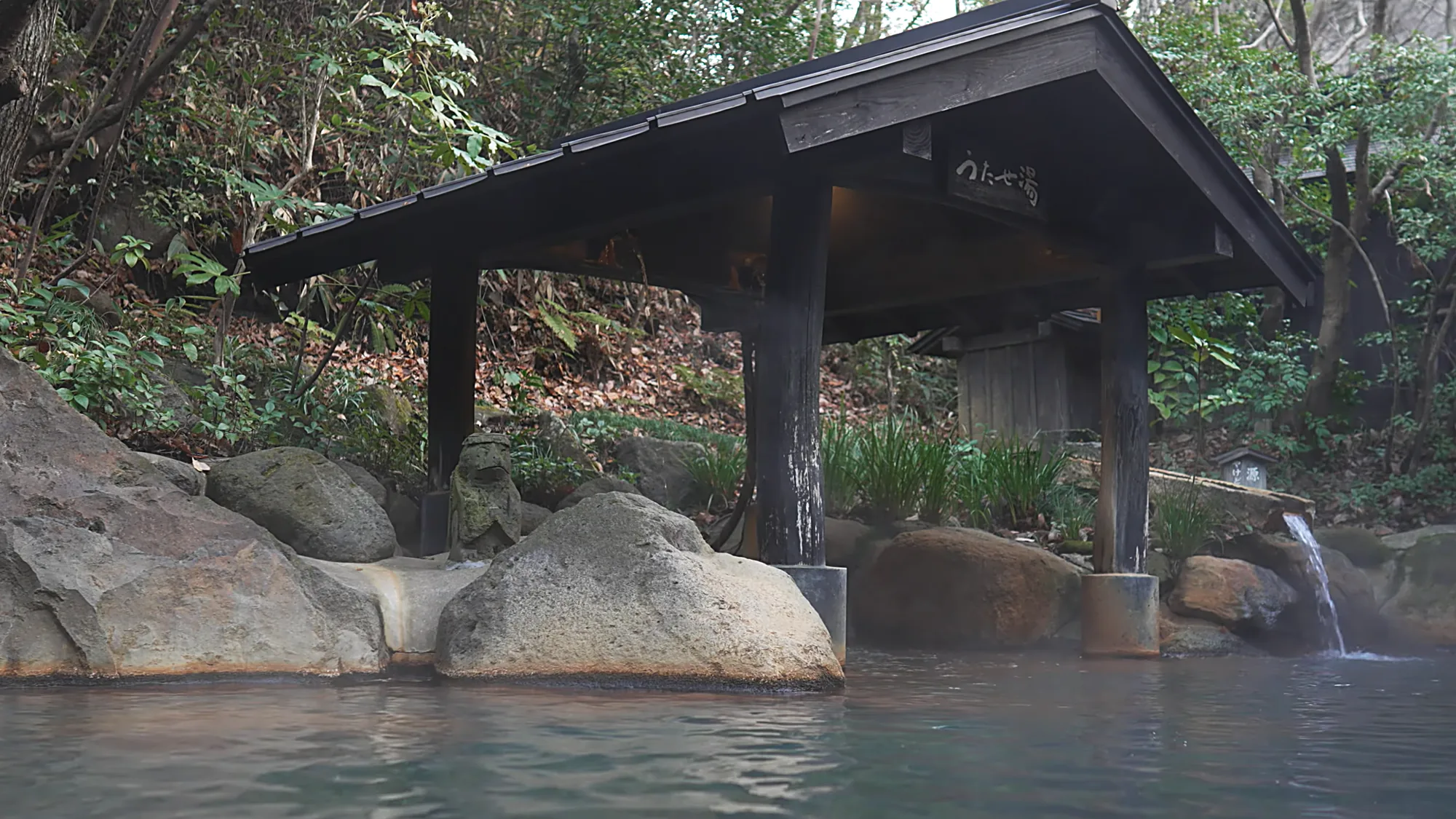
The cave was dug by hand. Everything since followed from it.
The cave bath (dōkutsu-buro) remains the draw: a low, dim tunnel of hot water reaching deep into the hillside, mineral-streaked, more chapel than spa. It is genuinely unlike anything else in the village and slightly unlike anywhere else in Japan. Claustrophobes should know the ceiling is low and the light is honest about it. The inn also keeps riverside rotenburo in the village center, so a Shinmeikan stamp buys variety as well as history. Sections of the cave have traditionally been mixed bathing with separate women's areas and hours; check the posted arrangements at the door. verify current bathing configuration.
The making of the cave is the most literal founder-effort story in Japanese onsen, and it is now confirmed at source rather than borrowed from a blog: the inn's own history records that its third-generation owner dug the tunnel by hand, aged twenty-four, with a chisel, over about three and a half years, in the lean stretch after the 1964 Yamanami Highway boom faded and left the village stranded.
We do not print his name, because neither the inn's history nor the spa association's listing carries it, and this project has shipped a fabricated person once already. The design idea he left the village — 「あるがままの自然」, nature as it is — is why every bath on this page looks unbuilt rather than landscaped.
One practical note that surprises first-timers: photography in the rotenburo is prohibited in principle across the whole village, an association rule and not this inn's, so the cave is a thing you carry out in memory, not on your phone.
Yamabiko Ryokan: the Senninburo, for people who like room
Yamabiko's claim is the village's largest rotenburo, the Senninburo, the "thousand person bath," which is village hyperbole for a broad pond like pool where even a holiday crowd spreads into privacy. The setting is gardenish rather than wild, generous and open, with the spaciousness doing for introverts what the cave does for romantics. On cold mornings the steam coming off that much surface area is a weather system of its own. Families rate it the easiest of the famous baths, and it pairs naturally with a stroll of the village center.
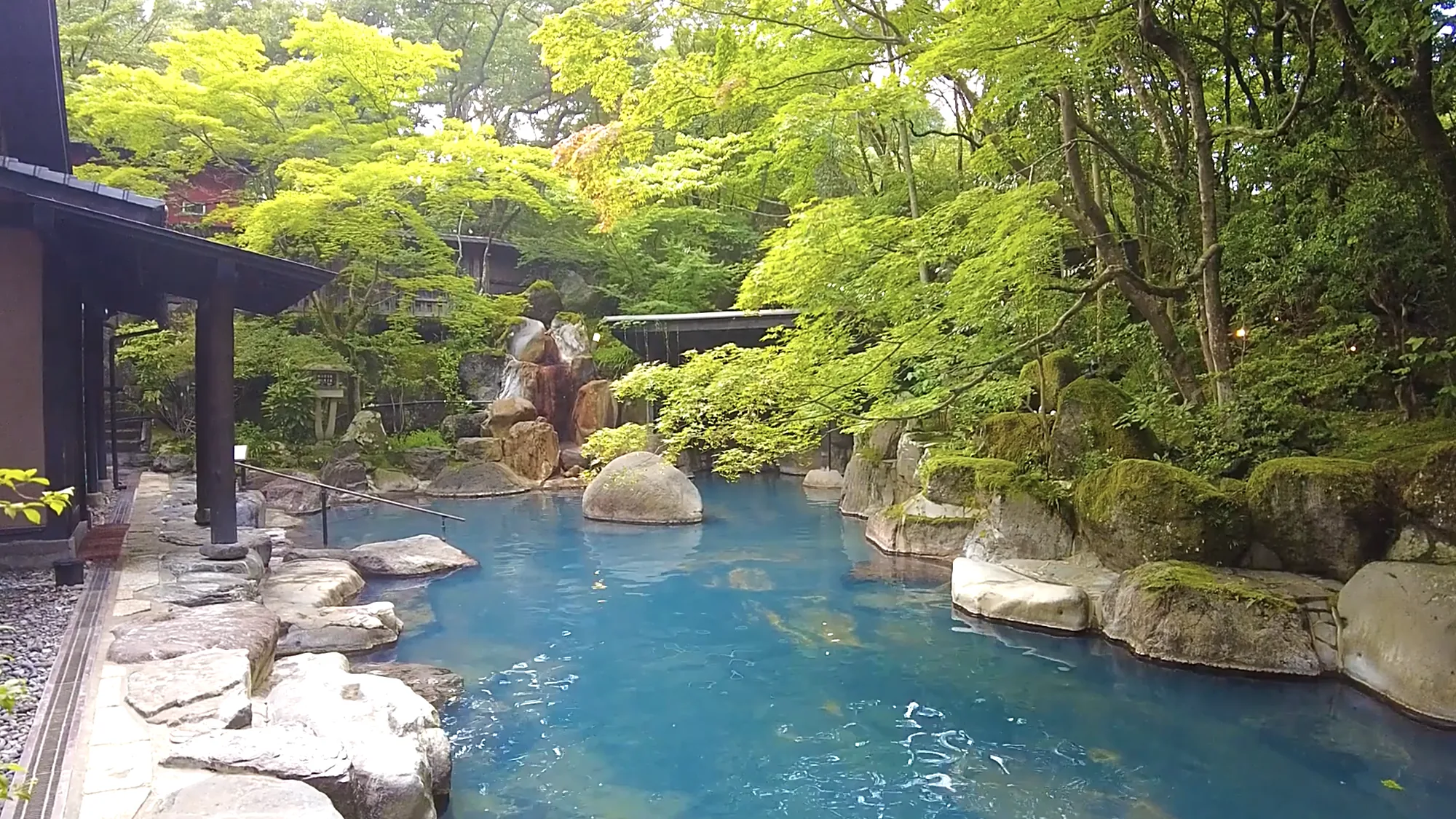
Senninburo means a thousand-person bath. It is not quite that, but it is close.
The "largest rotenburo in Kurokawa" billing is not our adjective — it is how the inn is described in the spa association's own member listing — so if the point of your third stamp is simply room to float without negotiating elbows, this is the sourced answer to that.
The trade is scenery: the Senninburo is a landscaped pond rather than a wild riverbank, which is exactly why families and anyone uneasy about the more theatrical baths tend to rate it highest. Go earlier rather than later. A pool this size is the one most obviously thinned or crowded by the day's timing, and it sits close enough to the centre that it fills first.
Ikoi Ryokan: the Bijin-yu, for people who care about the water
Every onsen town claims skin softening water; Kurokawa's most convincing case is at Ikoi. Its Bijin-yu, the beauty bath, is fed by a source whose slightly sulfurous, mineral-rich water leaves a noticeable silkiness, and the inn takes the bathing itself seriously across its dozen-odd bathing spots per-inn features verified before print.
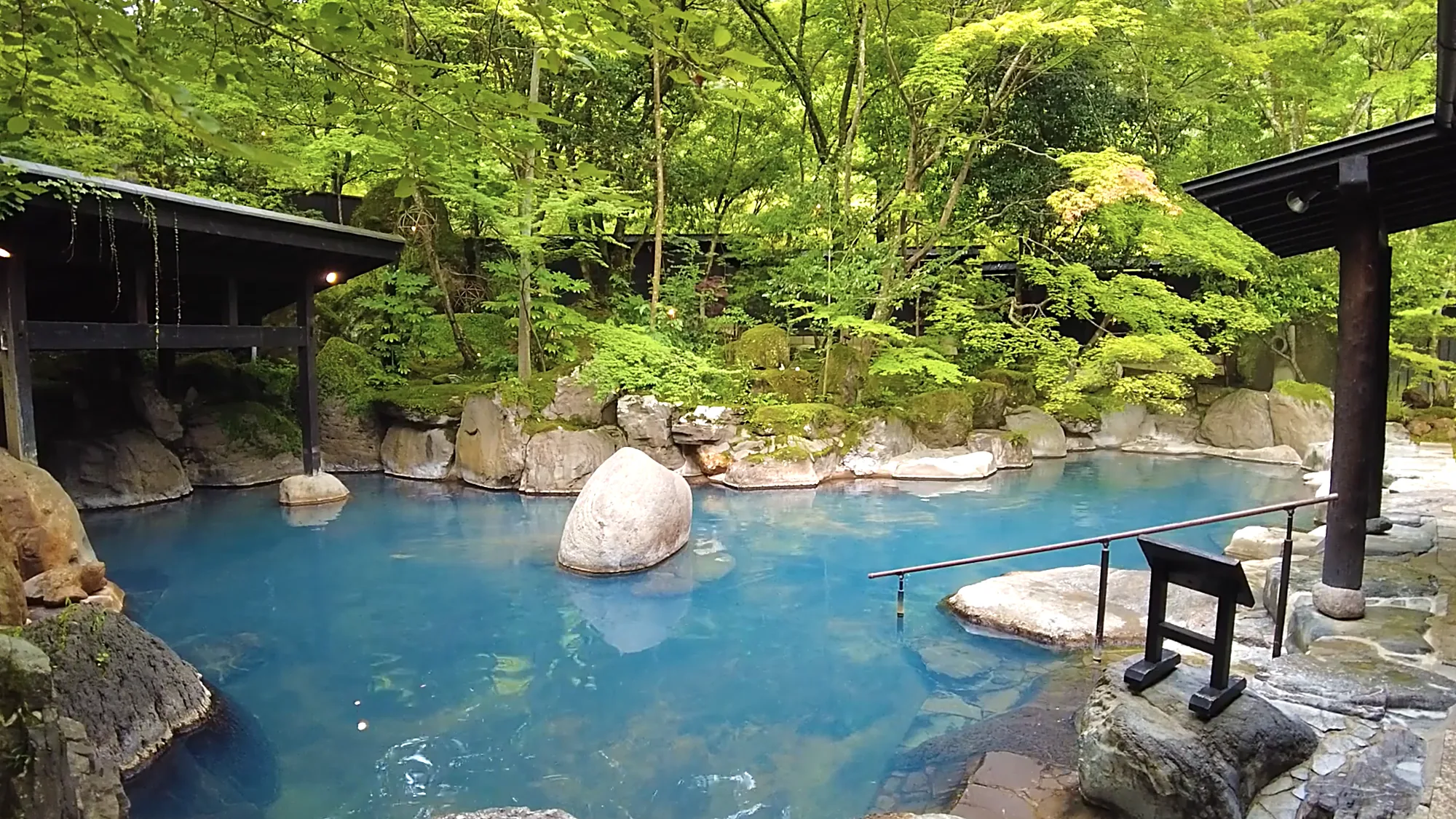
Bijin-yu, the beauty water. The claim is the inn's, not ours.
A correction our verification pass forced: the village's confirmed standing-depth soak (tachiyu, 1.5 m / 4.9 ft) is at Fumoto Ryokan, per the spa association's member listing — Fumoto runs eight baths including a sauna, and its deep tub is the verified leg-stretcher; Ikoi may keep one too, and that claim waits for Ikoi's own materials. The setting is intimate, central village rather than wilderness, and the point here is the substance over the scenery. Bathers who plan around water quality should put Ikoi first and argue later.
What we can source about Ikoi is genuinely strong even setting the beauty-bath billing aside: the ryokan runs thirteen baths, and it is the only inn in Kurokawa on the 日本の名湯秘湯百選, the standard "hundred famous and hidden hot springs" list, per the association's own inn directory. The Bijin-yu name and the skin-softening claim come from the inn's tradition and from visitors, not from a primary we have read, so we flag them and let the verified facts — thirteen baths and a national listing, in a central, unshowy setting — carry the recommendation.
Worth a stamp in the right mood
Fumoto Ryokan earns its own line, because it holds the village's one genuinely unusual format: a tachiyu, a standing bath 1.5 m (4.9 ft) deep that you soak in upright, confirmed in the spa association's member listing along with the fact that Fumoto runs eight baths in total, one of them a sauna. If your first two stamps went to scenery, spend the third on novelty here — there is nowhere else on the circuit to stand chin-deep in hot spring water.
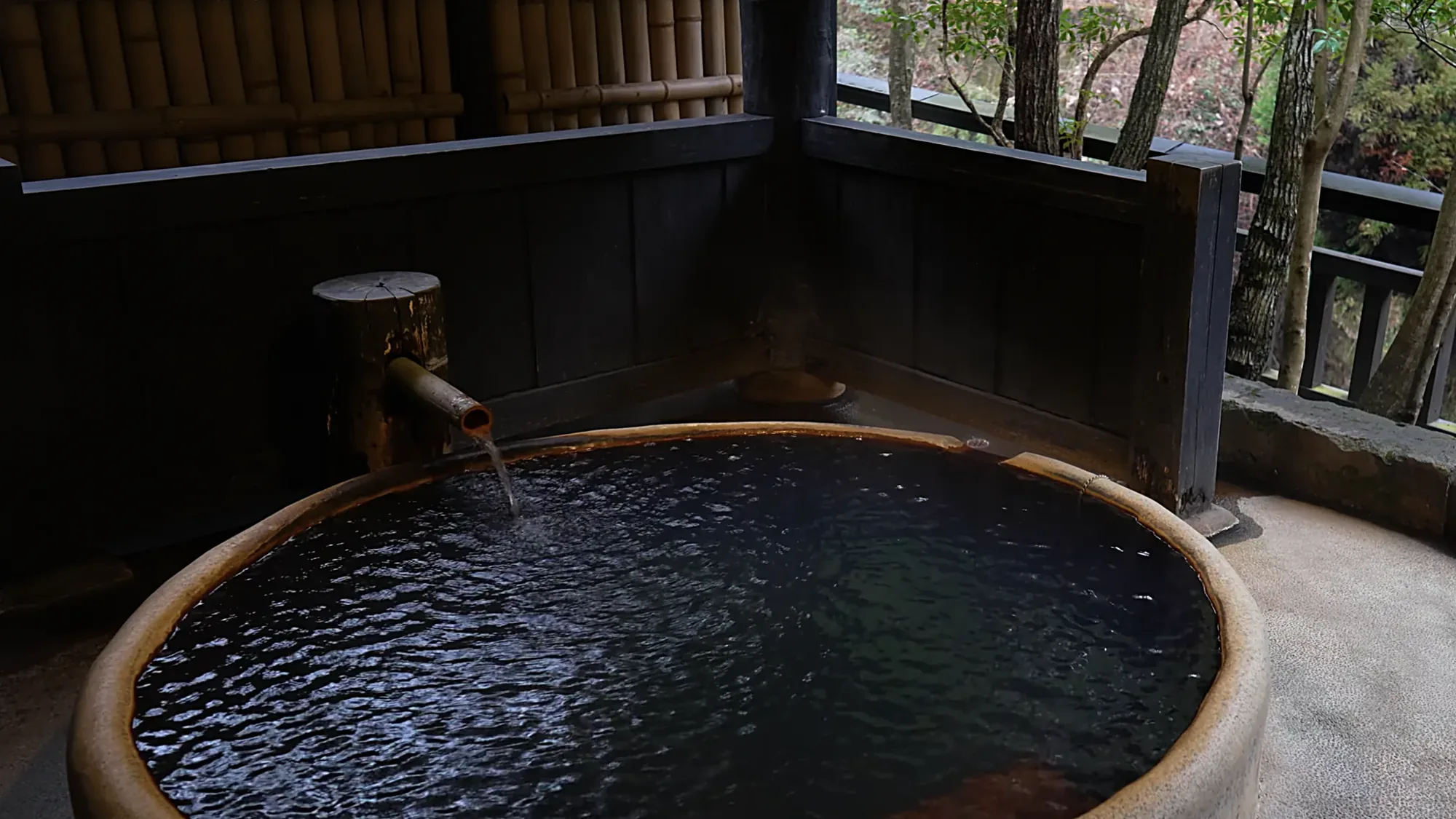
Smaller baths, and sometimes the better hour.
Kurokawa-sō keeps refined baths in a calmer corner of the village for those allergic to any crowd; the association singles out its 屏風岩 (byōbu-iwa) bath, framed by a folding-screen rock face, as the view worth coming for. It is the quiet-good choice rather than the dramatic one.
Wafū Ryokan Misato is the sourced answer for anyone who came to Kyushu wanting the postcard milky water: the association describes its bath as 乳白色したイオウ泉, a milky-white sulphur spring — the exception in a village whose central-hamlet water is mostly clear simple and chloride spring. If you want sulphur and colour, Misato is where the association points, not the more famous names.
Okunoyu, at the quieter eastern end, sits in roughly 2,000 tsubo (about 6,600 m² / 1.6 acres) of riverside grounds per its member listing, and rewards visitors already walking that direction; some of its baths are mixed, with women-only hours reported around 8 to 10 pm, so read the posted arrangements before you undress .
And Jizō-yu, the plain public bathhouse in the village centre, is not on the tegata at all: it is a 共同浴場, the locals' bath, a few hundred yen in the box, no view, all sincerity — and it is the one bath tied directly to the village's founding legend, standing where the headless substitute-Jizō asked to be enshrined and the hot water first ran. It is a fascinating counterpoint if you want to see what bathing here looked like before the village became beautiful. verify Jizō-yu current fee and visitor policy.
The public floor: Jizo-yu and Ana-yu, properly
The village's two communal bathhouses deserve more than the aside most guides give them, because they are the circuit's living baseline. Jizo-yu and Ana-yu are kyodo-yokujo, the town's own baths, tied by the government designation profile to the founding legend itself; they stand at the humble end of the map, near the hall where the headless Jizo is enshrined, and they pour their own water on their own terms, coins in a box, outside the tegata scheme entirely.
What the record does not carry, we do not print: current fees, hours and visitor policies were not captured, so treat both as ask-first doors and expect nothing resembling the inns' polish, no attendant, minimal washing provision, the bath as pure function. What they offer instead is perspective.
Every polished rotenburo in the scheme descends from bathing like this, farmers and neighbours in hot water because it was there, and ten minutes in the town's own bath recalibrates everything the famous pools then show you. The etiquette is the standard set plus humility: you are furthest here from being a customer and closest to being a guest in the town's kitchen.
For the bath-collector, the pair completes the taxonomy; for everyone else, they are the shortest possible history lesson in the village, administered at bathing temperature.
The stamp not taken: baths worth planning a second visit around
Every triad leaves twenty-two doors unstamped, and the honest close to a ranking page is an account of what the record says you have not yet seen. A first visit built on the classic set, cave, river, pond, leaves the entire chemistry wing untouched: Misato's colour-shifting white and Ichinoi's drifting yunohana wait for trip two, and they are, by the record, the most visually distinctive waters in the village.
It leaves the tachiyu's standing format untried, and with it the particular full-body evenness the depth delivers. It leaves Kurokawa-so's composed rock-face view, the quiet grounds of Okunoyu's eastern end, the sento pair's unvarnished baseline, and, at inns whose baths the record does not individually document, twenty-odd pools that the daily board rotates through the scheme without any English page ever profiling them, the genuine unknowns of the circuit.
This is the arithmetic the six-month validity was built for: three stamps sample the village, they do not survey it, and the disc's patience converts everything above from a list of misses into a queue. Plan the first triad for contrast, as this page urges throughout; then let the second visit's triad be built from this section, the formats and waters the first one taught you to want. The village's best-kept secret is not any single bath. It is that the ranking never ends, and the record, honestly read, says the unranked remainder holds real prizes.
What a day-use bath expects of you
Day-use bathing here runs on a short list of expectations, most of them the association's own published rules rather than etiquette we invented. The baths supply almost nothing to a bath-hopper: no towel, no soap, and no shampoo at most rotenburo, so the unofficial kit is a small towel, your own soap if you want it, and coins for any single-entry boxes. The village even asks that you use low-impact soap and shampoo — Kurokawa regulates what is used in its onsen out of concern for the stream it sits above, the same instinct that took the signs down.
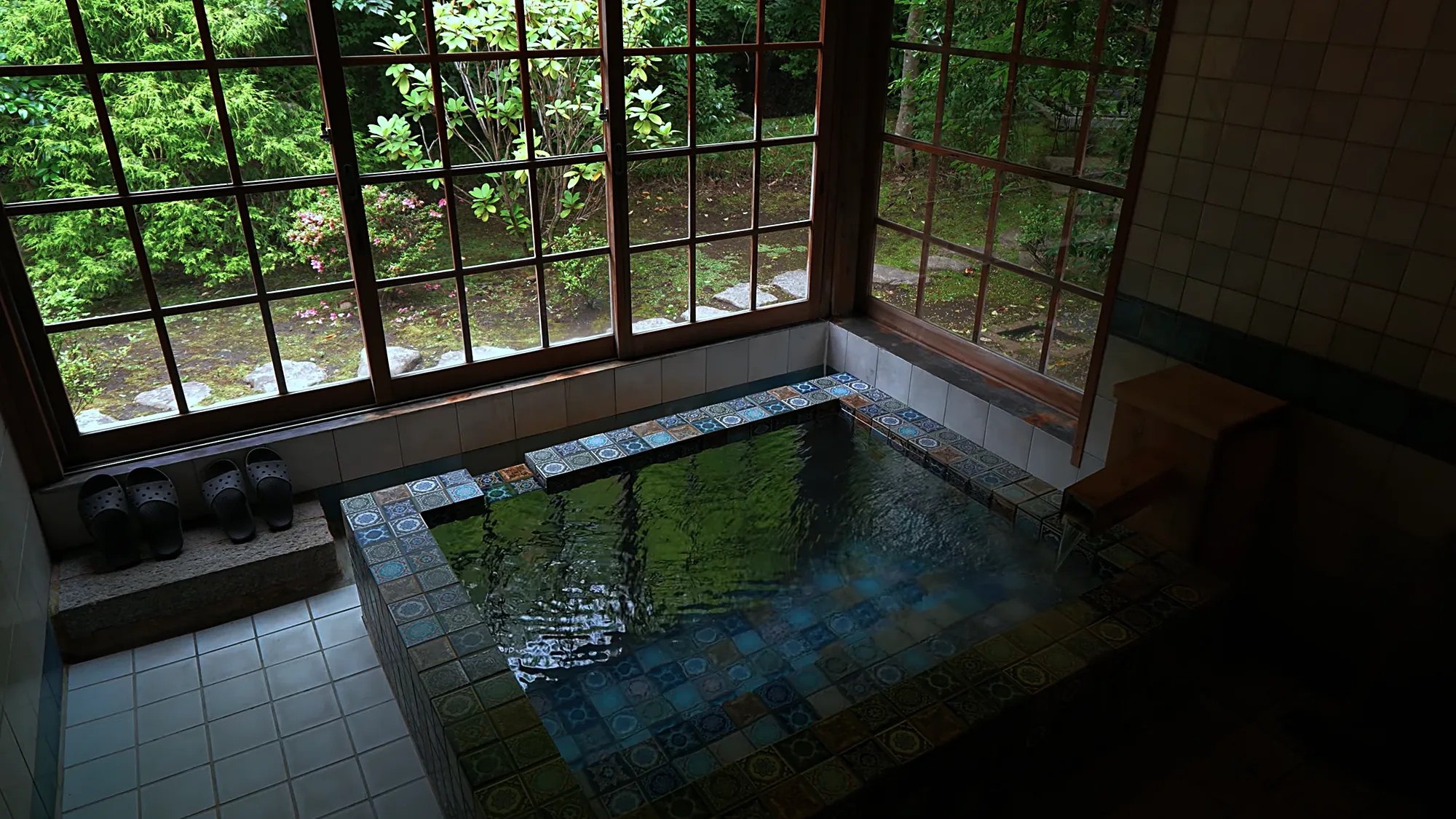
Shoes off, slippers at the door, and nothing in the water but you.
The association's visitor code, published in its FAQ, is worth reading once: the onsen town is non-smoking outside designated areas; drones need prior permission; do not pick plants or foliage, and do not enter private land; parking is limited and roadside parking is not allowed; do not put your towel in the water; and entry may be refused when a bath is crowded.
Photography in the rotenburo is prohibited in principle, which is why the famous baths are strangely absent from most honest visitors' camera rolls. None of it is heavy-handed in practice — it is the machinery that keeps a village of shared baths pleasant — but a first-timer who knows it arrives looking like a regular.
One more point the layout of the village forces on you: you are bathing inside working inns, threaded together by public lanes, so between baths you walk the streets in your inn's yukata with a small towel in hand, and the ground is hilly. Three hot soaks and two climbs in an afternoon is genuinely tiring, which is the real reason the association's design spec is three and not five.
The turn of the day: what day-use windows really mean
One documented schedule explains the whole circuit's daily rhythm, and reading it correctly will spare you the circuit's commonest disappointment. Yamamizuki publishes its day: bath-hoppers from 10:00 to 15:00, staying guests from 15:00 to 22:00 on the rotenburo, with the private bath running its own clock and reverting to guests' indoor use at 21:00.
That is one inn's arithmetic, but it is the pattern in miniature village-wide: the scheme's 8\:30-to-21\:00 window is the outer envelope, inside which each house draws a line across the afternoon where the bath's constituency changes from visitors to residents.
The strategic consequences: the tegata's prime hours run from opening to mid-afternoon, and any stamp planned after 16:00 is a gamble against a line you cannot see from the lane; the emptiest visitor bathing is the first ninety minutes, before the buses; and the loveliest hours at every famous bath, dusk and night, are structurally reserved for the people sleeping upstairs, which is not a flaw in the system but its entire sales pitch for the overnight.
When a door disappoints you at five o'clock, the correct reading is not that the village closed early; it is that the village keeps its evenings for its guests, and has been telling you so, in schedule form, all day.
The women's circuit, documented
Bath guides habitually describe the men's side and generalise, so here is what the record actually documents for women bathing Kurokawa. At Yamamizuki, the women's provision is, if anything, the richer: the Mori-no-yu rotenburo reached down its own riverside forest path, a dedicated women's indoor bath attached to it, the second women's indoor Fujin-no-yu with its high ceiling and old-house atmosphere, and, after 21:00, the Saotome kashikiri reverting to women's-only indoor use for staying guests, four documented spaces to the men's two.
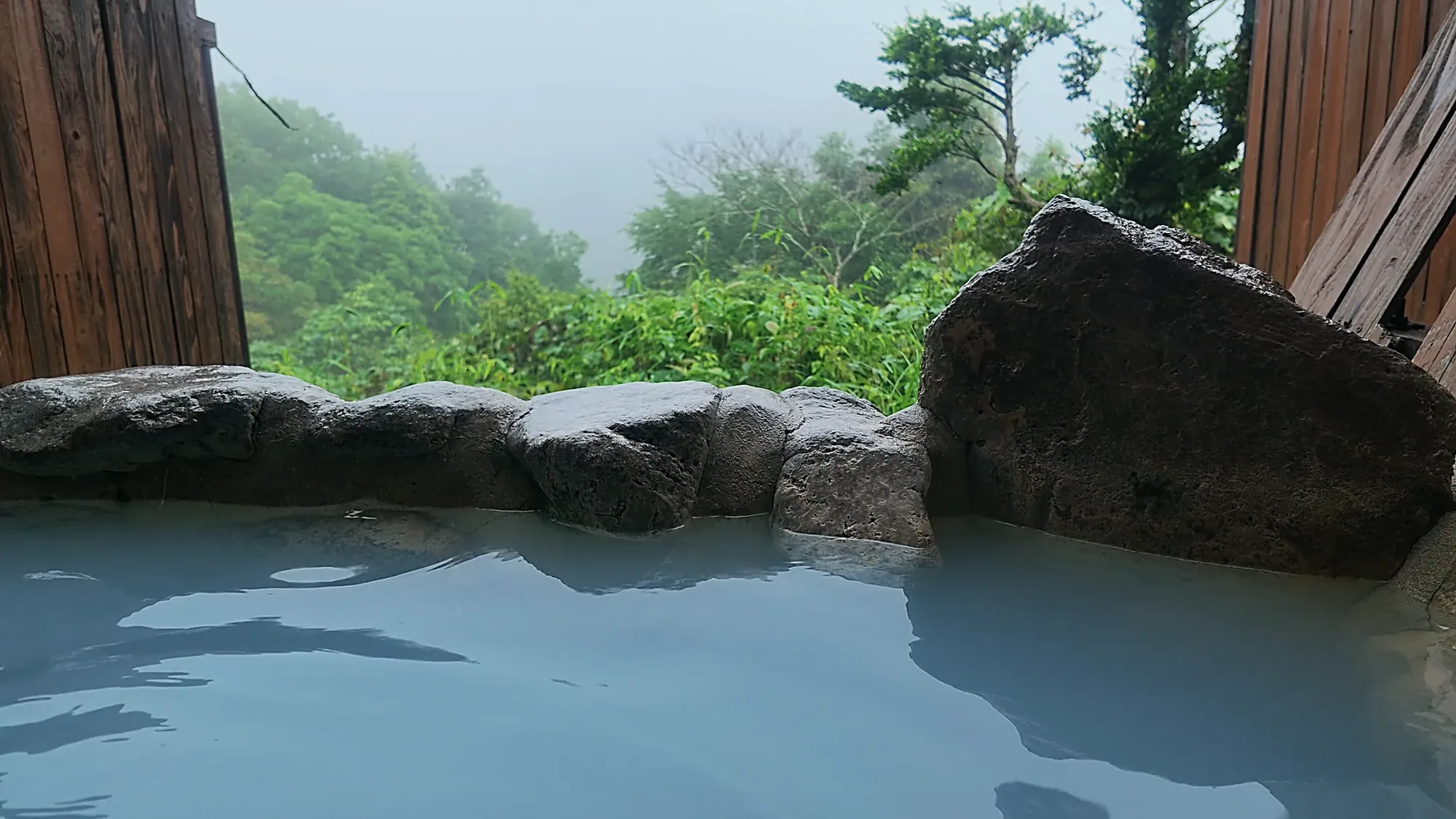
The women's side is not the smaller side here, whatever the photographs suggest.
At the mixed baths, the protections are the documented architecture: separate women's changing rooms opening onto shared pools, modesty wraps commonly provided, and posted women-only hours, with Okunoyu's evening window the example our sources carry, still flagged for confirmation. Across the ordinary separated baths, assume rotation: many inns swap their men's and women's sides by day or time so both see each setting, and the posted signs at the door, not memory or a blog, say which side is whose this afternoon.
Practicalities the circuit teaches: long hair ties are the one item the rustic rotenburo never supply; the wrap, where provided, is worn in the water at mixed baths and nowhere else; and any door's arrangement is answerable at the desk in one gesture.
The honest summary is that Kurokawa's record, where it documents gender at all, documents provision rather than exclusion, and the village's most photographed women's bath, the forest path to Mori-no-yu, is arguably its single most beautiful approach to any water.
Night bathing, for those who earned it
The day-use turn hands the village's evenings to staying guests, and the night circuit they inherit deserves its own paragraph, because it is the least documented and most remembered bathing in Kurokawa. What the record establishes: each inn's own guests bathe on house hours that outrun the 21:00 day-use close, Yamamizuki's rotenburo running to 22:00 for guests and its indoor baths through the night hours to 10:00, the documented example of a pattern the whole village shares in outline.
What the record leaves to experience: hot water in full dark, the river louder for being invisible, steam made visible only where lantern light crosses it, and, in the illumination seasons, the walk back through lanes still lit at an hour that belongs to nobody but the sleeping village and you. Night rules are the day's plus one: quieter still, since guest rooms stand nearer than they seem, and the photography ban needing no enforcement in the dark.
The strategic note for planners is simply that this circuit cannot be bought with stamps; it is the room key's exclusive, the thing the whole day-use architecture exists to protect, and the single strongest argument on this page, a page about baths anyone can visit, for becoming someone who does not have to leave.
If you would rather book a bath to yourself
The tegata circuit is public bathing — shared pools, communal changing, the occasional mixed section — and it is not for everyone. Kurokawa's answer is that private open-air baths (kashikiri) are unusually easy to find here: many inns rent a rotenburo by the hour to guests and, at some inns, to day visitors, typically in the ¥1,000 to ¥2,500 band (about US$7 to 17) per visitor reports , and some guest rooms come with a valley-view open-air bath of their own — Kōnoyu keeps nine such rooms, the village's entry point for a private rotenburo you do not have to share.
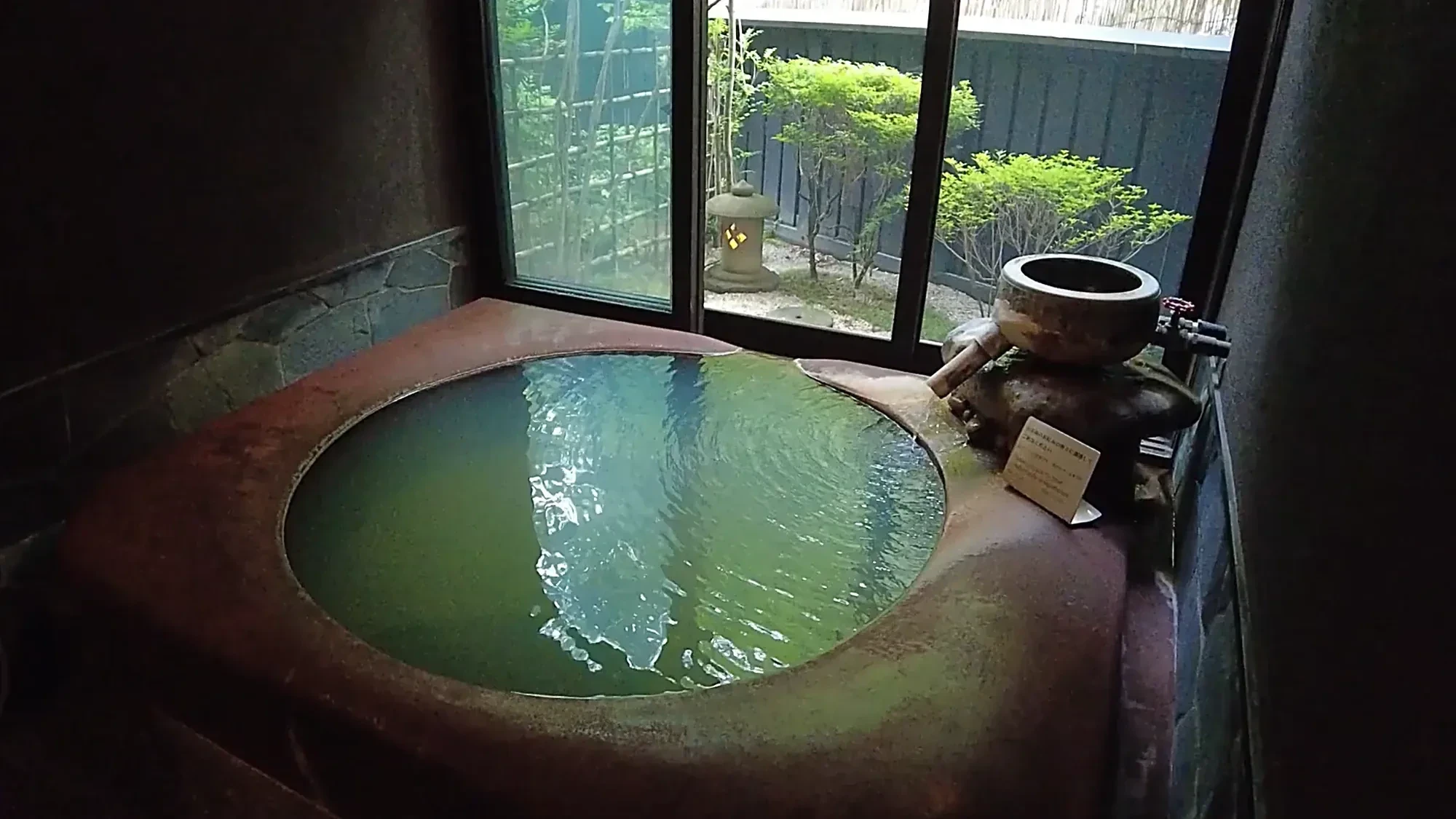
Kashikiri: booked by the hour, door locked.
For tattooed travellers this is also the practical way in: rather than negotiate each inn's public-bath policy, a booked kashikiri sidesteps the question entirely. The mechanics, the etiquette and the per-inn options belong to our private and mixed baths guide; treat this as a signpost, not the map.
When to come for the baths
The baths are good year-round, and the reason is the water: the source runs hot enough that inns add water to cool it, so there is no low season for temperature. What changes is the frame around the pool. Autumn colour peaks late October to mid-November, later than the lowlands because the village sits near 700 m (2,300 ft) and runs three to five degrees Celsius cooler; that fortnight is the most contested booking of the year.
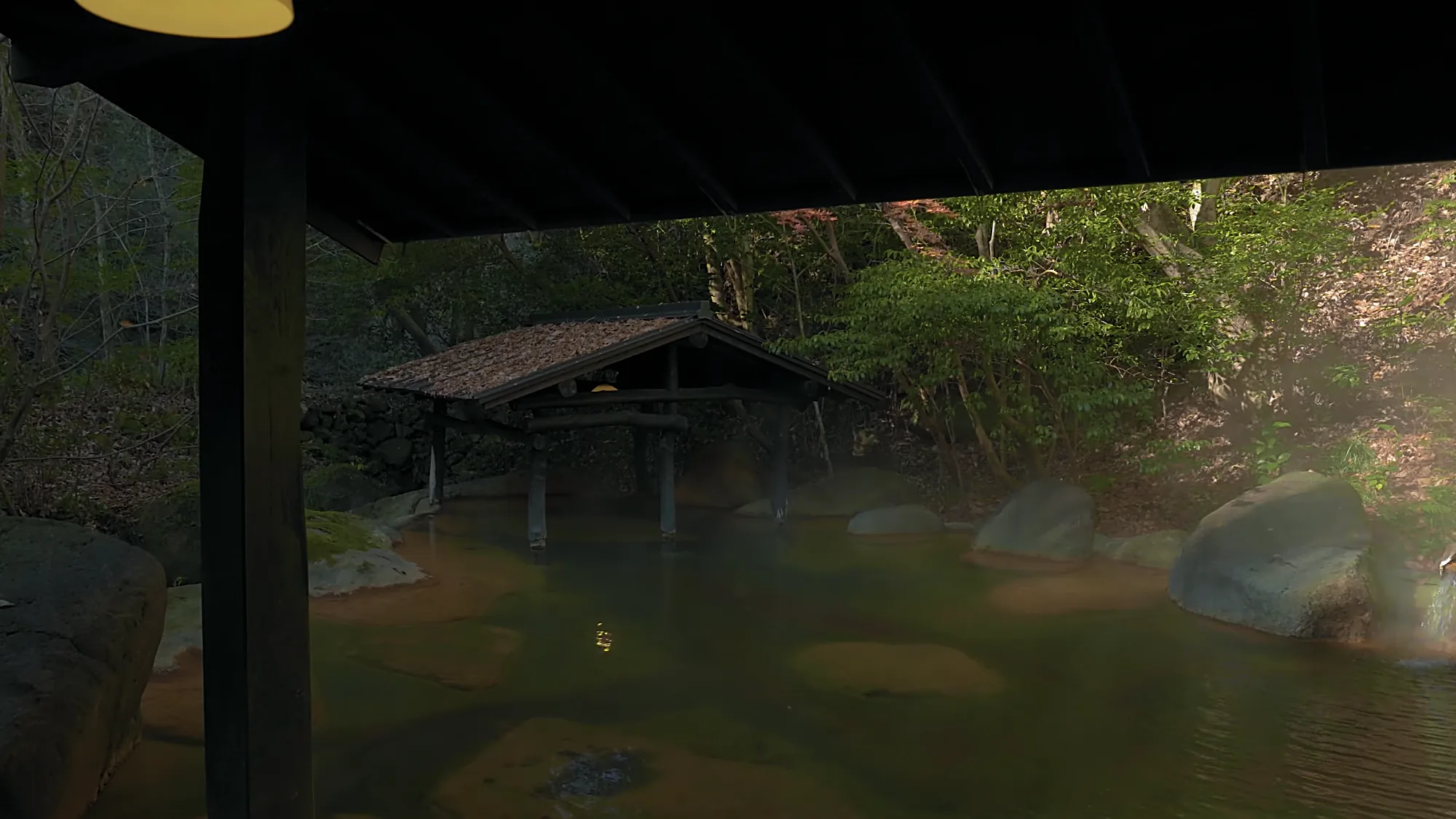
After the day-trippers leave, the village belongs to whoever stayed.
Winter is the connoisseur's pick — an open-air bath at bathing temperature against near-freezing mountain air is the entire argument for a rotenburo — and it doubles as the season of Yuakari, when the lanes fill with handmade bamboo lanterns after dark, a walk built for the gap between an afternoon and an evening soak. Spring and early summer are the quietest.
Our best time to visit guide carries the month-by-month detail; for bathing specifically, the honest answer is that the water does not keep a bad season.
The bath for the weather you actually get
Highland weather edits the circuit daily, and the formats above convert directly into a weather strategy. Rain, the commonest edit, divides the field: it flatters the enclosed and connected formats, the cave becoming fully weatherproof theatre and the indoor-to-outdoor architecture letting you undress dry, while it merely dampens the walk to the exposed riverside pools, which remain bathable, rain on hot water being its own minor pleasure, but punish the approach and the towel.
Wind is the view baths' enemy and the cave's irrelevance; on the gusty days the caldera occasionally sends, choose enclosure or depth, the tachiyu's chin-deep format holding warmth that a surface skim would strip. Snow, when the altitude grants it, inverts everything, the exposed formats becoming the prize and the enclosed ones a waste of the day; the winter page carries that circuit.
And heat, summer's edit, favours water over setting, the shaded forest pools and the morning bell over any midday exposure. The board at Kaze-no-ya reports closures, but it does not report comfort; that judgement is yours, and the format taxonomy is the tool.
A visitor who re-aims by weather rather than pushing the original list through a squall gets a better village and, not incidentally, has obeyed the circuit's oldest rule, which is that the day, not the plan, is in charge.
How to build your afternoon
Geography suggests the order. A sensible classic: start at Yamamizuki when baths open and crowds are thinnest, walk the river back into the village for Shinmeikan's cave before lunch, eat somewhere on the lanes (our Kurokawa food guide lists the association's own directory of places to eat, so you are choosing from sourced options rather than a blogger's favourite), then close with Yamabiko's space or Ikoi's water mid afternoon, before the inns turn toward their evening guests.
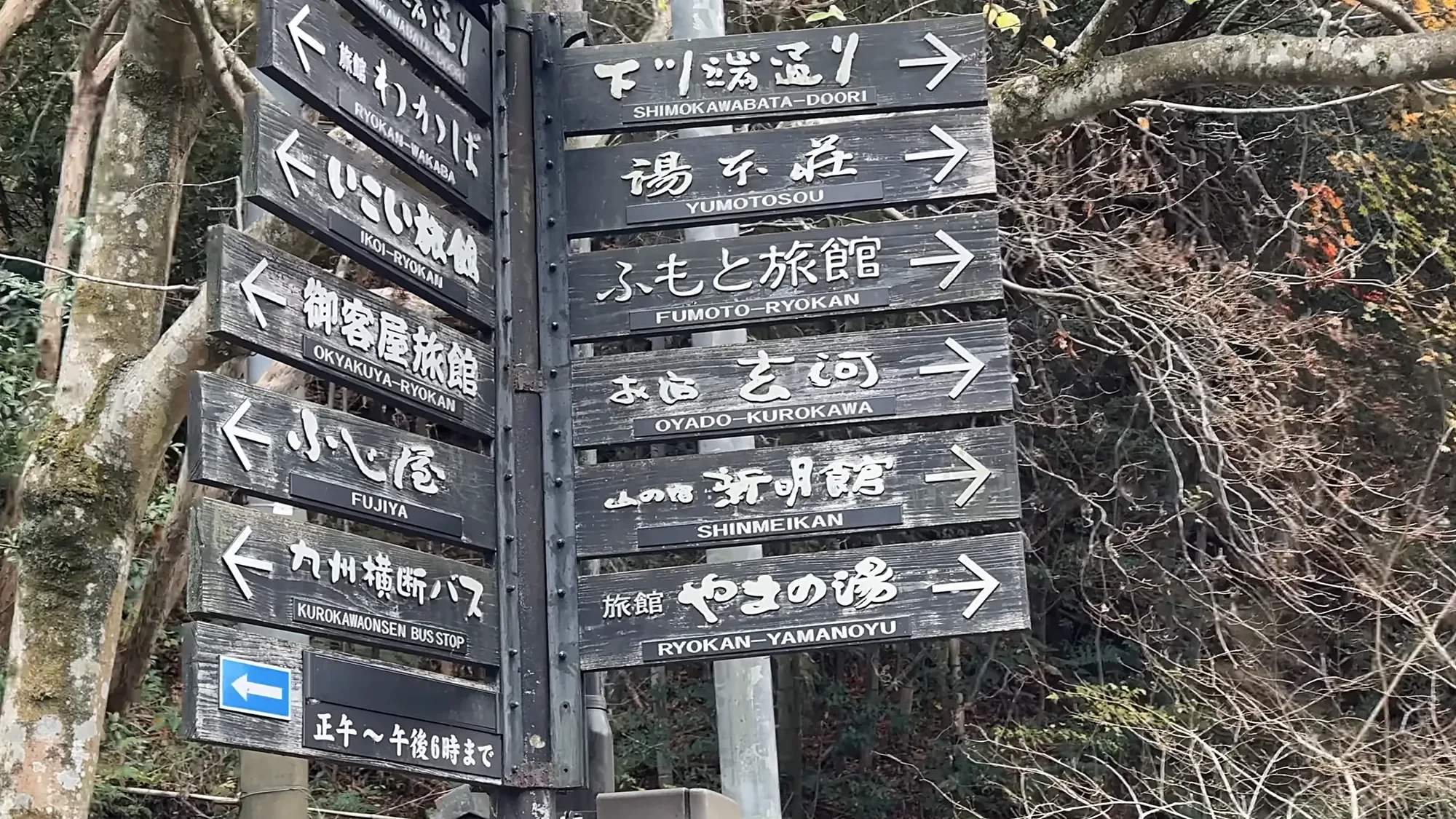
Plan the walk, not just the baths. The lanes are short but they climb.
Check the daily open-bath board at the Kaze-no-ya information center before committing; cleaning closures reshuffle the plan more days than not. Carry your small towel between baths, drink water, and accept that three serious soaks in an afternoon is an athletic event wearing a bathrobe.
If you are staying the night — and the village is built for exactly that — the better rhythm spreads the pass across the day the village keeps: an arrival bath in the afternoon, a single-seating kaiseki dinner, the lantern lanes after dark, then a dawn rotenburo before the coaches arrive and a final stamp before the midday bus out. Two baths in the afternoon and one the next morning is the connoisseur's pacing, and it is exactly why the tegata's six-month, use-it-later validity matters: no one should be racing three stamps against a bus timetable.
Pacing a multi-bath day
Three serious soaks in an afternoon is a physical undertaking, and the circuit rewards bathers who pace it like one. The working rules: eat something before the first bath, not after the third, because hot water on an empty stomach compounds; keep the individual soaks modest, ten to fifteen minutes in the water rather than heroic simmering, since the circuit's pleasure is variety, not endurance; drink water at every changing room, the quiet habit that separates the bathers who feel wonderful at dinner from those who feel poached; and honour the intervals, twenty minutes of walking or sitting between baths, which the village's geography conveniently enforces and its benches and cafes exist to furnish.
Respect the signals: light-headedness on standing, a heartbeat you can hear, skin that has stopped flushing and started complaining, are all the body's board at Kaze-no-ya, posting an early closure, and the correct response is the same, re-aim, sticker instead of stamp, bench instead of bath.
The register of official contraindications on our waters page covers who should not attempt a multi-bath day at all; for everyone else, the summary is that the tegata's three stamps are a well-designed maximum, the village's distances are a well-designed rest cycle, and a bather who finishes the day wanting a fourth has paced it perfectly.
The honest verdict
Yamamizuki is the best bath in Kurokawa and it is not particularly close. The interesting argument is for the other two stamps, and it comes down to temperament: history and drama at Shinmeikan, space and ease at Yamabiko, substance at Ikoi. There is no wrong answer, only a wasted third stamp spent on a bath too similar to your second.
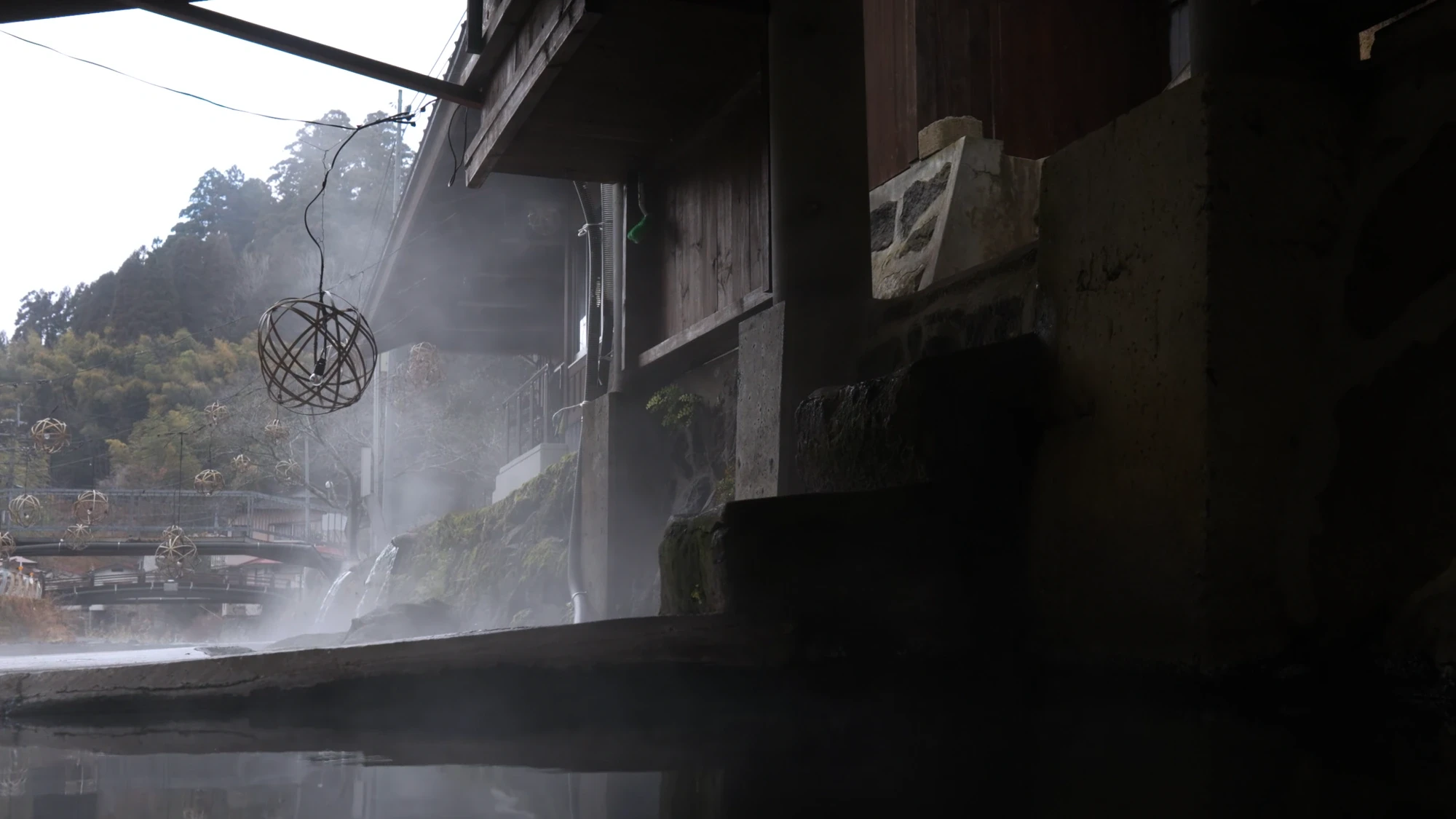
Three baths is the right number. A fourth is a queue.
Choose for contrast, check the board, and — by the custom visitors report, which we have not yet confirmed on the association's own pages — retire your spent tegata at the village's Jizō hall on the way out: the headless substitute-Jizō the village tells its founding story about, still enshrined at its centre.
How this page ranks, and what it refuses to
A ranking is only as honest as its method, so here is this one's, stated plainly. Every named bath fact on this page traces to the spa association's member listings, the inns' own pages, or the ryokan association's materials: the cave's hand-dug record, the Senninburo's largest-in-the-village billing, the tachiyu's depth, the rock face, the colour-changing and yunohana waters, the room-and-bath schedules.
Where reputation outruns the record, the beauty-water billing at Ikoi, the single-bath price band, the mixed-bath hours, we carry the claim with its flag rather than silently promoting it. What this page refuses to do is rank on sensation we have not sourced or scored: no invented star systems, no temperature guesses, no per-bath mineral numbers the certificates alone hold.
The consequence is a ranking with a particular shape, strong on which bath is which and honest to the point of stubbornness about which is best, since best is a judgement and we mark our judgements as ours. Readers deserve to know that the alternative exists and is worse: the English internet's Kurokawa bath lists descend from one another, not from the record, and carry each other's errors faithfully. This page descends from the record.
Its opinions are argued, its facts are receipted, and the difference between the two is always visible on the page, which is the only ranking methodology a village this honest deserves.
Claims about the baths you will meet elsewhere, checked
The English internet carries a stable set of Kurokawa bath claims, and this page's sources settle most of them. That the village's baths are mostly mixed: no, separated bathing is the norm, with konyoku surviving at several inns under posted arrangements, wraps and women's hours included.
That the famous cave is a free-for-all: its bathing configuration is posted at the door and has traditionally included mixed sections with women's provisions, and we flag the current arrangement for confirmation rather than asserting it. That there are twenty-six baths on the pass: the association's own page says twenty-five, and the older count survives online because aggregators copy each other rather than the source.
That any inn stay includes all the baths: no, your room includes your inn's baths, and the village-wide layer is the tegata's job, three stamps' worth. That the baths run all night for everyone: day-use runs 8:30 to 21:00 at the outside, with each inn drawing its afternoon line, and overnight bathing belongs to each inn's own guests under its own house hours.
That the best bath in the village is at an unlisted luxury inn: the inn in question sits outside the association table we can source, so the claim is unverifiable from the record and we leave it where we found it. None of these corrections diminishes the circuit; every one of them, checked, makes the village more orderly and more generous than the rumours do.
Frequently asked questions
Which is the most beautiful bath in Kurokawa Onsen?
What is the famous cave bath in Kurokawa?
Can you visit Kurokawa's baths without staying overnight?
Are Kurokawa's baths mixed gender?
How many baths can you realistically do in a day?

Verified by The Japan Onsen Society
Show all sources
Verified July 7 to 16 and September 6, 2026 by The Japan Onsen Society. What we could not confirm against a source we can stand behind: the single-bath (non-tegata) entry price, given as an approximate ¥500 to 800 from visitor reports; the Bijin-yu naming and beauty-water claim at Ikoi; Okunoyu's current women-only hours; Jizō-yu's current fee and visitor policy; the exact current mixed-bathing configuration of Shinmeikan's cave; and the custom of leaving a spent tegata at the Jizō hall.
Per-inn baths: Shinmeikan hand-dug cave (手掘り) · Fumoto 立湯 1.5 m + 8 baths incl. sauna · Yamabiko largest rotenburo · Okunoyu ~2,000 tsubo · Kurokawa-sō 屏風岩 · Misato 乳白色イオウ泉 · Ikoi 13 baths + 日本の名湯秘湯百選 → 温泉地詳細[黒川] (日本温泉協会) → https://www.spa.or.jp/search_p/detail_p/?F_ID=430260&pg=0 → member-inn descriptions → verified Jul 7 and Sep 6, 2026
Cave dug by hand by the third-generation owner (aged 24, chisel, ~3.5 yrs) · the 1964 Yamanami boom that faded · design idea 「あるがままの自然」 → 新明館 history shinmeikan.jp/history/ → verified Sep 6, 2026
Tegata mechanics: ¥1,500 adult / ¥700 child · 25 baths · valid 6 months · 8:30–21:00 · one pass per person · 3 red or 2 red + 1 green · 1% of sales to conservation · each inn its own stamp · began 1986 (40th year 2026) · photography prohibited in principle → 黒川温泉観光旅館協同組合 tegata page kurokawaonsen.or.jp/tegata/ → verified Sep 6, 2026
源泉かけ流し + 加水 disclosure · ~700 m altitude · the visitor code · soap/shampoo regulation → 組合 FAQ kurokawaonsen.or.jp/faq/ → verified Sep 6, 2026
日本温泉協会 温泉地詳細[黒川(南小国温泉郷)] (Japan Spa Association, spring-area record) - the format taxonomy's documented instances: the hand-dug cave, the Senninburo, the 1.5 m tachiyu and eight baths, the Byobu-iwa view bath, Okunoyu's grounds, Misato and Ichinoi's sulphur waters, verified July 7 and September 6, 2026
山みず木 温泉 (Yamamizuki, spa page) - the women's circuit documentation (Mori-no-yu, its indoor bath, Fujin-no-yu, the Saotome's 21:00 reversion), the Masurao connected format, the 10:00–15:00 day window against the 15:00–22:00 guest hours, and the overnight indoor hours, verified August 18, 2026
日本温泉協会 国民保養温泉地 南小国温泉郷 (designation profile) - Jizo-yu and Ana-yu as legend-linked communal bathhouses outside the scheme, verified September 6, 2026
黒川温泉観光旅館協同組合 入湯手形・お店一覧 (tegata page and shop directory) - the 8:30–21:00 envelope, the 25-bath count behind the claims check, the crowding-refusal clause, and the sticker items paired in the three walks (Inoya coffee, Kissho dango, Doradora dorayaki), verified September 6, 2026
Related guides
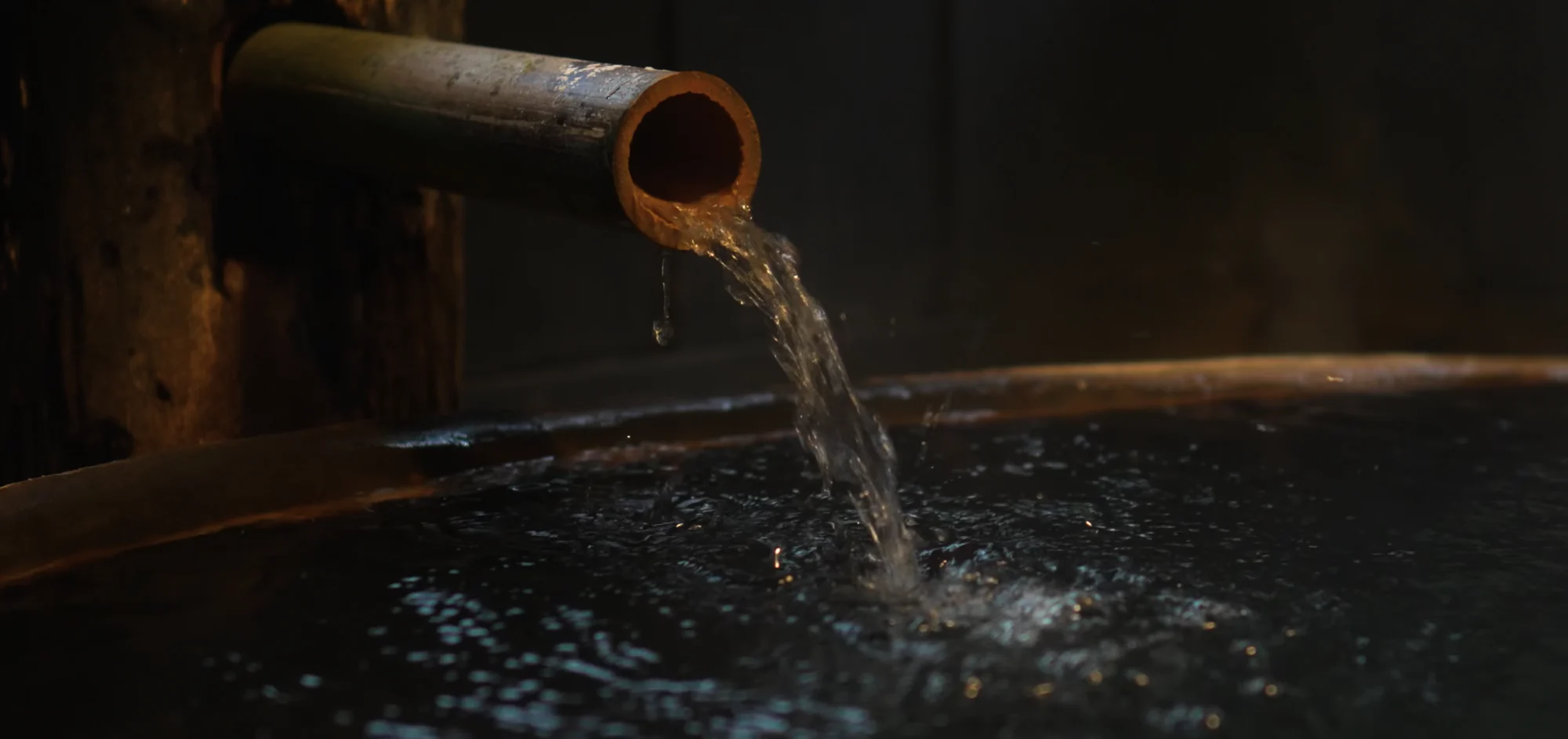
The Baths
The waters
Kurokawa has no single water. Each inn owns its source, so bath-hopping is chemistry-hopping — sulphur, chloride and bicarbonate within one lane.
The Baths
The Nyūtō Tegata Explained
A wooden disc buys any three of twenty-five baths, valid six months. Two stickers can go to baths and the third to lunch.

The Baths
Kurokawa Onsen: The Complete Guide
A wooden pass buys three baths from twenty-five. The innkeepers agreed, decades ago, to look like this.