
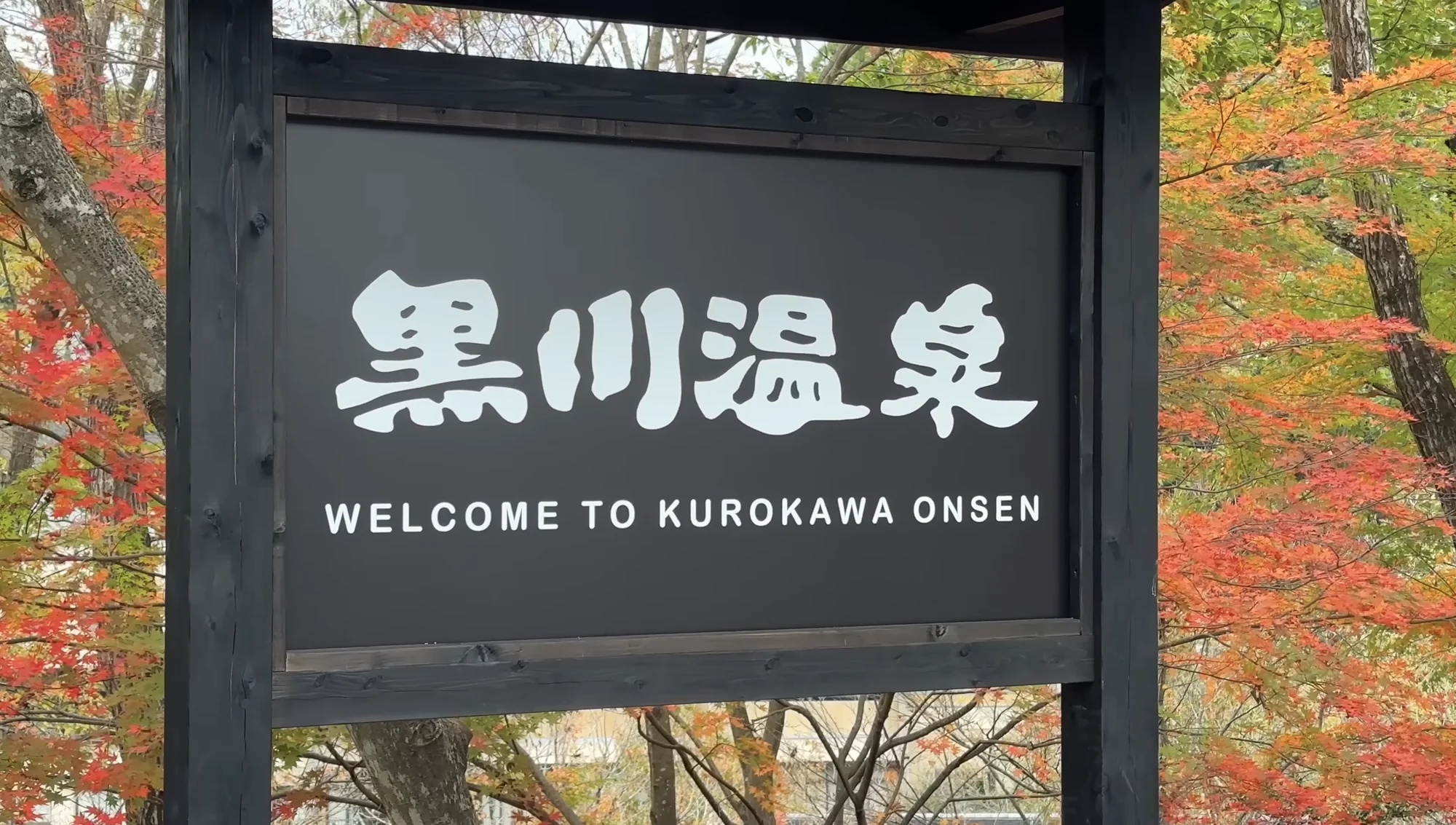
Most onsen towns are towns that happen to have baths. Kurokawa is closer to a single sprawling inn that happens to be a town. The village's own slogan says it plainly: 黒川温泉一旅館, Kurokawa Onsen is one ryokan. In that image each inn is a detached guest room, a hanare, and the lanes that run between them are the connecting corridors. The idea is not marketing added after the fact.
It is the operating agreement that saved the place, and it is still the best lens for planning a visit: you are not choosing between hotels here, you are choosing your room in a village that has agreed to share its baths.
This guide covers how that sharing works in practice, which baths deserve your three tegata stamps, when to come, how to manage the bus-only access, and where to sleep. Prices and timetables move; we flag the volatile ones so you can confirm before you travel.
What is Kurokawa Onsen, and why is it different?
Kurokawa is a hot spring village of about thirty inns, folded into a narrow river valley in Minamioguni in the north of Kumamoto Prefecture, on the highland skirt between the outer rim of the Aso caldera and the Kujū mountains. The stream that runs through it, the Tanohara River, is one of the uppermost sources of the Chikugo, the largest river in Kyushu. You arrive to the sound of that water, and it stays under everything else the village does.
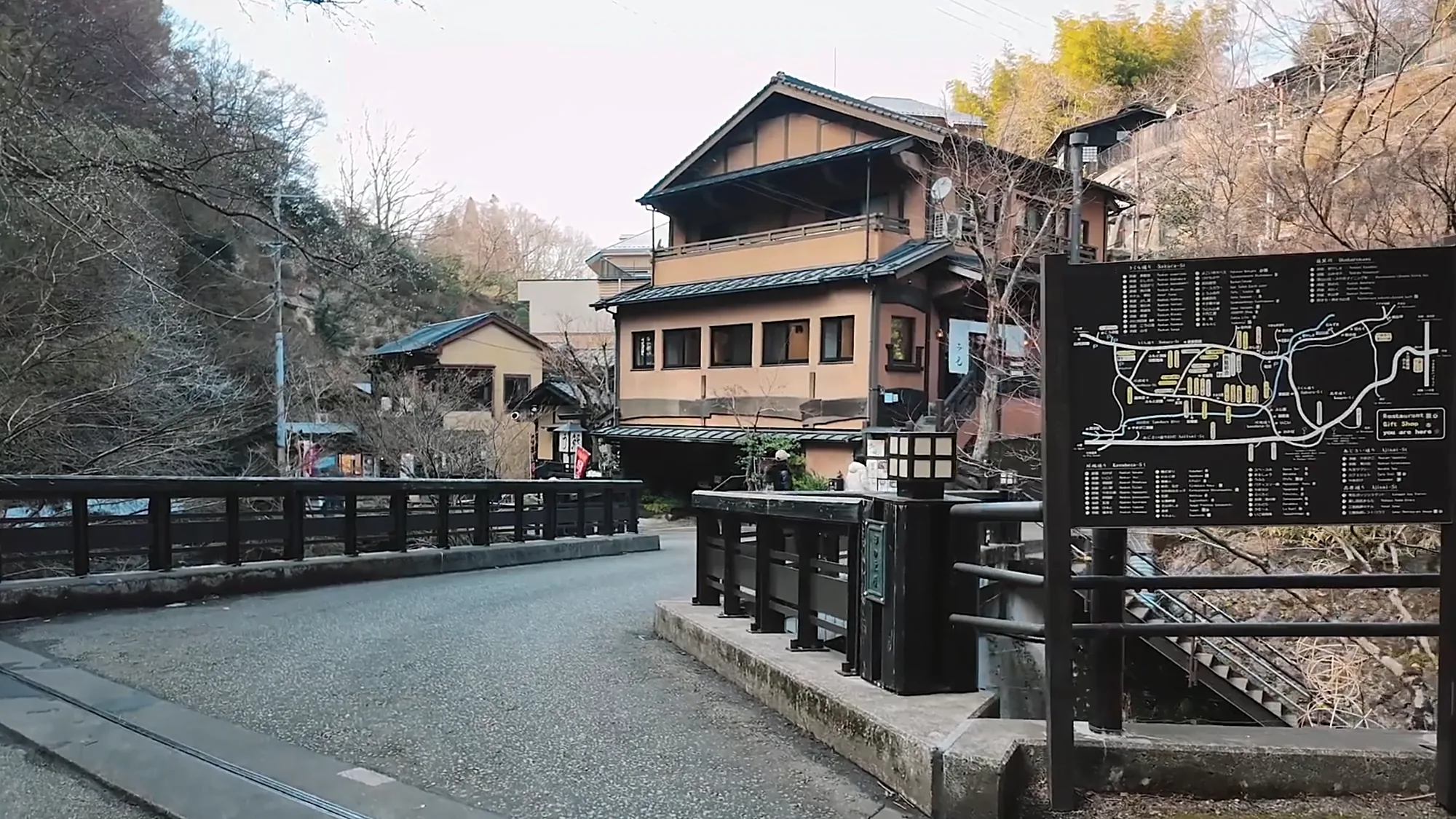
Thirty inns in a wooded gorge, and a village that agreed to look like one.
What sets Kurokawa apart is not one famous bath or a grand view. It is an agreement. The inns here open their outdoor baths to one another's guests, so that a single wooden pass lets you bathe your way across the village rather than staying put in one house. That arrangement, and the tegata pass that runs it, is why people cross Kyushu to reach a place that has no train station.
The village also belongs to a larger family of springs. Kurokawa is the best known of the five hamlets that make up Minamioguni Onsen-kyō, alongside Tanohara, Manganji, Oda and Shirakawa, and together they hold a national designation as a Kokumin Hoyō Onsen-chi, a hot spring recuperation area recognised by Japan's Environment Ministry. Across all five hamlets the area counts fifty-three lodgings and room for roughly 2,300 guests. Kurokawa's own association is the thirty inns in the valley you actually walk through, and Kurokawa is one of the springs chosen for the Hundred Famous and Secret Hot Springs of Japan.
The village calls its countryside kiyora no sato, the land of clear purity, and it means the phrase literally. Out of concern for the river and the springs, the town regulates the soap and shampoo used at its onsen. That is the tell. This is a place that treats its water, its forest and its lanes as one connected thing, and manages them that way.
None of this was inevitable. Until the year 2000, Kurokawa's name did not appear on the local newspaper's map of Kumamoto Prefecture at all. The village you see now, ranked routinely among the most beautiful onsen towns in Japan, was genuinely obscure within living memory. How it changed is the more interesting story.
What Kurokawa is not
Fair warning is part of a complete guide, and the village's absences are as authored as its presences. There is no nightlife beyond a couple of late counters; the directory's own hours make the point, with most doors shut by 17:00 and Irori-ya's 22:30 close standing as the village record.
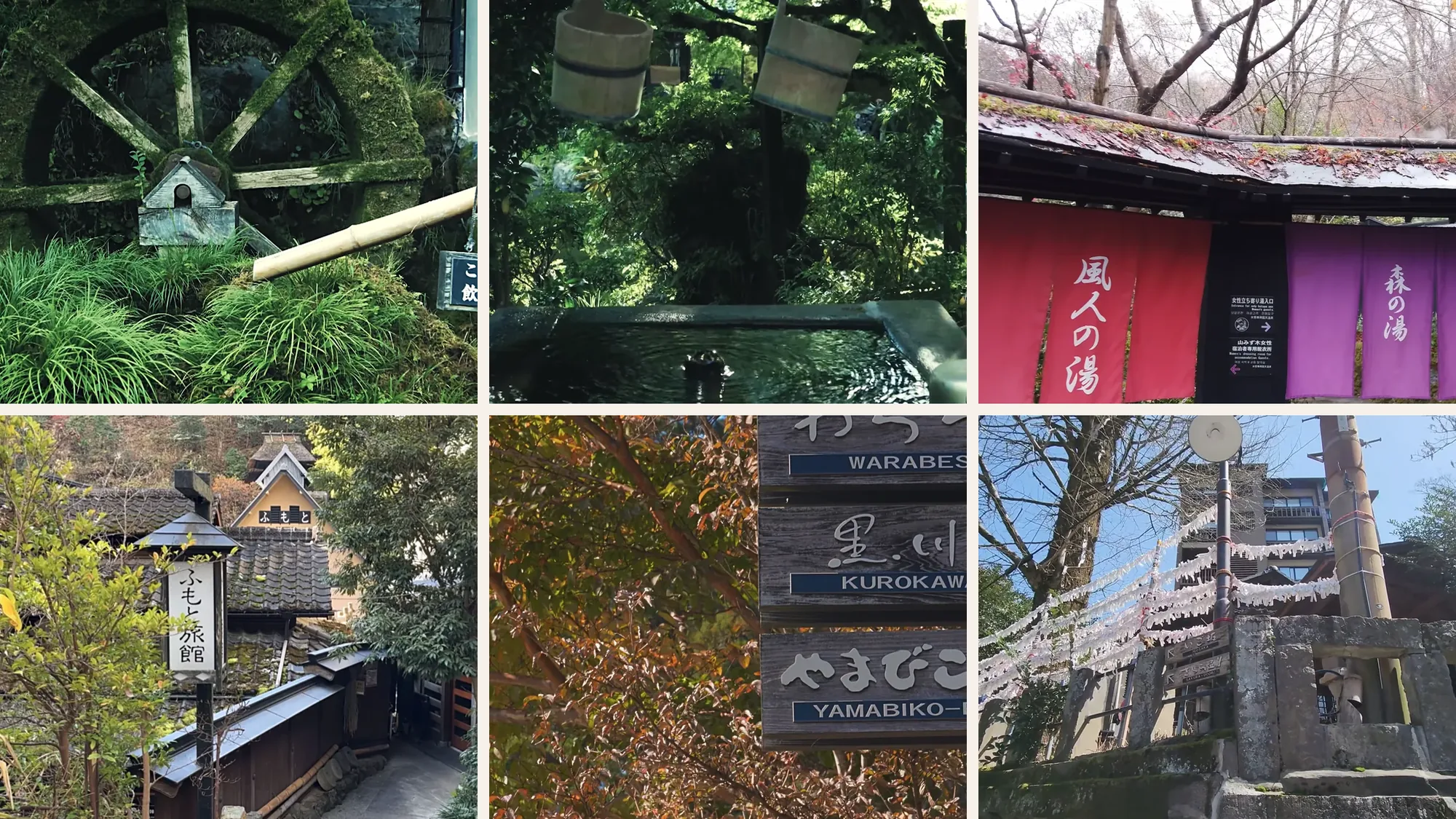
Not a theme park, and not a preserved village. People live and work behind all of this.
There are no museums, no arcades, no shopping street beyond the small-maker lanes, no neon, no tall buildings, and no chain anything; the code the innkeepers wrote in the 1980s pruned the lot, and the prosperity that followed has never tempted them to relent. It is not a spa resort in the Western sense either: no treatment menus, no robes-and-cucumber-water culture, just water, delivered as seriously as anywhere on earth.
And it is not a secret, whatever the marketing of others implies; the lanes at midday in November are proof enough. What it is, precisely, is a working village that sells one experience, done completely: the bath, the table, the lane, the dark, the dawn. Travellers who want that will find nowhere better arranged for it.
Travellers who want anything else are, by the village's own cheerful design, in the wrong valley, and both discoveries are best made before booking rather than after.
The village in numbers, each with its receipt
For readers who plan by figures, here is Kurokawa quantified, every number carrying a primary source behind it on this site. Thirty member inns in the association; twenty-five open-air baths in the tegata scheme; twenty-four inn listings captured with price bands, running ¥12,727 to ¥122,700 (US\$85 to \$818) per person with two meals; twenty-seven listed businesses in the shop directory, thirteen of them kitchens; nineteen doors honouring the pass's food-and-souvenir sticker.
Five hamlets in the national designation; four registered spring families across them; fifty-three lodgings and 2,300 guest capacity area-wide. Roughly 700 m (2,300 ft) of altitude and a three-to-five-degree-Celsius cooling on the lowlands; 2 hours 45 minutes from Hakata by the direct bus; two illumination seasons covering December 20 to March 31 and June 1 to September 30.
One pass, ¥1,500 (US\$10), three stamps, six months, 8:30 to 21:00; born 1986, forty years old in 2026; one percent of every sale returned to the landscape. Four rooms at the smallest inn, thirteen baths at the best-equipped, one hand-dug cave, two hundred signs removed, zero appearances on the prefectural map before 2000. Numbers are how this site verifies a village; the walk above is how you should actually meet it.
Where does Kurokawa Onsen come from? The legend of the headless Jizō
The village tells its own beginning as a story, and it is worth hearing before you bathe.
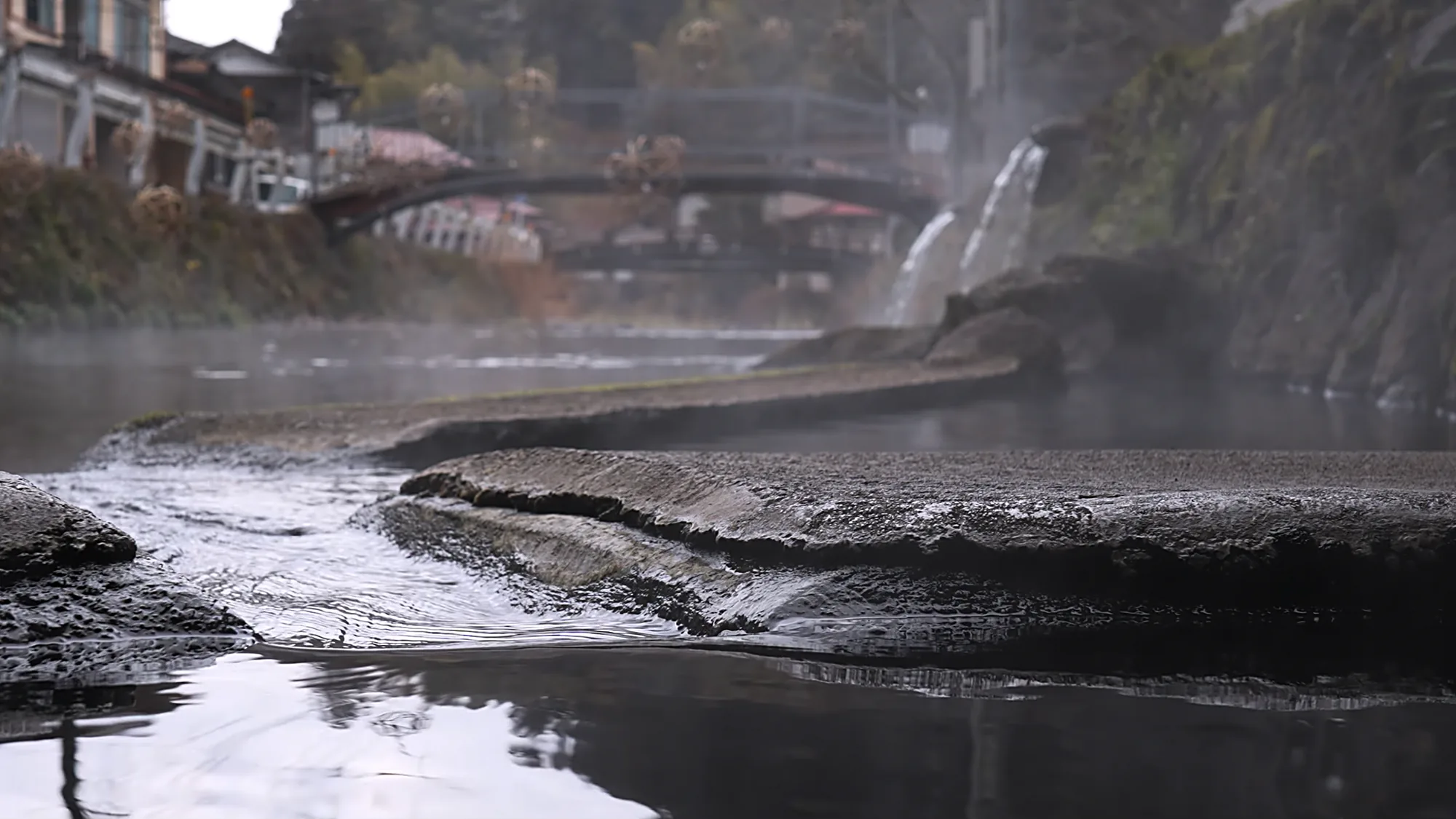
The village grew around its water, and the older claims on it are still standing underneath.
Long ago, the account goes, a poor young salt-seller named Jinkichi had a father who lay bedridden at home and had asked for one thing, a taste of melon. Jinkichi had no money. He left an offering of his own salt at a roadside Jizō, the guardian of travellers and children, and then took a melon from a field that was not his. The landowner caught him, and the price set for the theft was the boy's own head.
As the blade came down, it was the Jizō's head that fell, not Jinkichi's. The stone figure had taken the boy's place. That is the name the statue still carries: the kubinashi migawari Jizō, the headless substitute Jizō, the one who stood in.
The story travels from there. The headless Jizō was later carried toward Higo, the old name for this part of Kumamoto, by a wandering ascetic named Honda Katsujūtarō. When he reached the valley that would become Kurokawa, the statue suddenly spoke, asking to be enshrined on that spot. A hall was raised to hold it. And where the Jizō settled, hot water began to rise from the ground. That spring is the founding of Kurokawa Onsen.
You do not have to believe a word of it to feel why it matters. The statue is still enshrined at the centre of the village, not tucked away as a relic but standing where the lanes meet, and two of the town's plainest baths carry the story in their names and their use. Jizō-yu and Ana-yu are kyōdō-yokujō, public bathhouses open to the town, the humble end of a village otherwise known for its ryokan, and they sit at the legend's anchor rather than at any inn.
It is an easy thing to miss between the famous rotenburo. But it is the reason the water is here at all, in the village's own telling, and it rewards a minute. Drop a coin at Jizō-yu, soak where the town has soaked for far longer than any tegata has existed, and pay the headless Jizō a visit on the way out. The oldest bath in Kurokawa is not the most beautiful. It is the one the whole place grew around.
How did a struggling spa become Japan's prettiest onsen village?
For most of its history, Kurokawa was nobody's destination, a cluster of inns whose hot water was good enough for farmers and woodcutters taking the cure between seasons and for little else. The practice that kept it alive was the old one, tōji, hot water and cure: you came to soak for days because the water was thought to mend you, and then you went home.
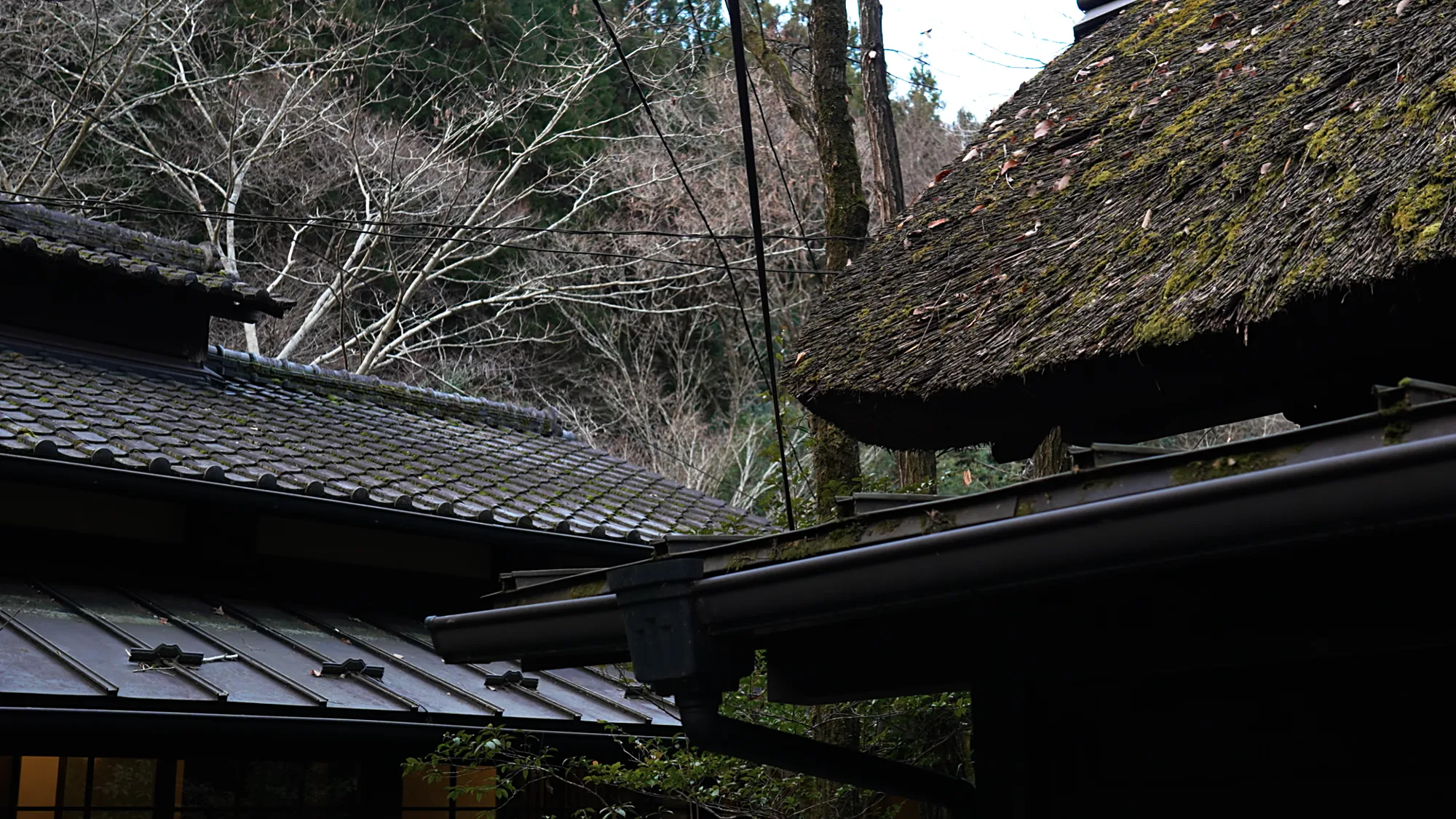
Wood, thatch, tile, no plastic. The rules are unwritten and everyone follows them.
When the Yamanami Highway opened in 1964 and cars began crossing the Aso highlands, Kurokawa drew a little attention. It did not last. The boom moved on to larger resorts with views and rail links, and the village was left behind.
The turn began with one inn and a rock face. The owner of Shinmeikan, the third generation to run it, believed that what a bath offered was not tile and chrome but atmosphere, the particular hush of warm water in the dark. So he dug a cave into the cliff behind his inn by hand, at the age of twenty-four, with a chisel, over three and a half years. The hand-dug cave is a matter of record, and guests came for it. The other innkeepers watched, and then they followed.
What they did next is the part worth honouring, because it was collective and it was slow. The inns agreed to open their outdoor baths to one another's guests, and the wooden tegata pass gave that agreement a shape a visitor could carry. Then they set about making the village look like one place rather than thirty competing ones. Together they took down roughly two hundred signs from the lanes. They replanted trees along the river and the streets.
They built in dark timber and earth tones, kept neon and convenience stores out, and let the sound of the town be water, wooden geta on stone, and little else.
Their own phrase for what they were after was arugamama no shizen, nature as it is. It is worth sitting with that, because the forest and the quiet it describes are not survivals from an older world. They are authored. A generation of innkeepers decided, together, that atmosphere was the product, and spent decades building it, which is why a village that feels timeless is in fact the result of a deliberate and patient act of design.
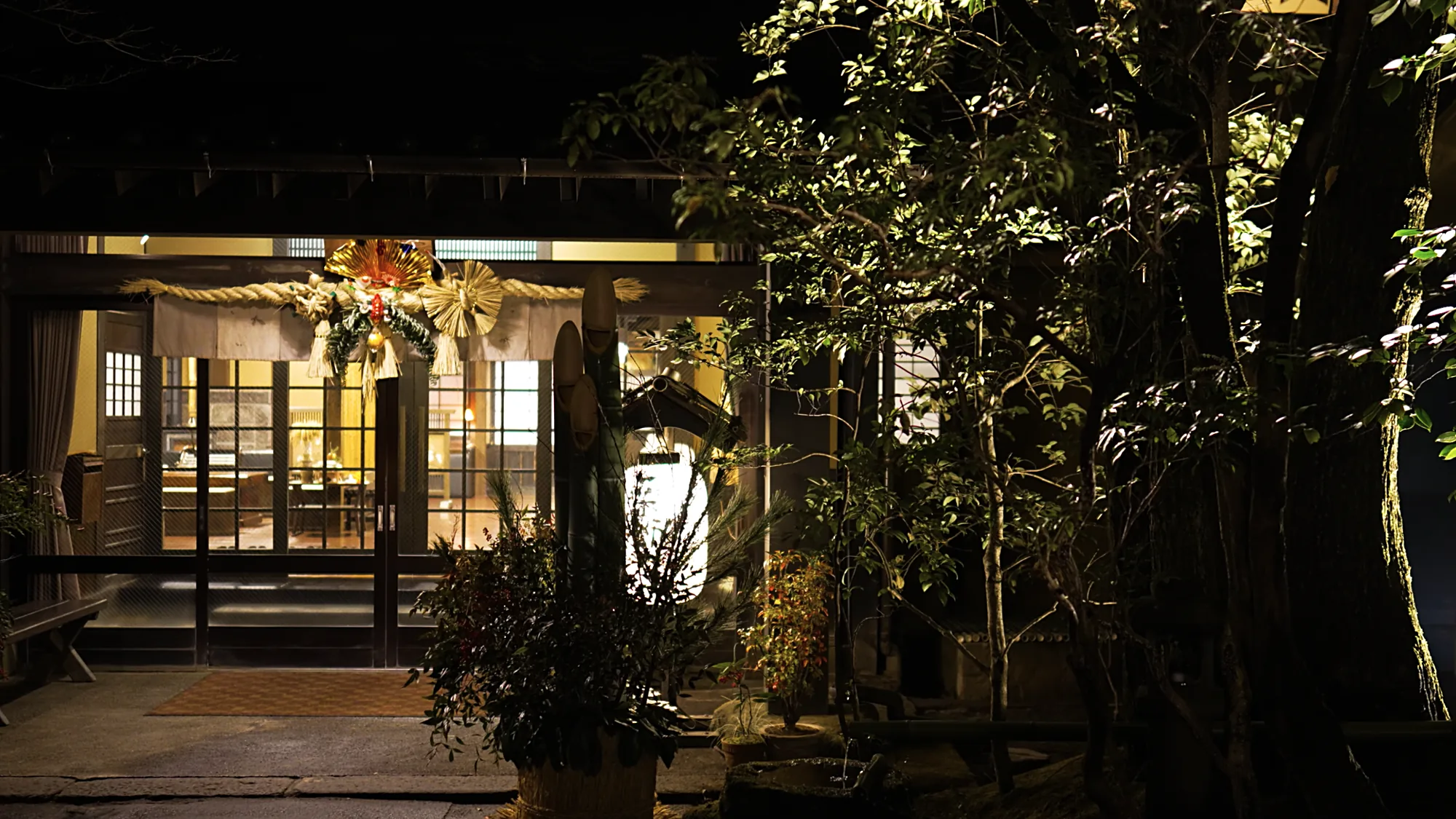
That is also why the one-ryokan idea is more than a slogan. No single inn wins here unless the street does. The baths are shared, the look is shared, and a share of what every visitor spends on the pass goes back into the landscape the whole village depends on. You feel the result at dusk, when the day visitors have caught their buses home and the lanes go still.
Steam lifts off the river, wooden geta knock against stone, and the water is exactly as warm as it has always been. Stay a night, and let the village do what it was rebuilt to do.
Who actually runs the village
Understanding Kurokawa's institutions makes every practical question easier to route, because the village has an unusually clear chain of custody. The operating body is the Kurokawa Onsen Ryokan Co-operative Association, the 組合 of thirty member inns, which runs the tegata system, the shared marketing, the daily bath board, the visitor code and the enquiry form through which individual questions, tattoo policy included, are brokered to individual houses.
Its physical face is Kaze-no-ya, the information house in the centre, and its fiscal signature is the one percent of every tegata sale returned to landscape and conservation work. Above it sits the town: Minamioguni's municipal offices handle the civic layer, and the government designation that frames the whole five-hamlet spa area comes from the Environment Ministry via the national spa association's records. For a traveller this hierarchy is not trivia; it is a phone tree.
The published contacts run: the ryokan association at 0967-44-0076 for anything about inns, baths and the pass; the Minamioguni tourism association at 0967-42-1444 for the wider valley; and the town hall at 0967-42-1111 for the civic layer. Most visitors never dial any of them, because the inns and Kaze-no-ya absorb the questions first.
But knowing that a village of thirty inns maintains three working front doors, each with a number that answers, tells you something about why the place functions the way it does.
How does the nyūtō tegata bath pass work?
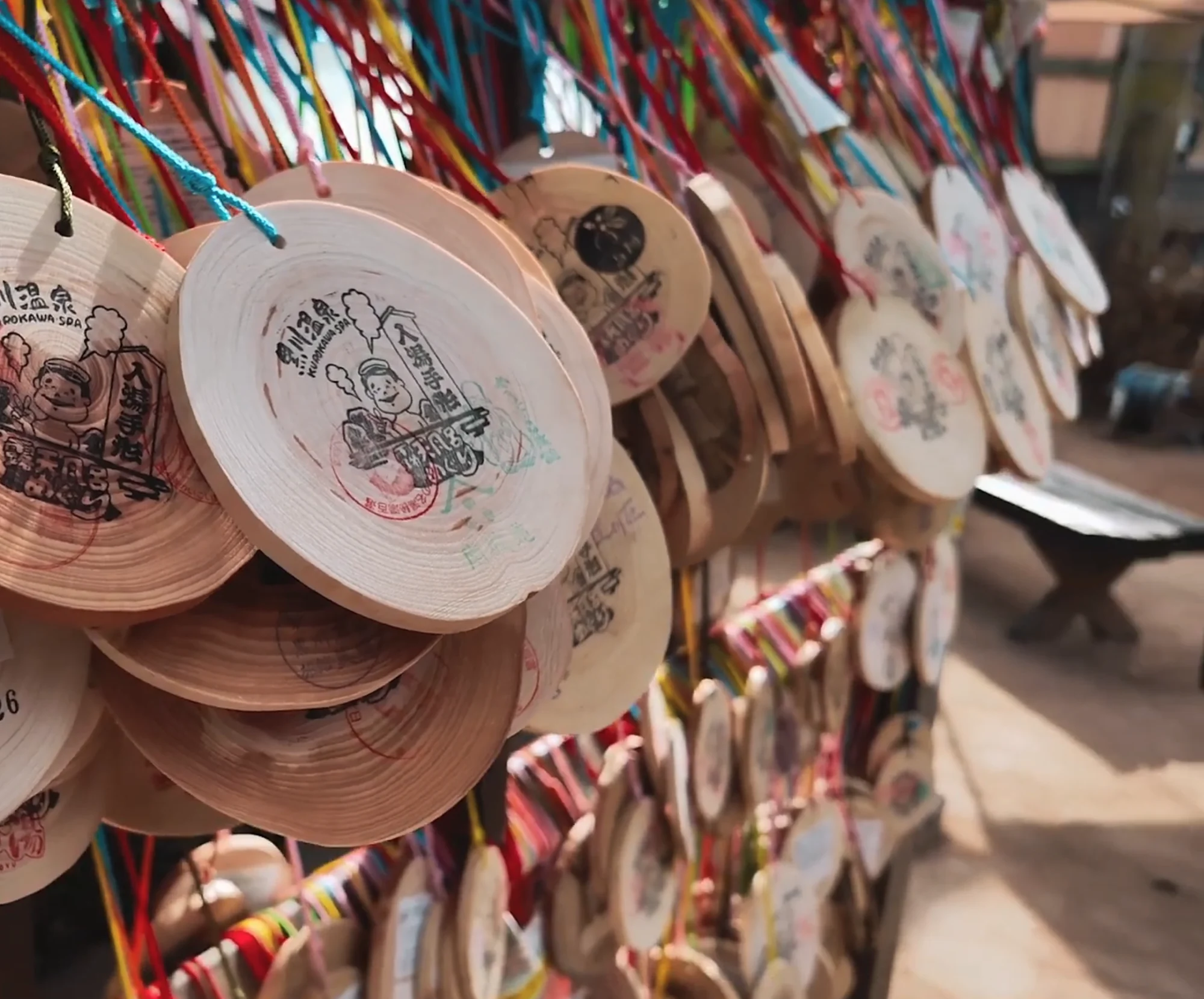
The nyūtō tegata is a palm-sized disc of local cedar, and it is the object that makes Kurokawa work. It costs ¥1,500 for an adult and ¥700 for a child (about US$10 and US$4.70), bought at any member ryokan or at the association's information house, Kaze-no-ya. The back holds three stickers. The usual way to spend them is three open-air baths, one inn each, in any order. There is also an option to take two baths and put the third sticker toward food or a souvenir at a participating shop. Both are valid; neither is the rule.
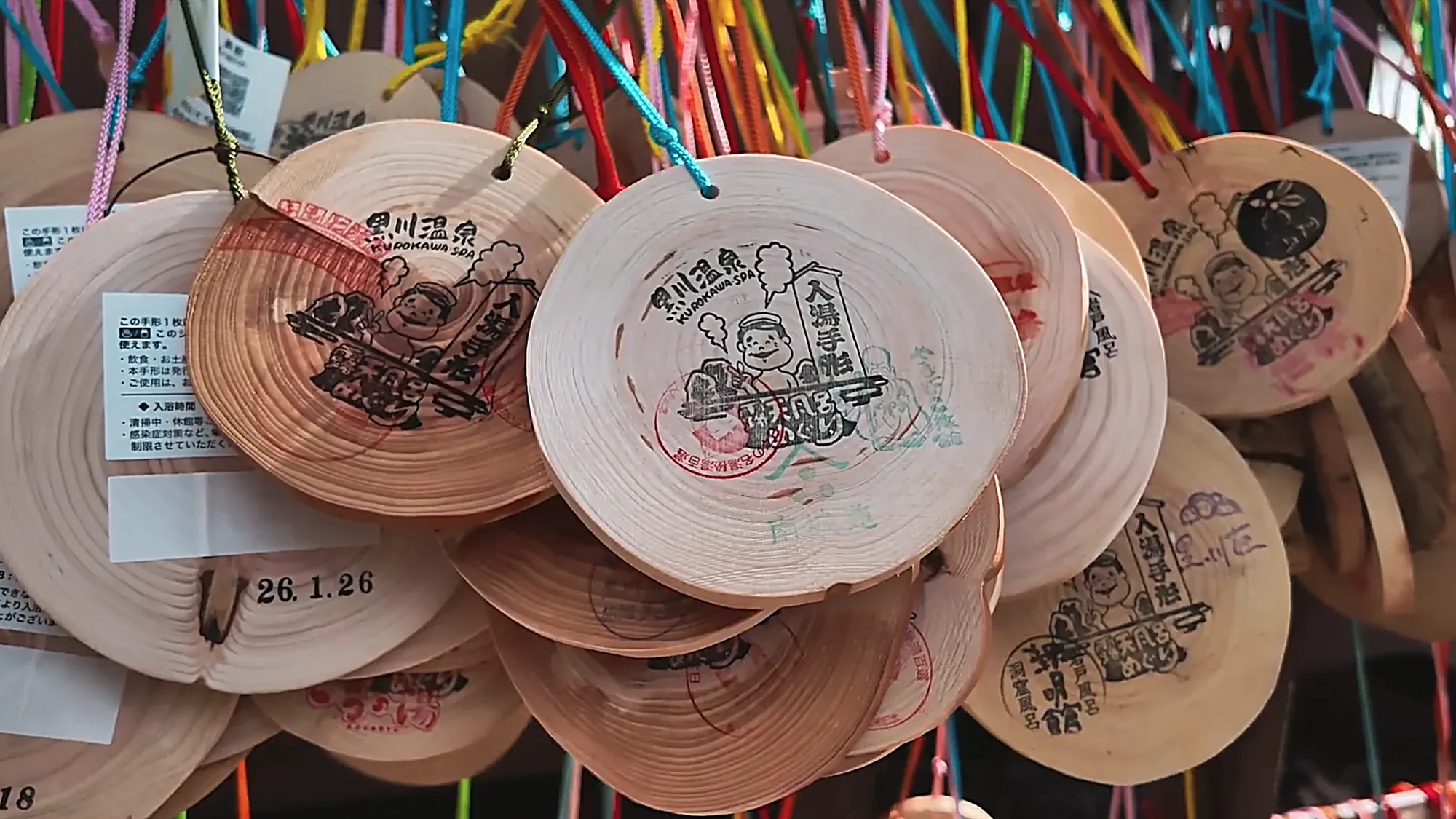
One wooden pass, three stamps, twenty-five baths to choose from.
The pass is valid for six months from purchase, and an unfinished one may be used on a later visit inside that window, so a half-used tegata is a reason to return rather than money wasted. It is one pass per person and cannot be shared. Bathing runs 8:30 to 21:00, though each inn sets its own window and closes for cleaning, so the association posts the day's availability.
Two numbers are worth keeping straight: thirty inns belong to the association, while twenty-five open-air baths are enrolled in the tegata scheme. They count different things, inns and baths, which is why they differ. Without the pass, single entry runs an approximate ¥500 to ¥800 (about US$3 to US$5) per bath, a visitor-reported range we cannot yet source officially , so the pass usually works out cheaper once you take three, though the saving is not really the point; what you are really buying is permission to wander.
The pass began in 1986, during the bubble years, and 2026 is its fortieth anniversary. Each ryokan carves its own stamp, so a finished tegata comes home as a personalised record of exactly where you bathed.
One percent of every pass sold is returned to landscape and nature conservation in the village, so the disc in your hand is quietly a contribution to the forest around you. One honest note: tegata bathing is a daytime culture. By late afternoon the day visitors leave and the inns reserve their baths for staying guests, which is the best single reason to be one of them.
Our full guide to the nyūtō tegata covers the current bath list, the food-and-souvenir shops, and the etiquette, inn by inn.
Why the pass exists at all
The tegata's origin is more practical than its cedar romance suggests. As Shinmeikan's own history tells it, the pass was created for the member inns that could not build an open-air bath of their own. If every inn's guests could bathe at every inn, no single house needed to own the whole experience, and the village's smallest members could sell the same afternoon as its grandest. It dates from 1986, the height of the bubble years, when the rest of Japan was pouring marble lobbies. Kurokawa's innkeepers pooled their baths instead, and the pooling outlasted the marble.
That decision is now old enough to carry its own anniversary. 2026 marks forty years of the tegata, and the association is running a fortieth-anniversary programme from July 1, 2026 to March 31, 2027, worth checking if your visit falls inside the window. Few travel schemes survive four decades. This one built the town that carries it.
Which baths deserve your three tegata stamps?
Every list of Kurokawa's baths is an argument, but a handful of inns turn up in nearly everyone's top three, and a couple of quieter names earn a place too.
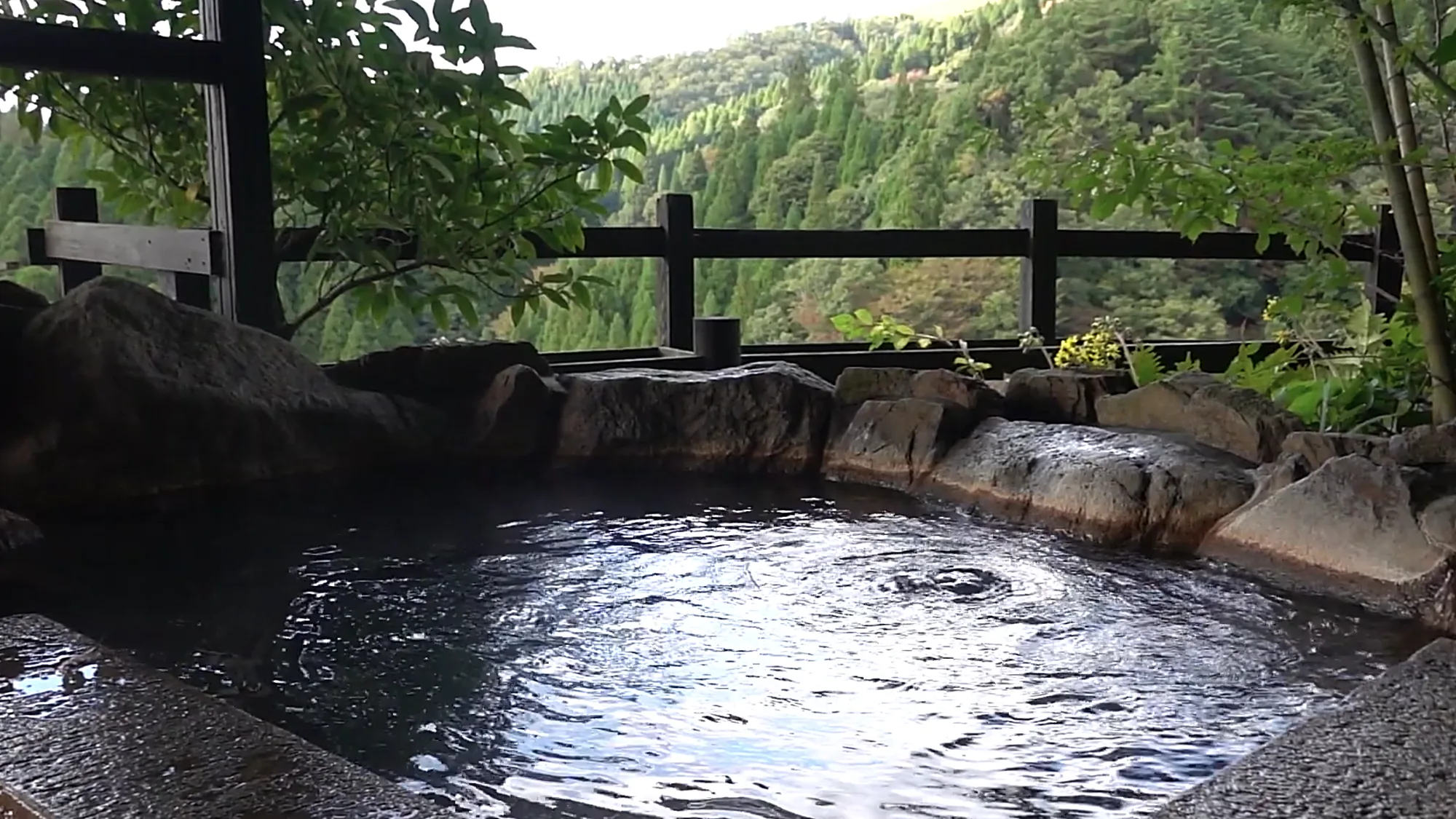
Three stamps is the whole allowance. Spend them on baths that are not alike.
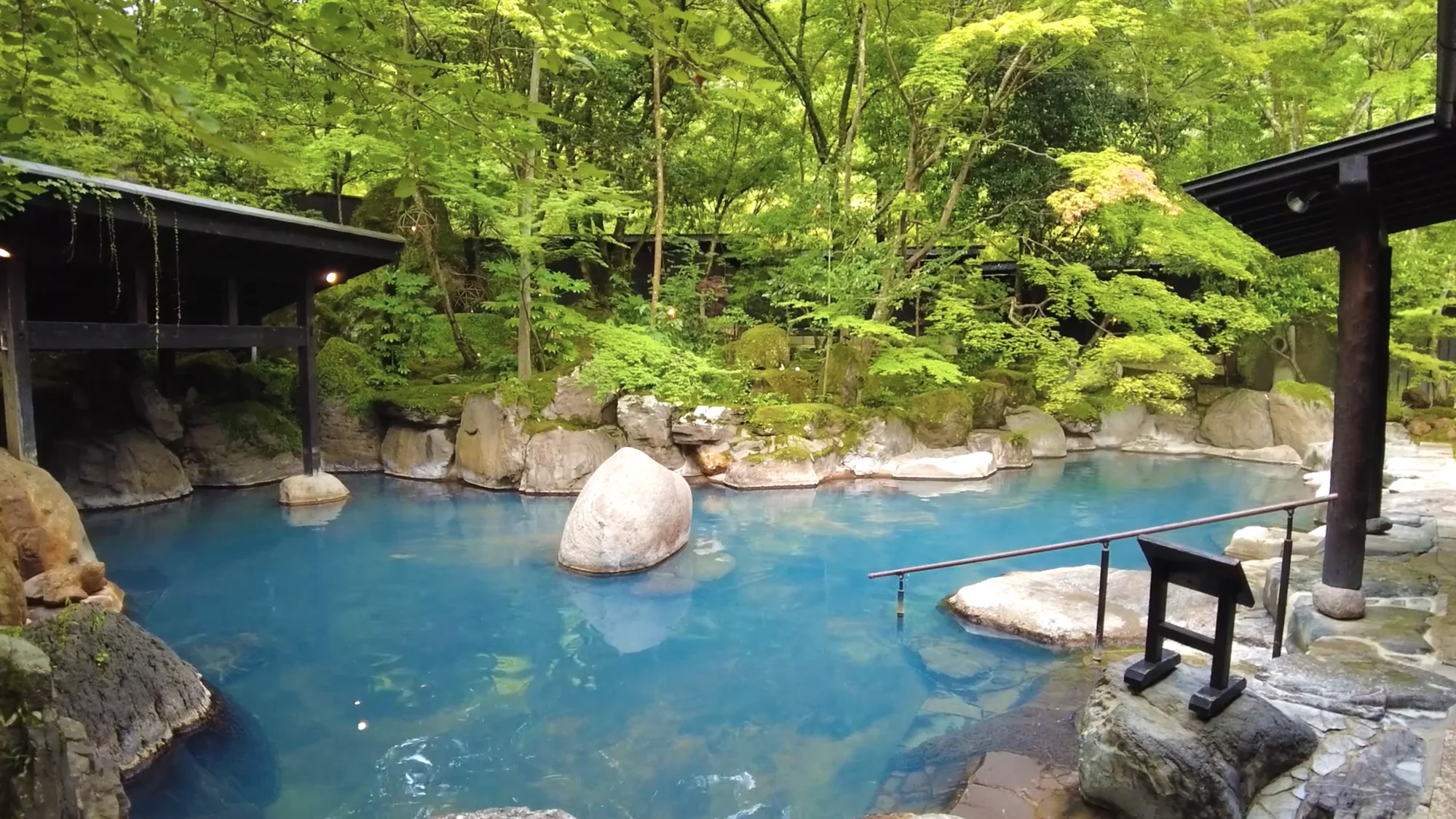
Yamamizuki is the consensus stunner, a few minutes outside the centre, its riverside rotenburo set in open forest where the only sound is water on rock. Shinmeikan, the inn that started the revival, keeps the hand-dug cave bath, a dim, dripping tunnel that feels closer to ritual than recreation. Yamabiko holds the largest rotenburo in the village, generous enough that even a busy afternoon spreads out.
Fumoto runs the village's deep standing bath, a tachiyu 1.5 m (4.9 ft) deep that you soak in upright, with eight baths in all. Ikoi is the only Kurokawa inn on the Hundred Secret Springs list and keeps thirteen baths of its own; its celebrated beauty bath, the Bijin-yu, is worth asking after, though the association's own listing does not describe it, so treat the beauty-bath billing as unconfirmed .
Two more earn a stamp for atmosphere. Kurokawa-sō looks onto a folding-screen rock face, the Byōbu-iwa, from its bath, and Misato pours a milky-white sulphur water, unusual in a village whose Kurokawa hamlet mostly runs clear. Okunoyu spreads across roughly two thousand tsubo of grounds with a river bath and its own small cave, and the village keeps a plain public bathhouse, Jizō-yu, tied to the founding legend, with a cash box at the door and no frills at all. Our open-air bath guide ranks all twenty-five by mood, season and crowd.
What is Kurokawa's water actually like?
There is no single Kurokawa water, and that is the honest and more interesting answer. Kurokawa is one of five hamlets in the wider spa area, and the Japan Spa Association records a different spring type for almost each one. Kurokawa's own hamlet runs simple and chloride waters; Tanohara, Manganji and Oda run bicarbonate; Shirakawa runs sulphur. Across the whole area the association lists four spring types in all: sulphur, bicarbonate, chloride and sulphate. So the useful question is not what Kurokawa's water does, but which Kurokawa you are soaking in.
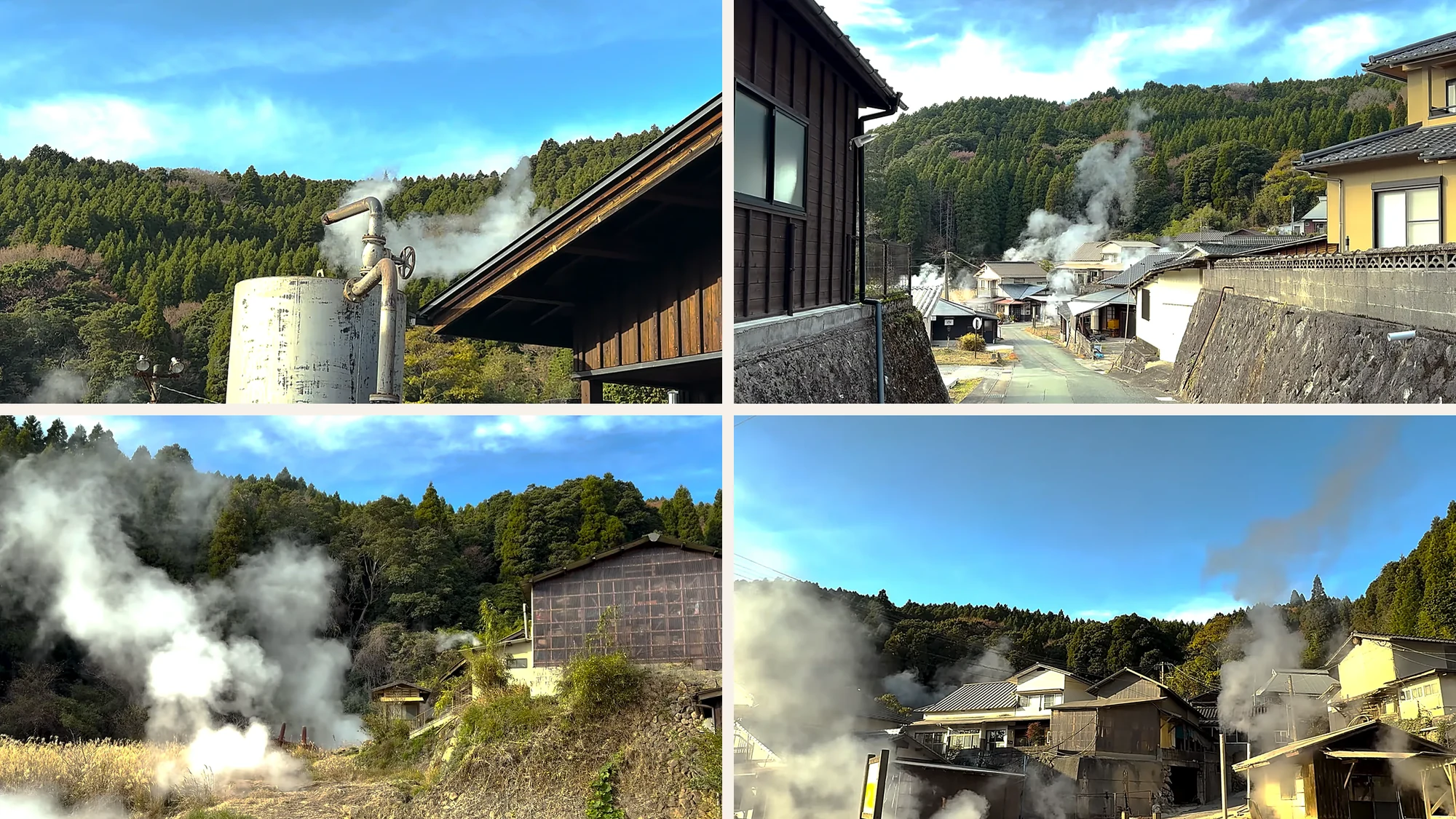
Over the ridge the ground does this on its own, with no inn built around it.
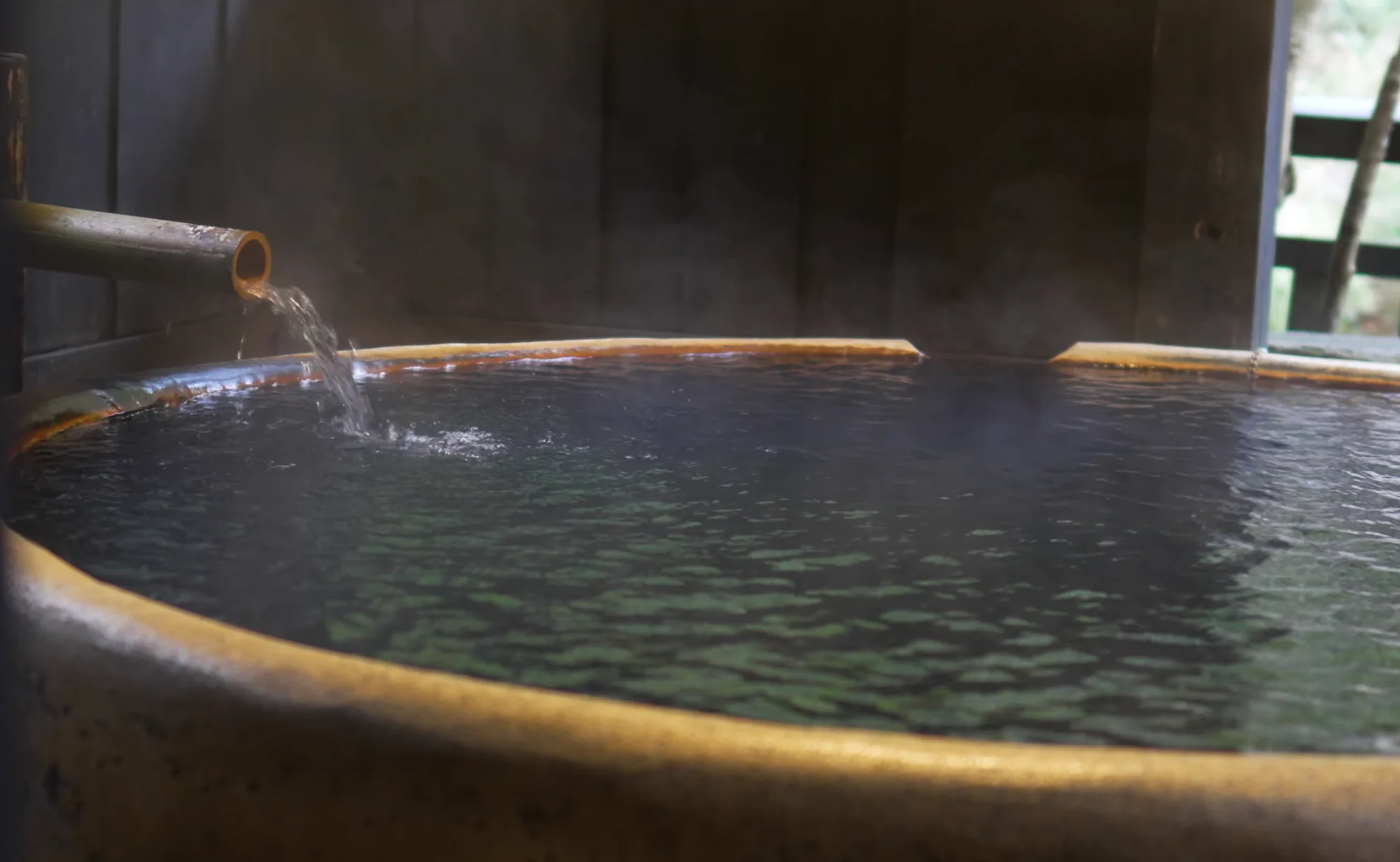
There is one honesty worth stating plainly, because the association states it itself. Nearly every Kurokawa inn is genuinely free-flowing from the source, gensen kakenagashi, rather than recirculated. But the source runs so hot that many inns add water to bring it down to a bathable temperature, and the association is clear that this adjustment does not change the mineral content or the designated effects. It is the rare operator that volunteers the qualification instead of just selling the word natural, and it is worth trusting them for it.
You can sometimes see the difference. Most Kurokawa-hamlet baths run clear, while a sulphur source like the one at Misato pours milky-white. The variety is the point of bath-hopping: three stamps can be three genuinely different waters in one afternoon.
The association also publishes the official indications for each spring type. Sulphur waters are designated for skin conditions such as atopic dermatitis, chronic eczema and psoriasis; chloride waters for cuts, poor circulation and sensitivity to cold; simple waters for insomnia and nervous tension. These are the national designations for the spring type, recorded by the Japan Spa Association, not medical advice or a cure, and anyone with an acute illness, heart or lung disease, or another serious condition should read the standard onsen contraindications first.
Our guide to the waters of Kurokawa maps every hamlet and inn by spring type.
When to visit
Kurokawa works in every season, which is rarer than it sounds. The village sits at about 700 m (2,300 ft), so it runs 3 to 5°C (5 to 9°F) cooler than the lowlands, which shifts its calendar and makes its summers kind.
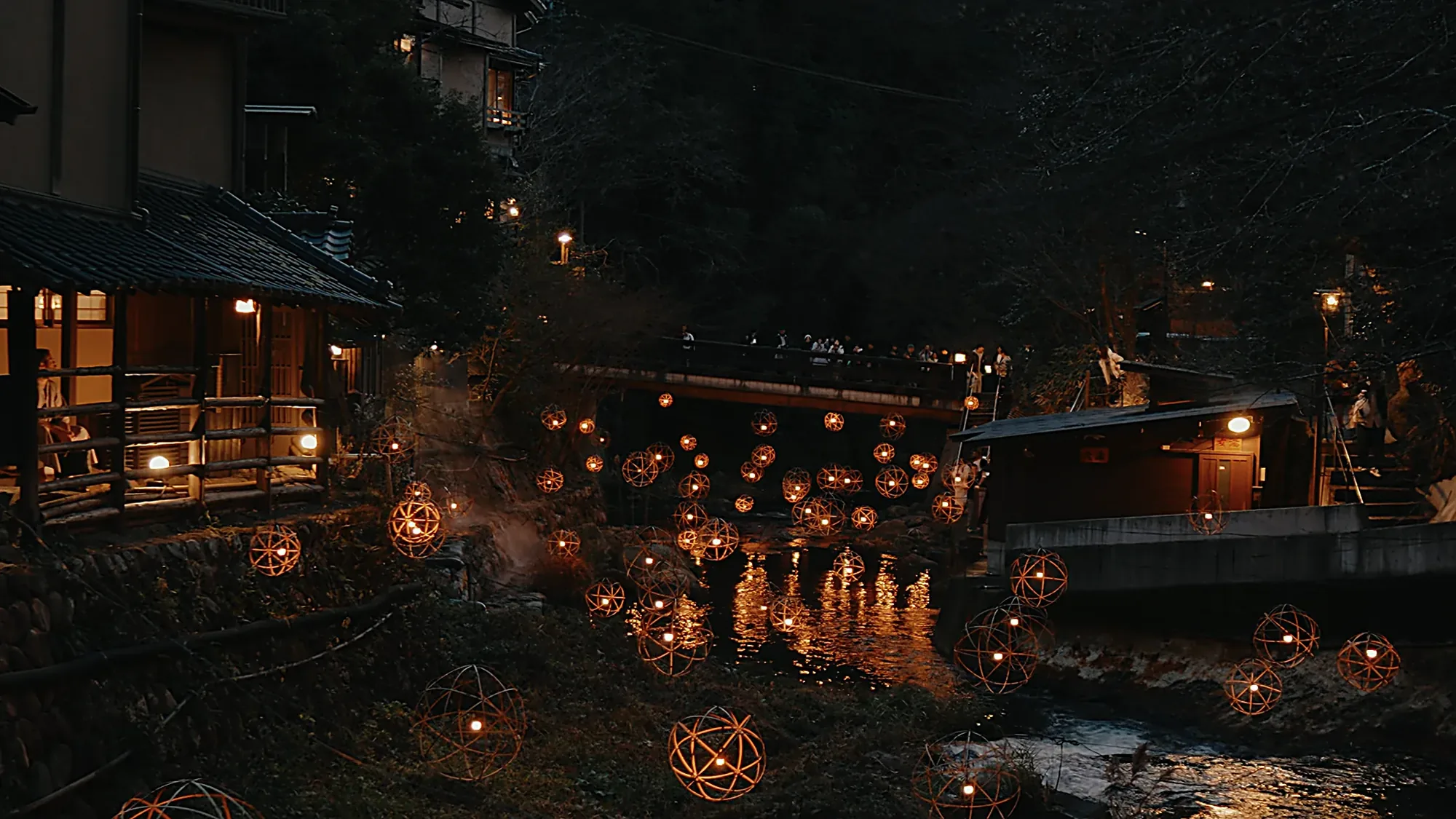
October turns the gorge before it turns the valley floor.
Winter is the romantic peak. The valley gets snow, the open-air baths steam hard against the cold, and from late December to the end of March the Yuakari illumination lines the lanes and the river with handmade bamboo ball lanterns after dark. The 2025 to 2026 run is set for December 20 to March 31, and exact dates are announced each year confirm per season.
There is a summer light show too, which almost no English guide mentions: Kasa Andon, roughly June 1 to September 30, pairs travel parasols with round lanterns along the streets. Spring brings the village's cherry blossom in early April, later than the lowlands because of the altitude, and autumn colour follows the same logic, arriving late October to mid-November and turning the gorge above the baths gold and red.
Crowds peak on winter weekends, over the New Year and during Golden Week in early May. A midweek visit in any season is a quieter, better town. Our best-time guide breaks down every month, with the bloom and foliage windows and the illumination dates.
Getting here without a car
There is no train to Kurokawa. The simplest arrival is the direct highway bus from Fukuoka, boarding at Hakata Bus Terminal, Tenjin or Fukuoka Airport, which the association times at 2 hours 45 minutes to the Kurokawa Onsen stop, around ¥3,470 (about US$23) one way. Seats are reserved and the few daily departures sell out in peak season, so book ahead. From Kumamoto the Kyushu Odan bus runs direct in about 3 hours, and the same Odan line threads the onsen triangle, linking Kurokawa with Yufuin and Beppu, which makes a Fukuoka-in, Yufuin-out circuit genuinely practical.
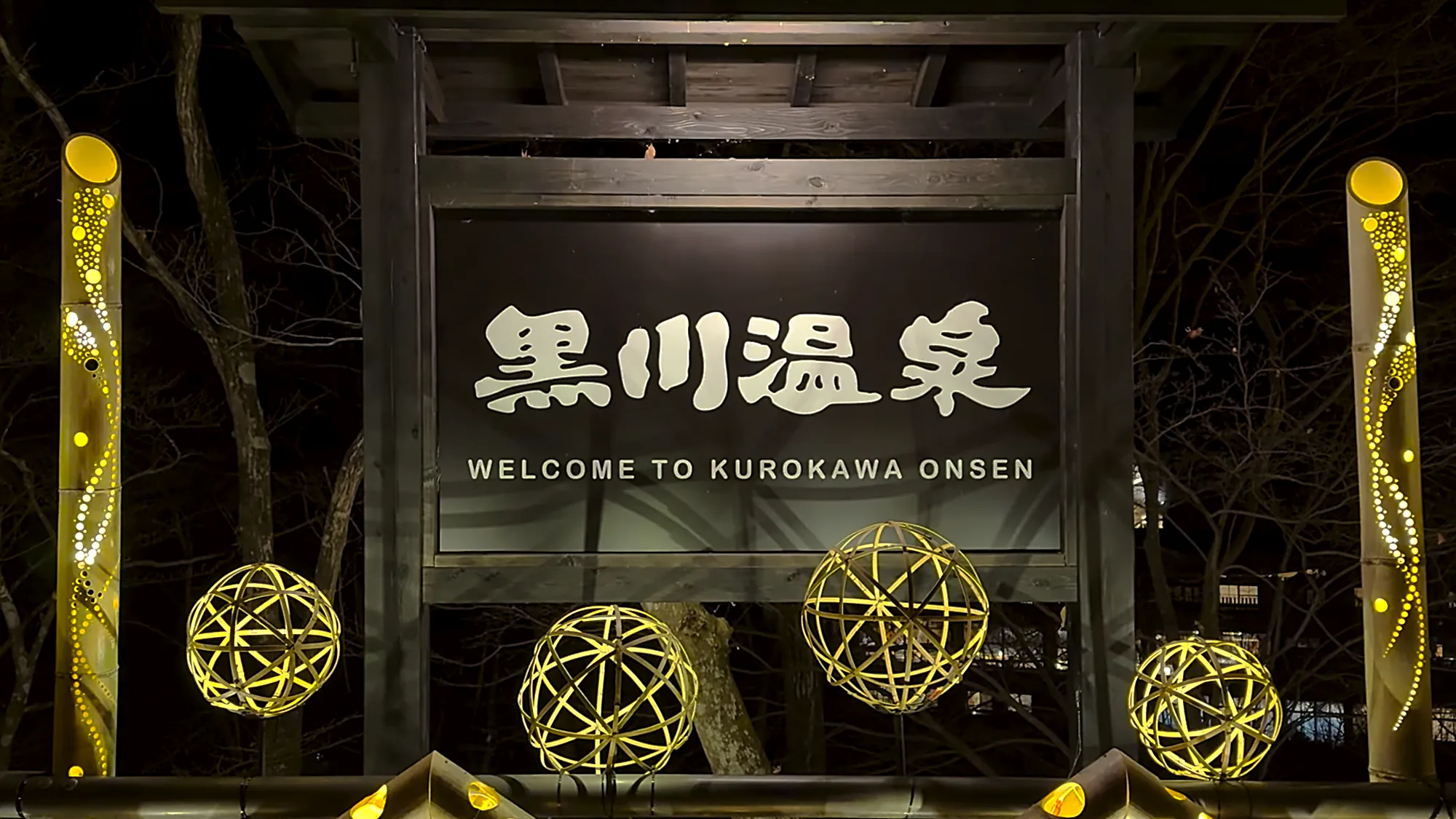
Every route ends here. Even the bus shelter is thatched.
Coming by train, the nearest stations are JR Aso from the Kumamoto side and JR Hita from the Fukuoka side, each about an hour out by bus or car. One detail worth heeding: some local bus routes end at the Minamioguni town hall, ten minutes by car short of the village rather than in Kurokawa itself, which can strand a late arrival. Fares and timetables move, and the 2026 Kumamoto earthquake has reduced some services, so check the association's live traffic page before you travel . Full step-by-step routes, origin by origin, are in our transport guides.
Once there, you need nothing on wheels. The village crosses on foot in about fifteen minutes, the information house hands out walking maps, and inns shuttle guests to the bus stop when the lanes turn icy.
Getting here from the rest of Kyushu
The Fukuoka and Kumamoto approaches above cover most arrivals, but the association publishes routings from every corner of Kyushu, and two of them make Kurokawa the natural hinge of a longer island itinerary rather than a dead end.
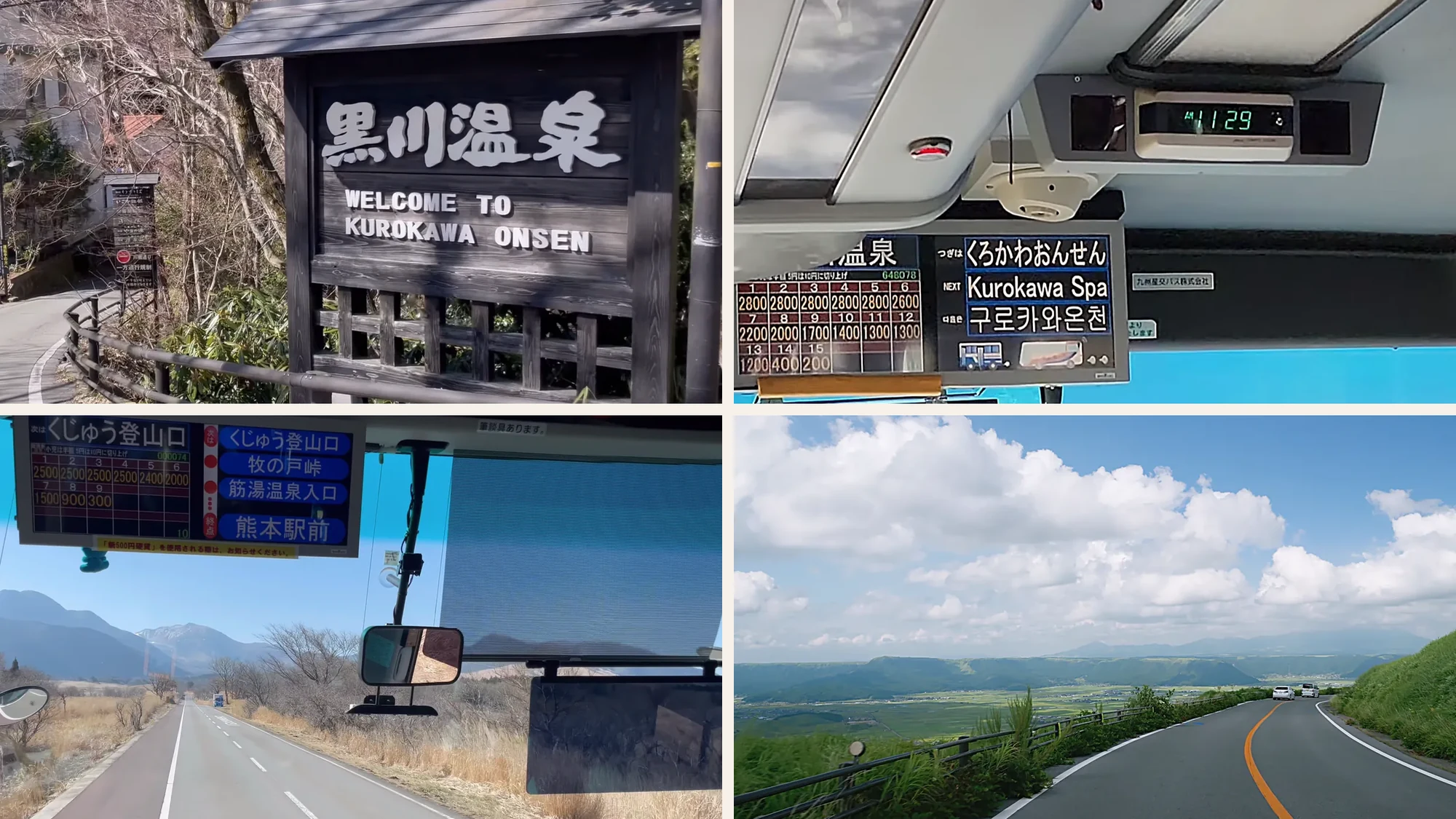
No railway reaches the valley. Every one of these is a bus, and that is fine.
From the east, the onsen triangle is the classic play. The Kyushu Odan bus links Kurokawa with Yufuin in 1 hour 37 minutes and continues to Beppu, so a single bus line pairs Japan's most fashionable onsen town and its most productive one with the quietest of the three. On the operator's current fare table, revised August 1, 2026, the leg between Kurokawa and Yufuin Station costs ¥2,700 (about US\$18) and the through fare to Beppu Station ¥4,000 (about US\$27).
The short hop up from Aso Station is ¥1,600 (about US\$11), and the full run from Kumamoto ¥3,400 (about US\$23). Coming from Oita Airport, the association's own routing chains the Airliner bus to Oita city, a 13-minute JR hop to Beppu, the Kamenoi bus to Yufuin in 1 hour 8 minutes, and the Odan onward. It is long on paper, but every leg is a scheduled service and the last of them is the prettiest bus ride in Kyushu.
From the west, the association routes Nagasaki travellers on the JR Kamome to Saga in 1 hour 20 minutes, a Kyushu Kyuko bus of 2 hours 10 minutes to the Kosoku-Kiyama highway stop, and a 2-hour highway bus on to Kurokawa. From the south, Kagoshima is simpler: the Shinkansen reaches Kumamoto from Kagoshima-Chuo in 50 minutes and the direct Kurokawa bus takes over from there, while Miyazaki runs a 3-hour-50-minute highway bus to Kumamoto and continues the same way. From Kokura at the island's northern gate, a 15-minute Shinkansen ride to Hakata puts you on the direct bus.
From Aso Station itself, two official routings exist side by side: the Kyushu Odan bus runs through in 40 to 50 minutes, while the local Sanko line runs toward Oguni in about 60 minutes with a 30-minute connection on to Kurokawa. Both are published by official bodies; take whichever departs first, but confirm the day's services, because the 2026 Kumamoto earthquake has reduced some schedules.
Drivers have the simplest approach of all: leave the Oita Expressway at the Hita interchange and follow Routes 212 and 442 for roughly 60 km (37 mi), about an hour through farm valleys and over the shoulder of the highlands. Two cautions apply. Parking in the village is limited and roadside parking is not allowed, so use your inn's lot and walk.
And remember the altitude: at about 700 m (2,300 ft) the road surface behaves like mountain country, not like the lowland cities you left. Every journey time in this section is the association's or the operator's own published figure, not our estimate, and the association's live weather and traffic page is the final word before you commit to a connection.
Getting around once you are here
Inside the valley the transport plan is your feet, and the village is built to that scale: the walkable core crosses in about fifteen minutes, every central bath, shop and bridge inside it. Three mechanical facts complete the picture. First, the shuttles: outlying inns meet the village bus stop by arrangement, Yamamizuki's free pickup being the documented example, so tell your inn which bus you are on and the distance problem dissolves; in winter, when the lanes ice, the same arrangement covers the last stretch even for nearer houses.
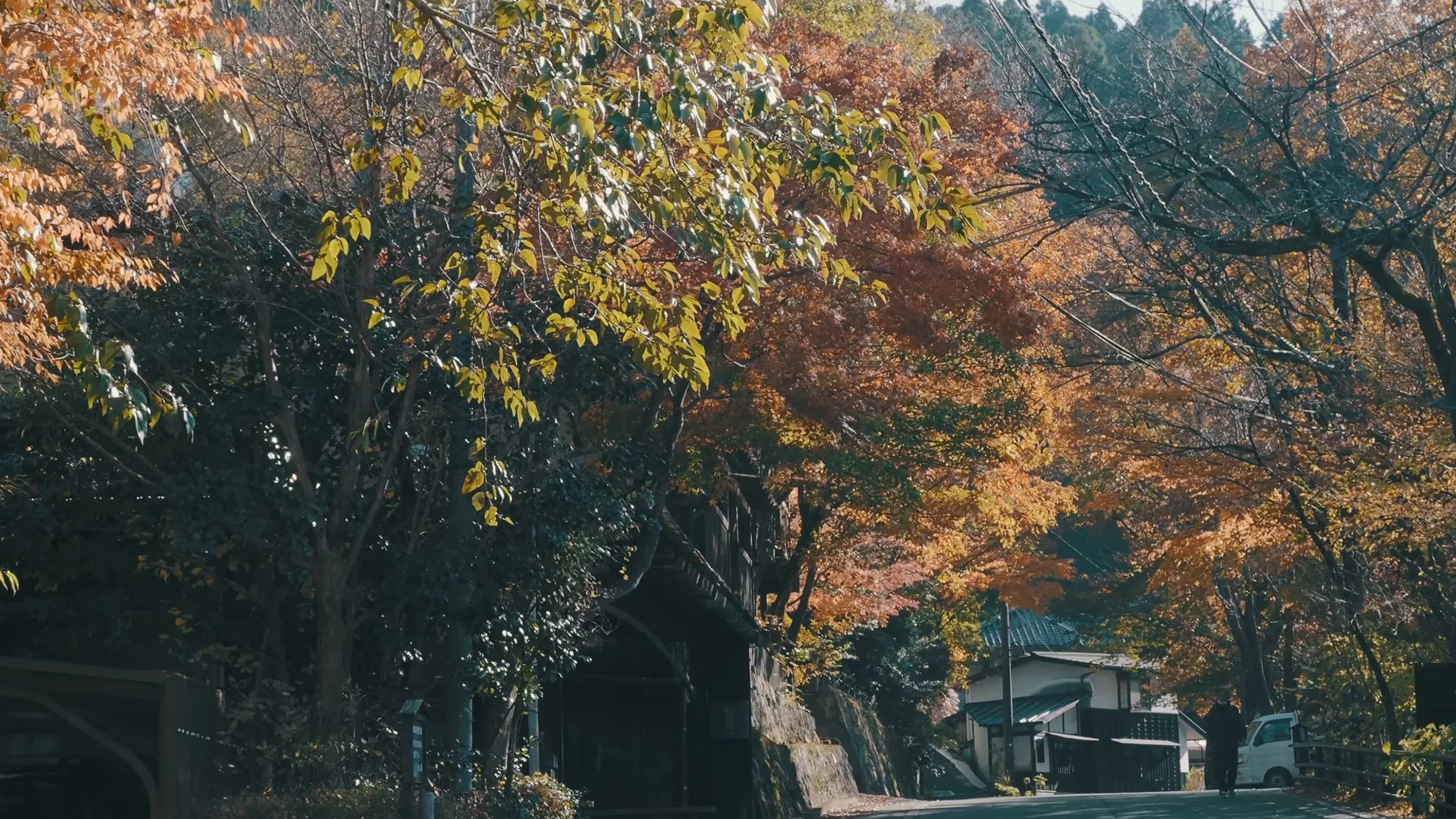
Nothing in the village is more than ten minutes' walk from anything else.
Second, the parking rules: the visitor code is blunt that parking is limited and roadside parking is not allowed, so drivers use their inn's lot and treat the village as pedestrian, which it functionally is; day-visiting drivers should ask Kaze-no-ya where to put the car before threading the lanes looking for luck.
Third, the slope: the village is a river valley, which means every lane away from the water climbs, gently on Kawabata-dori, honestly on Igozaka, and the stone underfoot is beautiful, uneven and slick when wet. Comfortable shoes are the actual local transit system.
Travellers with mobility concerns should route through the association's barrier-free facet and enquiry process rather than assume either difficulty or ease; the honest generalisation is that the village's charm and its accessibility challenges come from the same stones.
Where to stay
Sleep in the village. The tegata bathing, the yukata, the one-seating kaiseki dinner and the lantern-lit lanes after the day visitors leave are a single product, and it is sold by the night. Nearly every guest stays in a ryokan with dinner and breakfast included.
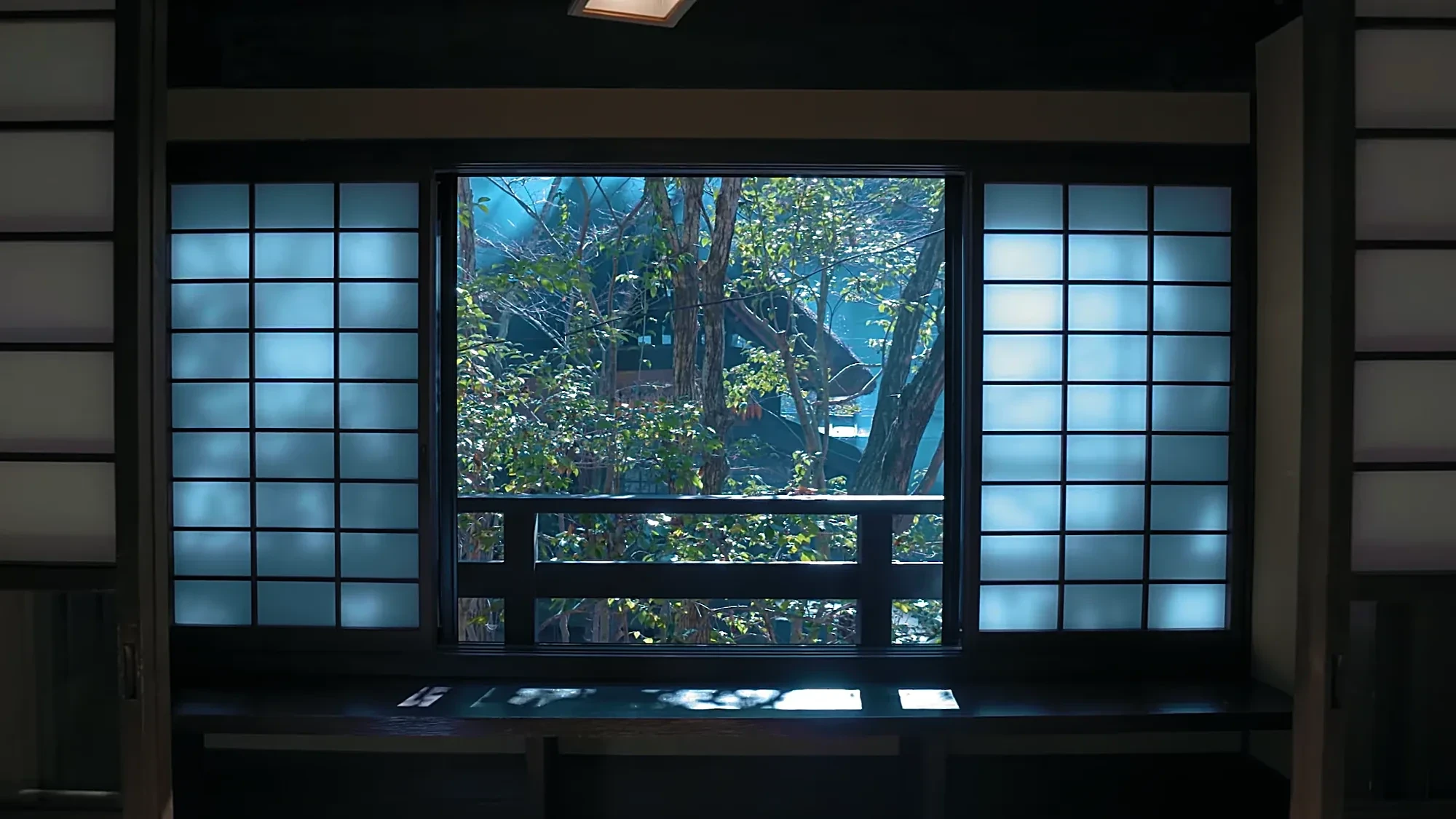
Every bed in the village is a ryokan with dinner.
The association publishes a per-person rate for every member inn, one night with two meals, and the honest range runs from about ¥12,700 (about US$85) at the most modest inns to ¥40,000 (about US$267) and well beyond at the grand houses, before tax and peak-weekend premiums. The association's directory lists no hostel or dormitory tier among its member inns, so the practical entry point is a modest ryokan rather than a bunk.
Many inns keep a private kashikiri bath bookable by the hour, the standard answer for families, couples and tattooed bathers. Our where-to-stay guide compares the inns honestly, with luxury and budget shortlists and the private-bath options.
What a night actually costs
The association does something few onsen towns do: it publishes an indicative per-person rate for every member inn, one night with dinner and breakfast included, tax excluded, with the stated caveat that final prices come from each inn's own plans. Read together, those listings are the most honest picture of Kurokawa's economics you can get before you arrive.
The floor and the ceiling are both instructive. The least expensive listing is Genka, at ¥12,727 to ¥14,545 (about US\$85 to US\$97) per person, and it is not a consolation prize: a four-room inn in the dead centre of the village, small enough that the whole house goes quiet when the last guest turns in.
The most expensive is Gekkoju, at ¥69,900 to ¥122,700 (about US\$466 to US\$818) per person, the forest retreat at the far end of the scale, whose own listing promises a guest held by the forest and the moon. That is nearly a tenfold spread inside one small valley, and it is the real finding of the table: Kurokawa is not a luxury town or a budget town but a complete ladder, and the lanes, the river and the tegata belong equally to every rung of it.
Most of the village sits between those poles, with the bulk of inns quoting somewhere between ¥16,000 and ¥35,000 (about US\$107 to US\$233) per person. Keep the arithmetic straight, because it surprises first-time ryokan bookers: rates are per person, not per room, and they include a multi-course dinner and breakfast. A ¥20,000 rate is lodging plus the evening's main event and the next morning's meal, not a bare bed.
The directory's one-line self-descriptions reward reading, because the association lets each inn say what it actually is. Yamabiko names its great open-air Senninburo; Misato claims the only water in Kurokawa that changes colour; Ikoi counts thirteen baths and its place on the Hundred Famous and Secret Hot Springs list; Senomoto Kogen Hotel offers the five peaks of Aso across its horizon; Fumoto notes a bath house and annexe renovated in August 2024.
The directory also filters by practical facets, from barrier-free rooms and pet policies to in-room dining and card acceptance, so the honest answer to most "which inn can take us" questions is to ask through those filters, or by phone, rather than trust a secondhand list.
What to eat
Kurokawa's kitchens lean on the Aso grasslands and the mountain rivers. The regional hero is akaushi, the lean red wagyu that grazes the caldera, usually served as steak or over rice; basashi, Kumamoto's horse sashimi, turns up on braver menus; river fish grill over charcoal at inn dinners; and dangojiru, the miso-and-dumpling soup of rural Kyushu, anchors the lunch counters.
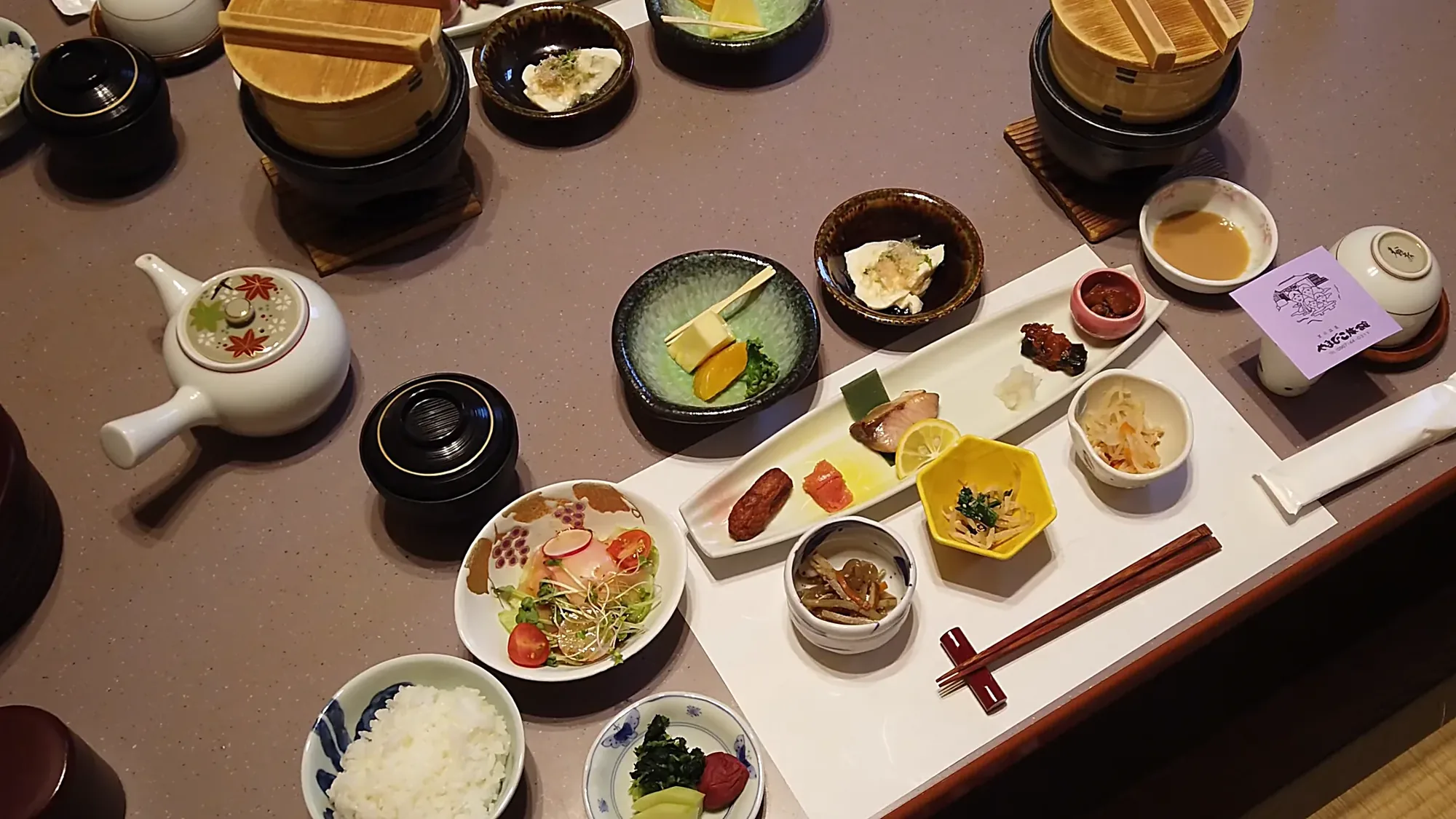
Dinner is included, and it is the reason to be inside by six.
Between baths, the food-and-souvenir sticker on the tegata comes into its own. The association lists a run of small makers who accept it: honey soft-serve at Sugi Yohoen, dango at the tofu maker Kissho, Jersey-milk soft-serve at Yama no Ibuki, a highball at Irori-ya, a branded towel from Shinmeikan, and more besides. Our food guide covers the kaiseki tradition, the akaushi specialists and the full snack circuit.
How eating works in the village
Kurokawa's food culture runs on inn time, and knowing the rhythm saves you a hungry evening. Dinner is overwhelmingly a ryokan affair: the kaiseki that comes with your room rate is the village's main restaurant, seated early and built from the region's larder. The lanes themselves are a lunchtime and afternoon economy. The association's own directory lists twenty-seven businesses in three categories, thirteen places to eat and fourteen souvenir shops among them, and most keep daytime hours.
By early evening the street goes quiet, with the izakaya-style Irori-ya, serving from 18:00 to 22:30 midway up the Igozaka slope, standing as one of the few late options.
Two of the most interesting kitchens illustrate the second rule: book ahead. Aka, an akaushi beef specialist that opened in November 2025, and TONKOU, a pork specialist from October 2025, are both reservation-only, and TONKOU's evening course is restricted to guests staying overnight in Kurokawa. That last detail is the village's whole argument in miniature. The best of the place is reserved, literally, for the people who sleep here.
In between, graze. The tegata's food-and-souvenir sticker connects the pass to a named list of small makers, and even without it the lanes reward wandering: shiratama dumplings of stone-milled Aso mochi rice beside the stream, tofu cooked around an irori hearth with headwater from the Chikugo, dorayaki grilled by hand on the slope, and a sake shop more than ninety years old at the top of it, where residents and visitors have always met. The full directory, with phone numbers and what each house makes, is in our food guide.
What is worth seeing beyond the baths?
Kurokawa is the reason to come, but the Aso highlands around it reward an extra half-day, and the options are not all equal. Here is how they rank when time is short.
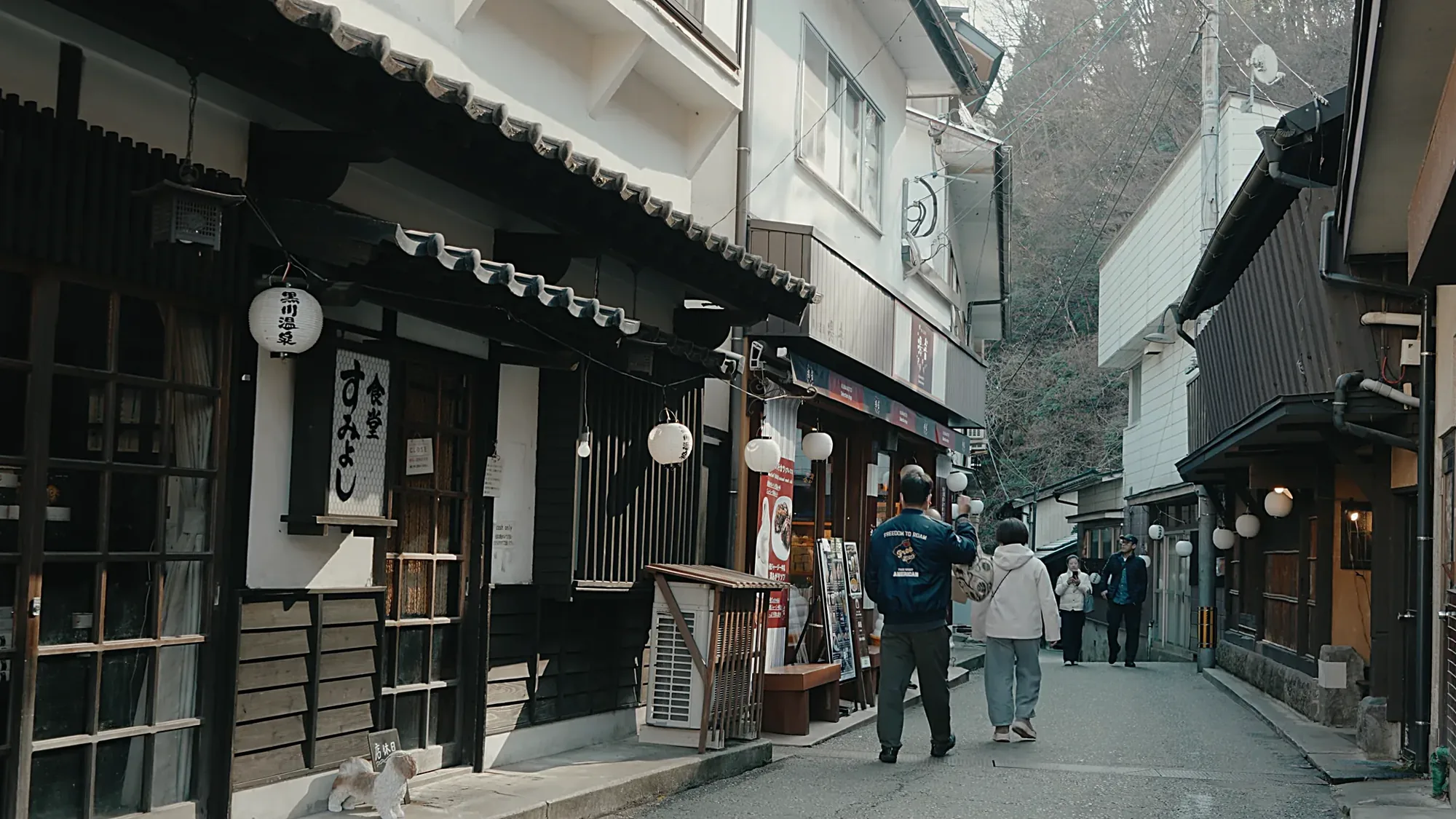
The lanes are the attraction. They were designed to be.
Nabegataki Falls is the one to make room for. About twenty minutes away by car, it is the rare waterfall you can walk behind, a wide curtain of water over a basalt overhang with a path along the hollow behind it. Its fame outgrew its car park, so entry now runs on timed online reservations; book before you go rather than turning up confirm the current system and fee.
The Daikanbō viewpoint is the other essential, a rim lookout over the whole Aso caldera, one of the largest on earth, with the five central peaks lying across the plain like a sleeping figure. Between the two, the grassland drive over Senomoto Highland earns its wheel time on its own: it is ranked first among Kumamoto's hundred green landscapes, and the open grazing land, where Aso's red cattle spend the summer, is as much the point as any single stop.
With a full day and a car, the caldera keeps giving. Mount Aso itself, crater activity and access permitting check the current status, is one of the few active volcanoes you can drive most of the way up. The Kujū range on the far side draws hikers for its early-summer azaleas and its autumn ridgelines. Waterfall collectors can add Meoto Falls, a paired his-and-hers cascade, and Nanataki, a run of seven, both short stops off the roads north.
A few places reward specific curiosity rather than a detour for its own sake. The Oshitoishi petroglyphs are a cluster of standing stones carved with marks some read as ancient script, a genuinely strange hour for anyone who likes an unsolved puzzle. Seiryū no Mori, the clear-stream forest, holds the small volcanic hollow called Suzume no Jigoku, the sparrow's hell, where gas seeps from the ground. The Konpira cedar and the Takenokuma zelkova, two of the region's great old trees, are single-stop pilgrimages for people who love old timber and quietly skippable for everyone else.
One caution against a wasted turn: the cosmos garden is worth it only when the flowers are actually up, in autumn, and is a bare field the rest of the year. Ask before you drive out to it.
For visitors without a car, the tourist information house marks three short walking routes that start from the village and need no wheels at all. That is honestly enough for most one-night stays; the caldera is the reward you earn with a second day. Our day-trips guide has the full driving routes, reservation links and times.
The village, door by door
Kurokawa is small enough to learn as a single walk, and the association's own directories place enough of it precisely that we can write that walk down. You arrive at the Kurokawa Onsen bus stop above the valley and drop toward the river; the first civic building that matters is Kaze-no-ya, the association's information house, where the tegata is sold, the day's open-bath board is posted, and the walking maps live. From there the centre opens.
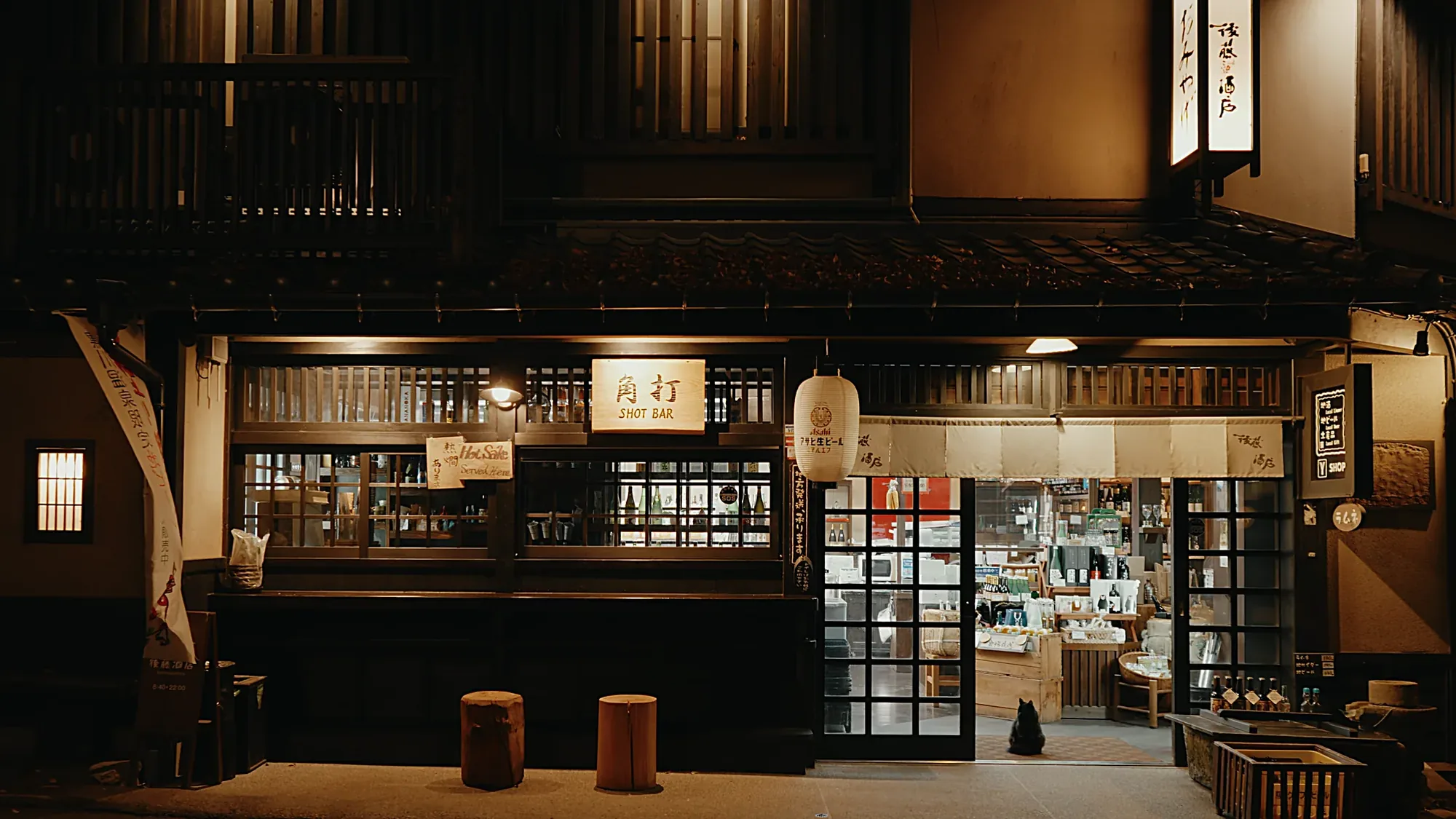
Most of the village is one doorway wide. That is the reason to walk it slowly.
The Jizo hall stands where the lanes meet, holding the headless statue of the founding legend, with the two legend-linked public bathhouses, Jizo-yu and Ana-yu, close by. Around this heart cluster the centre's inns: Genka, four rooms only, the village's least expensive listing at ¥12,727 to ¥14,545 (US\$85 to \$97) and proof that the middle of everything is not a premium here; Fumoto and its annexe Rokuan, whose bath house came out of renovation in August 2024 and whose eight baths include the 1.5 m (4.9 ft) standing tachiyu; Shinmeikan on the river with the hand-dug cave behind it; and Ikoi, thirteen baths and the village's only listing on the Hundred Famous and Secret Hot Springs roll. The historic Okyakuya pours coffee and beer from 8:30 to 20:00, the longest counter hours in the centre.
Kawabata-dori, the stream-side lane, is the village's pantry. Along it the directory places the eel house Una-kita with its takeaway counter, Shiratamakko working stone-milled Aso mochi rice beside the water, the one-table diner Sumiyoshi Shokudo under its red lantern, Machiya's souvenir counter, the old-house Patisserie Fumoto, and Yune with its Jersey milk and its producers' photographs. Where the lane meets the foot of Marusuzu bridge stands Waroku-ya, the akaushi kitchen in a relocated Meiji-era farmhouse, counter seats reserved for solo diners.
Igozaka, the slope, is the village's high street in the literal sense. Doradora hand-grills dorayaki partway up; Irori-ya, the late izakaya, sits midway, serving 18:00 to 22:30; the ceramics house Igozaka Toan keeps its seventy-kiln stock on the climb; and at the top waits Goto Saketen, ninety-plus years old, sake and spring-water beer and the closest thing the village allows itself to a convenience store. A minute from the Sakura-dori plaza, Hirano Shoten cures its pickles.
And beyond the walkable centre the outliers begin: Yamamizuki alone on its stretch of river about 1.6 km (1 mi) past the town-entrance filling station, shuttle on request; the high-ground houses, Konoyu and Kiyashiki, above the rooftops; and further out on the grassland, Senomoto Kogen Hotel with the five peaks of Aso on its horizon and Miyama Sanso under its dark planetarium sky. Walk the loop once with this paragraph in hand and the village stops being a postcard and becomes an address book.
What about the rest of the spa area?
Kurokawa is the famous name, but it is one of five hamlets in the Minamioguni spa area, and two of its neighbours are worth knowing, because they do things Kurokawa does not.
Tanohara, up the valley, has been a working tōji ground, a place for the old multi-day water cure, for around three hundred years. Its source comes out of the ground hot enough that the baths need no reheating at all, which is rarer than it sounds and is much of the reason the cure took hold here. It is a working cure-ground rather than a polished sightseeing street, and it carries a small piece of film history as a location in the long-running Tora-san films.
Manganji is stranger, and for some visitors the highlight of the area. Its open-air bath is built into the bank of the Shizu River and ringed with stones, so that you are effectively bathing in the river itself, in moving water, in the open. The stream holds a protected natural monument, a freshwater alga called okichi-mozuku that grows in only a few clean, spring-fed rivers in Japan. Above the bath stands the temple that gives the hamlet its name, Manganji, founded in the thirteenth century by Hōjō Tokisada.
Neither is a detour for a single-night Kurokawa stay. But with a car and a second day they are the two places to point it, and they show what Kurokawa's water actually belongs to.
How should you behave in the village?
Kurokawa rebuilt itself around a shared look and a shared quiet, and it asks visitors to help keep both. The association publishes a short code, and it is worth reading before you arrive. Smoking is limited to designated areas. Drones need prior permission. Do not pick the plants or foliage, do not enter the inns' private land, and sort your rubbish rather than leaving it. Parking is limited and roadside parking is not allowed.
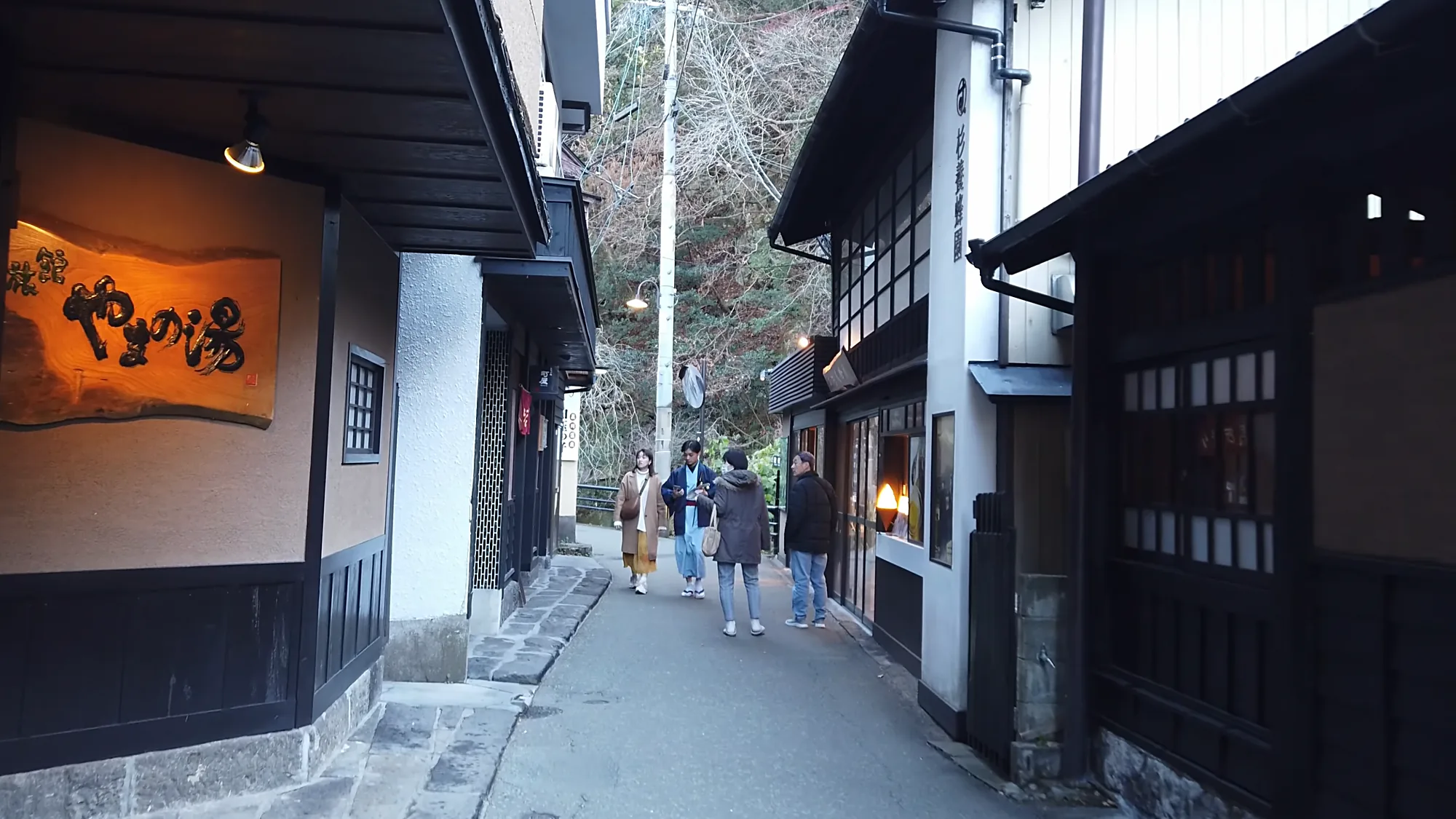
Yukata in the lanes is normal. Photographing strangers in them is not.
In the baths the usual onsen rule holds, keep your towel out of the water, and an inn may turn day bathers away when its bath is already full. None of it is onerous. It is the same bargain the innkeepers made with each other, extended to you for an afternoon. Our etiquette guide covers the bathing manners in full.
The visitor's toolkit: the village's own pages
Kurokawa documents itself unusually well, and a visitor who knows the association's five working tools travels with current information no guidebook can match. The tegata page carries the pass's full terms, price, validity, hours, the sticker mechanics and the redemption roster. The inn directory prices all thirty member houses and filters them across eleven practical facets, from barrier-free access to card acceptance. The shop directory lists the village's twenty-seven eating and souvenir businesses with hours and phone numbers.
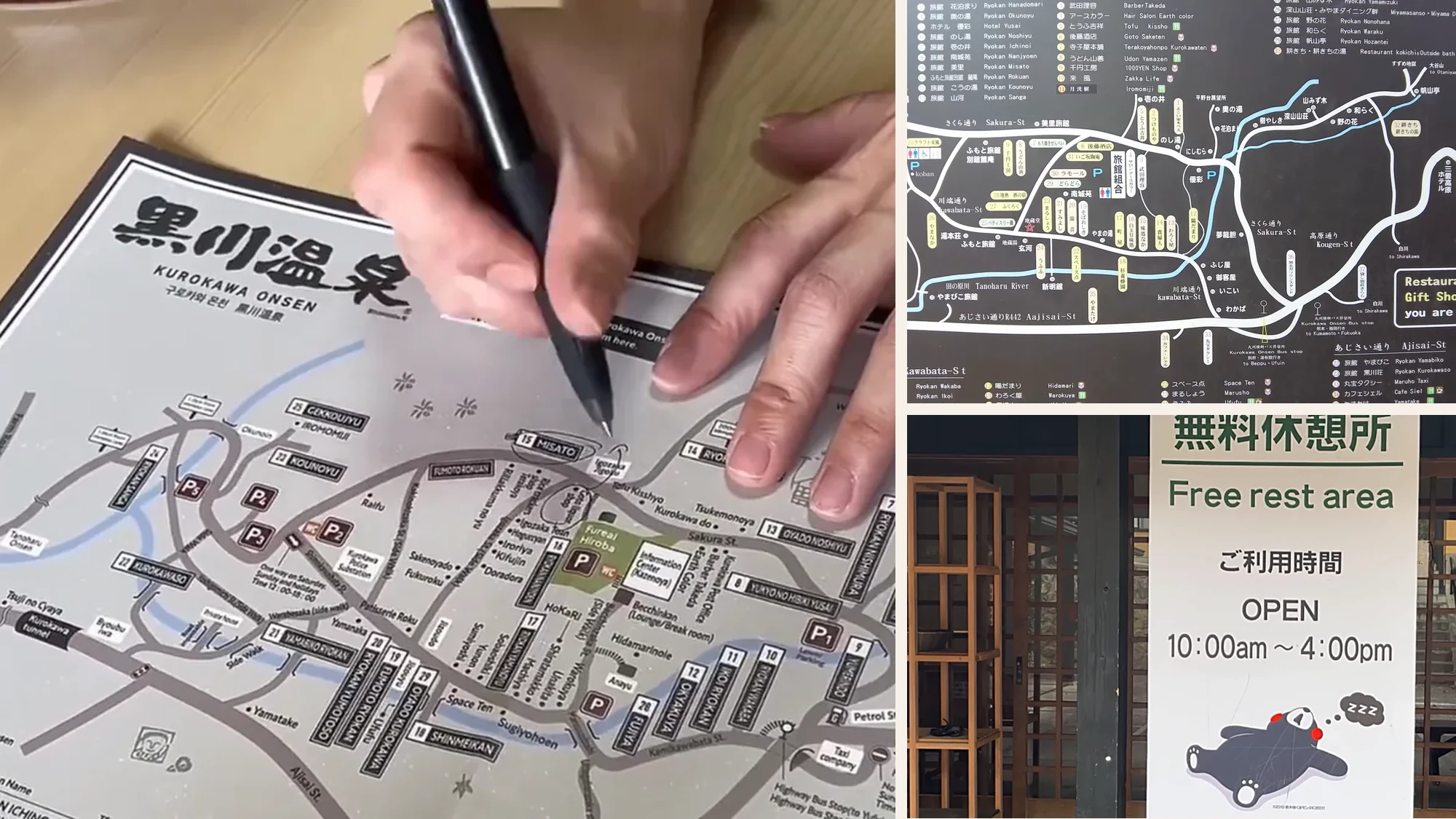
The village publishes all of this on paper, in Japanese, and it beats any app.
The daily bathing-status page, mirrored on the physical board at Kaze-no-ya, says which baths are actually open today, the single most useful page in the set. And the live weather-and-traffic page, born of necessity in the earthquake era, reports the roads and services as they stand this morning. All five are in Japanese; all five translate serviceably in any browser; and together they replace the stale English aggregators that still misprice the tegata by a decade.
Bookmark them when you book, check the last two the morning you travel, and you will know the village's day better than most visitors standing in it.
How long you need
One night is the canonical Kurokawa trip: arrive early afternoon, three tegata baths before dinner, kaiseki, lantern walk, your own inn's bath before bed, and a slow morning soak before the bus. Two nights adds Nabegataki and the caldera, or simply a second lap of the baths at a pace that approaches the philosophical. A pure day trip is possible thanks to the tegata, and it is the thinnest version of the place; see our how long guide for the honest comparison.
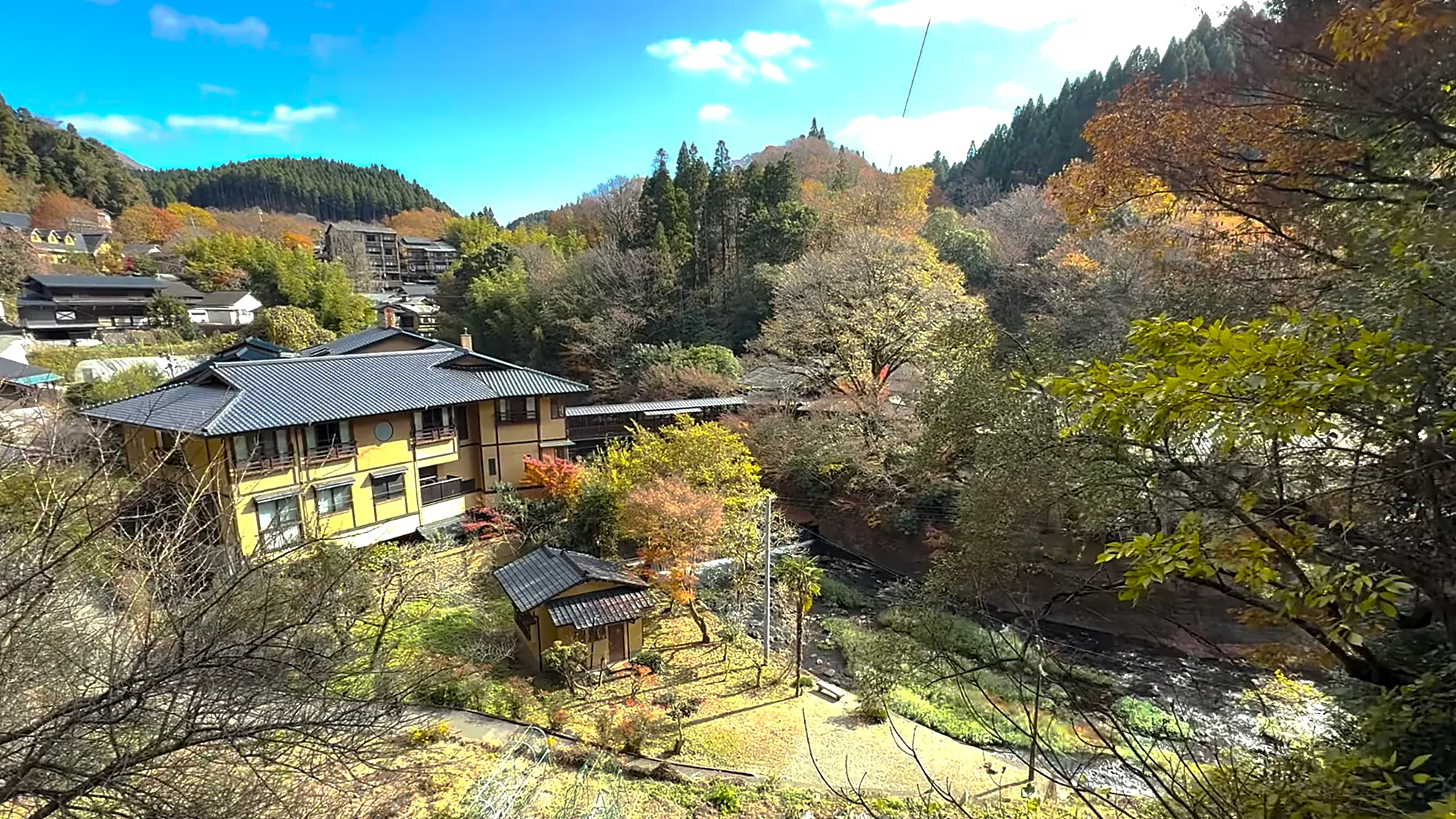
The morning after is the argument for staying the night.
Three lengths of visit, planned honestly
Four hours, the tight day trip. Feasible only with the morning bus. Buy the tegata at Kaze-no-ya on arrival and read the board before deciding anything. Two baths before lunch, chosen for proximity rather than fame if the clock is unkind; lunch on Kawabata-dori; the third stamp spent either on one more central bath or, more wisely, on the green sticker at a counter that catches your eye.
Skip the outliers entirely, Yamamizuki included, painful as that is; the walk out and back consumes a stamp's worth of time. You will leave before the village turns beautiful, which is the argument the whole site keeps making against this itinerary, but four well-run hours beat none.
Twenty-four hours, the canonical visit. Arrive by mid-afternoon; first bath at your inn; one tegata stamp before the day visitors thin; kaiseki at your inn's seating; the lane walk under whichever lights the season provides; a late soak. Next morning, dawn bath, breakfast, then the remaining stamps in the emptiest hours the circuit ever has, 8:30 to 11:00, with the third stamp or the sticker closing the account before the midday bus. Nothing about this plan hurries, and it touches every register the village runs: bath, table, lanes, dark, dawn.
Forty-eight hours, the connoisseur's version. Day one as above. Day two chooses a direction: the caldera loop by car, Nabegataki's reserved slot, Daikanbo and the Senomoto grassland; or the five-springs loop through Tanohara, Manganji, Oda and Shirakawa, the same designation in four other characters; or, carless, the three marked walking routes and a second unhurried lap of the baths with day-use additions like Yamamizuki's ¥600 (US\$4) window. The second night costs only the room, the transport already amortised, and buys the one thing the one-night plan cannot: a day in the village with no bus in it at all.
Kurokawa the second time
The village plans a second visit for you whether you noticed or not. The tegata's six-month validity is the explicit invitation, an unfinished disc being the association's own suggested reason to return; the two illumination seasons are the structural one, since a first trip in either half of the year leaves the other half's lights unseen; and the depth chart does the rest.
A useful second-visit template: change the season for contrast, winter steam after a summer trip or the reverse; change the inn tier deliberately, the modest house after the famous one or the reverse, since the table above shows both directions cost less than assumed; spend one day outside the village proper, on the five-springs loop or the caldera, which first visits almost never manage; and finish the old disc before buying the new one.
Repeat visitors also unlock the village's quietest pleasure, which is being recognised: thirty small inns remember guests in a way no hotel chain can, and the second arrival at the same front desk is a different, warmer transaction than the first. Kurokawa built itself for return custom, farmers once, bathers now, and the machinery, from the pass in your drawer to the stamp designs you have not yet collected, is all pointed the same way: back.
Questions first-timers actually ask, answered from the record
Is there a train station? No. The nearest stations are JR Aso from the Kumamoto side and JR Hita from the Fukuoka side, each about an hour out by car or bus, and every arrival ends on wheels of some kind. The association's access matrix, reproduced in our transport pages, carries the published journey times from every major origin.
Is there a convenience store? Not in the chain-store sense; the design code that removed two hundred signs never admitted one. The sourced near-exception is Goto Saketen at the top of Igozaka, which the directory describes as carrying a convenience-store section alongside its sake, and which has been doing so for over ninety years, which is to say since before the term existed.
Can I pay by card? Assume cash and be pleasantly surprised. The association's inn directory carries a card-acceptance facet precisely because it varies house by house, and the shop directory lists no payment details at all, so the honest kit is yen in reasonable quantity, especially in coins for baths and boxes.
Can I leave my luggage somewhere while I bathe? The association's own FAQ fields exactly this question, along with locker sizes and umbrella loan, which tells you the answer exists and is administered locally; the arrangements were not captured in our reading, so ask at Kaze-no-ya on arrival rather than planning blind, and know that asking is normal.
How hot are the baths? Hot at the source and adjusted for bathing: the association discloses that nearly all inns run free-flowing spring water and that many add water to cool it, with mineral content unchanged. In practice the pools vary bath to bath, which the circuit turns into a feature.
What if a bath I wanted is closed? Expect it some days; cleaning closures and guest reservations rotate through the roster, and the association posts daily availability. The board at Kaze-no-ya, or the bathing-status page, re-aims your plan in a minute, and a stamp never expires faster than six months.
Frequently asked questions
Is Kurokawa Onsen worth visiting?
How much is the Kurokawa Onsen bath pass?
How do you get to Kurokawa Onsen from Fukuoka?
Can you visit Kurokawa Onsen as a day trip?
Is Kurokawa Onsen tattoo friendly?
Do you need a car in Kurokawa?

Verified by The Japan Onsen Society
Show all sources
Verified July 7 to 16 and September 6, 2026 by The Japan Onsen Society.
Multi-type waters, Fumoto 立湯 1.5 m, Shinmeikan hand-dug cave, access routes → 温泉地詳細[黒川(南小国温泉郷)] (日本温泉協会) → https://www.spa.or.jp/search_p/detail_p/?F_ID=430260&pg=0 → spa-association data sheet → verified Jul 7, 2026
国民保養温泉地 designation, 地蔵湯/穴湯 legend anchor, 53 lodgings/2,300 capacity denominator → 南小国温泉郷 (日本温泉協会 国民保養温泉地) → https://www.spa.or.jp/kokumin/1131/ → government-designation profile → verified Jul 7, 2026
Tegata terms (price, validity, hours, one-per-person, the 2+1 sticker option, 1% conservation, 1986/40th anniversary), the 黒川温泉一旅館 slogan, the origin legend, the inn price band, the access matrix and the visitor code → 黒川温泉観光旅館協同組合 (Kurokawa ryokan association) → https://www.kurokawaonsen.or.jp (/tegata/, /about/, /oyado/, /access/, /faq/, /weather_traffic/) → verified in a rendered browser Sep 6, 2026
History and revival (1964 Yamanami Highway, the hand-dug cave by the third-generation owner, ~200 signs removed, 「あるがままの自然」 nature as it is) → 山の宿新明館 (Shinmeikan) → https://shinmeikan.jp/history/ → the inn's own history page, verified Sep 6, 2026
Currency: USD figures use ¥150 = US$1 as of Sep 6, 2026, rounded for planning. Card and cash rates will differ.
A note on what we could not confirm, in the interest of the mark above. The history that records the hand-dug cave does not name the third-generation owner who dug it, so we do not print a name. We found no primary source for the number of trees the village replanted, or for the often-repeated claim that it buried its power lines, so neither appears here. The ryokan association handles tattoo policy inn by inn and publishes no list, so we do not offer one. Bus fares and timetables change, and the 2026 Kumamoto earthquake has reduced some services, so we point to the operators' live pages rather than print figures that would age. And one number you may meet elsewhere: an older national designation profile still lists the tegata at ¥1,200, while the association's own page sets it at ¥1,500, and the operator's live page is the one we follow.
黒川温泉観光旅館協同組合 アクセス (Kurokawa Onsen Ryokan Co-operative Association, access matrix) - official journey times for every origin routing in the Kyushu section, verified September 6, 2026
九州産交バス 九州横断バス運賃表 (Kyushu Sanko Bus, Odan fare table, revised August 1, 2026) - Kurokawa fares to Yufuin, Beppu, Aso and Kumamoto, verified August 18, 2026
黒川温泉観光旅館協同組合 お宿一覧 (member inn directory) - per-inn price bands including the Genka floor and Gekkoju ceiling, inn self-descriptions, facet filters, re-verified September 7, 2026
黒川温泉観光旅館協同組合 入湯手形 (tegata page) - 1986 start, fortieth-anniversary programme July 1, 2026 to March 31, 2027, verified September 6, 2026
黒川温泉観光旅館協同組合 お店一覧 (shop and restaurant directory) - the 27 listed businesses, reservation-only and overnight-guest rules, Irori-ya hours, verified September 6, 2026
山の宿 新明館 歴史 (Shinmeikan, history page) - the tegata created for inns without a rotenburo of their own, verified September 6, 2026
日本温泉協会 温泉地詳細[黒川] (Japan Spa Association, spring-area record) - Hita IC car route and the two Aso bus routings, verified July 7 and September 6, 2026
山みず木 アクセス (Yamamizuki, access page) - the 1.6 km placement past the town-entrance filling station and the shuttle arrangement, verified August 18, 2026
黒川温泉観光旅館協同組合 よくある質問・入湯手形 (official FAQ and tegata pages) - the luggage, locker and umbrella questions the association fields, the kakenagashi disclosure, the visitor code, and the pass terms in the toolkit, verified September 6, 2026
南小国町役場 0967-42-1111 · 南小国町観光協会 0967-42-1444 · 組合 0967-44-0076 → published contacts per the 日本温泉協会 国民保養温泉地 profile spa.or.jp/kokumin/1131/, verified September 6, 2026
Related guides
Trip Planning
The Nyūtō Tegata Explained
A wooden disc buys any three of twenty-five baths, valid six months. Two stickers can go to baths and the third to lunch.
Trip Planning
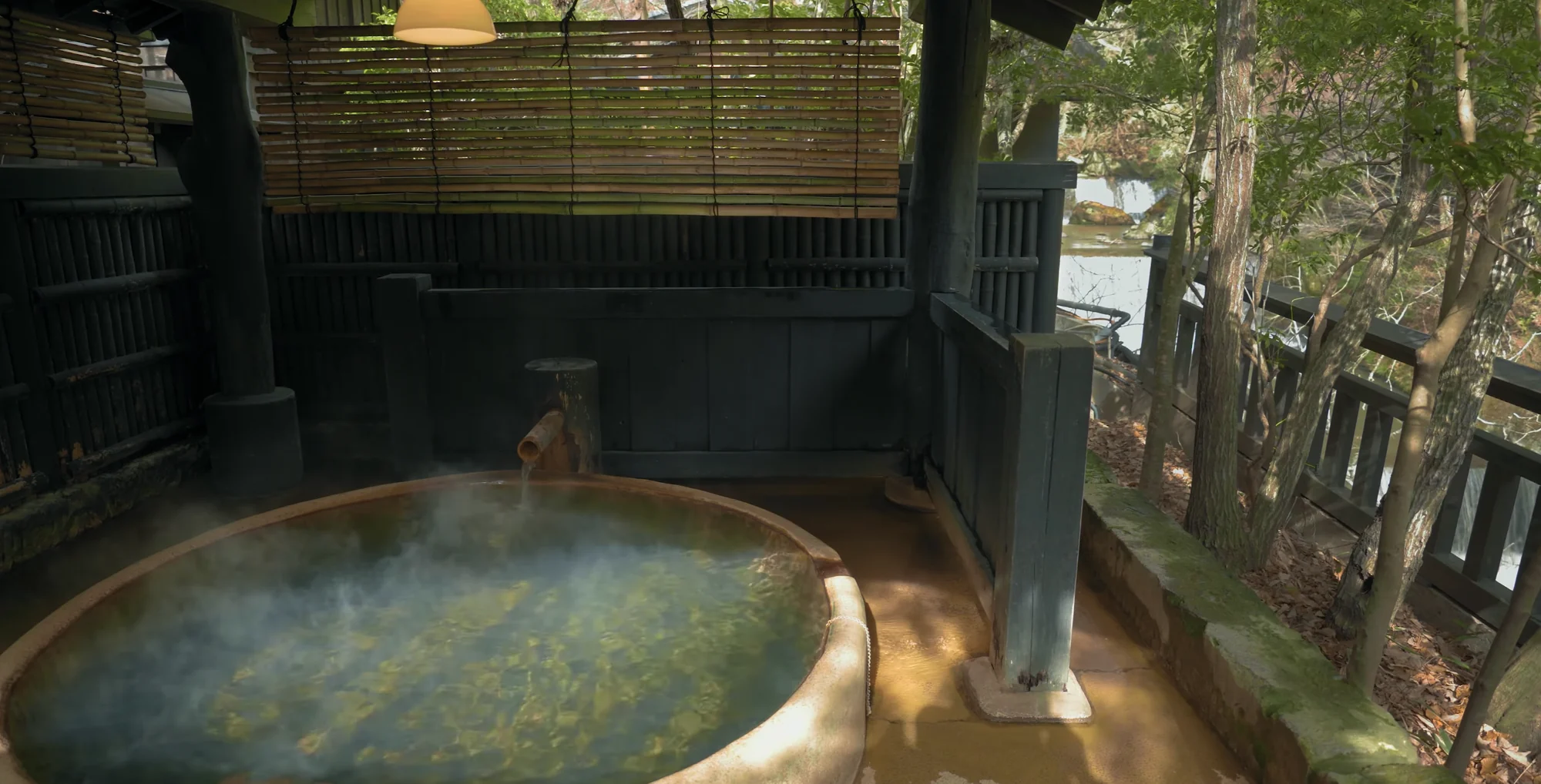
The Best Open-Air Baths (Rotenburo)
The tegata buys three of twenty-five open-air baths. Choose for contrast — a river, a cave, a pond — not three of the same.
Trip Planning
Best time to visit
Kurokawa has no bad season; what changes is contrast, colour, and competition for beds in a village of thirty small inns.
Trip Planning
Where to Stay: Ryokan Guide
Every Kurokawa bed is a ryokan with dinner, from ¥12,727 to ¥122,700. Choose by setting and budget; the tegata gives everyone the baths.
Trip Planning
Private & mixed baths
Kurokawa keeps two baths most towns dropped: the bookable private one and the mixed one. This is how each works — informed, not nervous.
Trip Planning
Etiquette
Universal onsen rules apply unchanged; what Kurokawa adds is bath-hopping through other people's working inns, plus the village's own published code.